Solid phase peptide synthesis is the method that builds a peptide one residue at a time on an insoluble polymer bead, adding each amino acid from the C-terminus toward the N-terminus and washing away every excess reagent by filtration between steps. It replaced solution-phase assembly for almost all routine work because it removes the slowest part of the old approach: purifying a soluble intermediate after every coupling. This guide covers the modern Fmoc/tBu workflow end to end — the repeating chemical cycle, the resins and reagents that run it, the side reactions that spoil it, and the mass shifts that expose them in the crude. Each stage links to a dedicated article where the mechanism goes deeper.
Check Coupling Difficulty with Peptalyzer™
Before you commit a sequence to the synthesizer, the SPPS Difficulty Profile flags aggregation-prone regions and suggests where a coupling is likely to stall. It flags sequence-based risk only — it doesn’t replace bench optimization or LC-MS confirmation of the product.”
📘 What will you learn here?
Why Solid Phase Peptide Synthesis Uses an Insoluble Support
The central idea, introduced by Merrifield in 1963, is to anchor the growing chain to a solid so reagents can be driven in large excess and then removed by washing. In solution, every intermediate must be isolated and purified before the next bond forms, and yields erode fast over a long chain. On a bead, the peptide stays put while soluble reagents and by-products flow through the frit. Coupling can therefore run with three- to five-fold excess of activated amino acid, pushing each step close to completion, and the “purification” between steps is nothing more than a solvent wash.
That trade has a cost. Because intermediates are never isolated, any step that fails silently carries its error forward, and a single incomplete coupling becomes a deletion impurity in the final product. The whole discipline of Fmoc solid phase peptide synthesis — the monitoring, the excess reagent, the capping — exists to keep each cycle near quantitative, because nothing downstream will catch what one cycle gets wrong.
The peptide is assembled C-to-N: the first residue is attached through its carboxyl to the resin linker, and each new residue arrives with a free carboxyl and a protected α-amine, coupling onto the amine exposed by the previous cycle.
The Solid Phase Peptide Synthesis Cycle at the Bond Level
Every residue is added by the same four-operation cycle: deprotect the α-amine, activate the incoming carboxyl, couple, then wash. The cycle repeats once per residue, so a 30-mer runs it thirty times. The chemistry of each operation is worth stating at the arrow level, because that is where the failures come from.
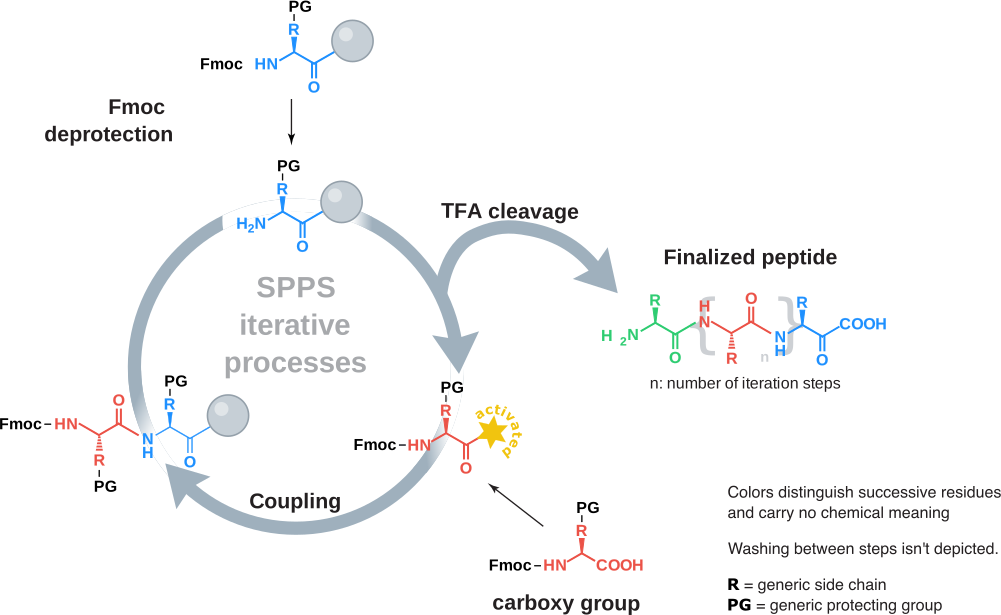
Nα-Deprotection: Removing the Fmoc Group
Piperidine removes the Fmoc group by base-driven β-elimination. The secondary amine abstracts the acidic proton at the fluorene 9-position; the resulting carbanion is stabilised as an aromatic cyclopentadienide, and it collapses by expelling the carbamate to form dibenzofulvene. The carbamate then loses CO₂ to release the free α-amine. Piperidine traps the reactive dibenzofulvene as a stable adduct, which is what stops it re-alkylating the peptide. The mechanism, its UV-quantifiable by-product, and its failure modes are treated in full under Fmoc cleavage and Fmoc deprotection monitoring.
Activation and Amide Bond Formation
A free carboxyl will not react with an amine at a useful rate, so it is activated into a reactive ester first. With a carbodiimide such as DIC, the carboxylate adds across the central carbon to give an O-acylisourea; an additive such as OxymaPure or HOBt then displaces it to form an active ester. The incoming α-amine attacks the ester carbonyl, and the tetrahedral intermediate collapses, expelling the leaving group to form the new amide bond. The additive matters because the O-acylisourea can cyclise to an oxazolone that racemises the activated residue; converting it quickly to the active ester suppresses that pathway. The reagent families are compared under OxymaPure/DIC coupling and HATU coupling.
Washing, Capping, and Iteration
Between chemical steps the resin is washed with DMF to flush spent reagent, then the next cycle begins. Where a coupling is known to be incomplete, a brief acetic anhydride cap acetylates the unreacted amines so they cannot extend further, converting a hard-to-remove deletion sequence into a truncated one that stops growing. Capping is a decision, not a default — it trades a cleaner deletion profile for a shortened by-product, and many syntheses omit it and rely on high coupling efficiency instead.
Fmoc/tBu vs Boc/Bzl: The Two Strategies
Fmoc/tBu chemistry dominates because it separates the two deprotections by mechanism, not merely by acid strength. The α-amino Fmoc group comes off with base (piperidine); the side-chain tert-butyl-type groups and the resin linker come off with acid (TFA). Base and acid are orthogonal, so the temporary and permanent protections are removed on independent triggers, and the final cleavage needs only TFA.
Boc/Bzl chemistry, the original Merrifield scheme, instead uses graduated acidolysis: the α-amino Boc group is removed with moderate acid (TFA) each cycle, while the benzyl-type side chains and the resin bond survive until a final treatment with anhydrous HF. It still has a place for some thioester and highly aggregated targets, but the routine need for HF — with its handling hazard and specialised apparatus — is the main reason most laboratories default to Fmoc. Fmoc’s base-labile α-group also means the acid-sensitive side chains never see repeated acid during the chain assembly.
Resins and Linkers in Solid Phase Peptide Synthesis
The linker decides the C-terminal chemistry of the product and the acid strength needed to release it. Choose it before the first residue, because it is fixed once loading starts. The table below maps the common linkers to what they yield and when to reach for each.
| Linker / resin | Product and cleavage | When to choose it |
|---|---|---|
| Wang | C-terminal free acid; released by ~95% TFA | Standard peptide acids; the default acid-terminus resin |
| Rink amide | C-terminal amide; released by ~95% TFA | When the sequence needs a C-terminal carboxamide |
| 2-Chlorotrityl chloride | C-terminal free acid; released by dilute acid (e.g. AcOH or HFIP in DCM), leaving side chains protected | Protected fragments for convergent assembly; suppresses diketopiperazine loss at the dipeptide stage |
| MBHA | C-terminal amide; released by anhydrous HF | Boc/Bzl chemistry, where amides are needed |
The 2-chlorotrityl support, introduced by Barlos, is the practical answer to diketopiperazine loss because its bulk slows the cyclisation that ejects the first two residues; that side reaction is covered under diketopiperazine formation.
Coupling Reagents and Additives
The reagent’s job is to convert the carboxyl into an active ester fast, with minimal racemization, and Fmoc-SPPS offers three families that do it by different routes. Carbodiimides (DIC) build the O-acylisourea directly and rely on an added nucleophile to carry the activation onward. Aminium/uronium salts (HATU, HBTU, HCTU) and phosphonium salts (PyBOP) deliver the active species in one reagent, generally with faster kinetics on demanding couplings. Across all of them, an additive — HOBt, HOAt, or OxymaPure — forms the active ester that limits epimerization.
Reagent choice is a decision with trade-offs, not a ranking. Carbodiimide/OxymaPure is a low-cost, low-racemization workhorse; the uronium and phosphonium reagents buy speed on difficult couplings at higher cost and their own artifact risks, such as guanidinylation of the N-terminal amine. Each family has a dedicated treatment: HATU and HBTU, PyBOP, COMU, and the HOBt/HOAt additives themselves.
Side-Chain Protection and Global Cleavage
Reactive side chains are masked for the whole synthesis and unmasked once, at the end. Under Fmoc chemistry the permanent groups are acid-labile: tert-butyl esters and ethers on Asp, Glu, Ser, Thr, and Tyr; trityl on Cys, His, Asn, and Gln; Pbf on Arg; Boc on Lys and Trp. Because these survive piperidine but fall to TFA, a single acid treatment removes them at the same time it cleaves the peptide from the resin.
Global cleavage is therefore a concentrated-TFA step, typically 90–95% TFA with scavengers — water, triisopropylsilane, and, for sensitive residues, thiol additives — to trap the cations released as the protecting groups leave. Without scavengers, those cations re-attach to Trp, Tyr, Met, or Cys. The cocktail choice is sequence-dependent and is covered under TFA peptide cleavage, with the Arg case under Pbf deprotection and the Cys case under cysteine protecting groups.

Side Reactions in Solid Phase Peptide Synthesis
Most crude-peptide problems trace to a handful of side reactions, each with its own mechanism and mass signature. Aspartimide formation is the base-catalysed cyclisation of an Asp side chain into the backbone, losing water and opening the door to epimers and piperidides — the single most common Fmoc side reaction, treated under aspartimide formation. Diketopiperazine formation ejects the first two residues by cyclisation at the dipeptide stage. Racemization at the activated residue is the coupling-step risk, most acute for cysteine and histidine. N-terminal Gln or Glu can cyclise to pyroglutamate, and dibenzofulvene from the deprotection step can alkylate the chain if it is not trapped. On long or hydrophobic sequences, on-resin aggregation stalls coupling and deprotection alike; the backbone-protection remedies are covered under peptide backbone modifications.
Monitoring and the Analytical Signature
On-resin colour tests catch a failed coupling before the next residue is added: the Kaiser (ninhydrin) test turns blue on free primary amines, and the chloranil test covers secondary amines such as proline. The check that settles it is LC-MS of the crude, where each side reaction leaves a characteristic mass shift. The table maps the common shifts to their cause and to the interpretation trap — the second species that produces the same nominal mass and would mislead a reading based on mass alone.
| Δm (Da) | Cause | Interpretation trap |
|---|---|---|
| −[residue] | Deletion sequence from an incomplete coupling (e.g. −57.02 for Gly, −113.08 for Leu/Ile) | An internal deletion and an N-terminal one give the same mass; only the fragmentation or retention tells them apart |
| +222.07 | Fmoc retained from incomplete deprotection | Not the same as the +178 dibenzofulvene adduct; a retained Fmoc-amino acid unit is heavier still |
| −18.01 | Aspartimide (loss of water from an Asp side chain) | Any dehydration reads as −18; N-terminal pyroglutamate from Gln gives the same loss |
| +56.06 | tert-Butyl retained on Asp/Glu/Ser/Thr/Tyr from incomplete cleavage | A t-Bu cation re-alkylating the peptide gives the same +56; distinguish incomplete removal from re-addition |
| +242.11 | Trityl retained on Cys/His/Asn/Gln | The trityl cation can also re-alkylate a scavenged position; check which residue carries it |
| +252.08 | Pbf retained on Arg | Partial Pbf loss can leave a sub-population; a multi-Arg peptide shows a ladder |
| +15.99 | Oxidation, most often Met to the sulfoxide | A single oxygen is ambiguous: Met, Trp, or Cys oxidation all read as +16 |
Every one of these shifts, with its full derivation, is collected on the Peptide Mass Shift Index.
A Representative Fmoc Protocol for Solid Phase Peptide Synthesis
The numbers below are a standard manual Fmoc cycle, drawn from the widely used Coin protocol, for a resin loading near 0.06–0.25 mmol. They are a starting point to adapt, not a universal recipe — difficult sequences need longer or repeated couplings and elevated temperature.
Deprotect with 20% piperidine in DMF, a short treatment followed by a longer one (roughly 1 min then 10 min), then wash with DMF five to six times. Couple with about 3–5 equivalents of Fmoc-amino acid and coupling reagent, activated with base (DIEA), for 30–60 min, and repeat the coupling on positions that are known to be hard. Wash again, then run the next cycle. After the final residue and Fmoc removal, cleave with 90–95% TFA plus scavengers for 2–3 h, precipitate the peptide in cold diethyl ether, and analyse by LC-MS before purification.
Recent Advances in Solid Phase Peptide Synthesis: Green, Microwave, and Flow Methods
Two pressures have reshaped practice since the 2010s: reducing solvent waste and cutting cycle time. On the green side, work has focused on replacing DMF — a reprotoxic solvent used in large volumes — with binary mixtures and greener dipolar aprotic media, and on trimming the washes that dominate solvent consumption. On the speed side, elevated-temperature coupling shortens each step, though the demonstrated acceleration comes with a higher epimerization risk that has to be managed by reagent and temperature control rather than assumed away. Automated flow synthesis has pushed cycle times to the minute scale and enabled the assembly of protein-length chains, as Hartrampf and co-workers demonstrated in 2020. These methods are maturing; their generality across long, aggregation-prone, or heavily modified sequences is still being mapped.
Coupling Efficiency and Yield in Solid Phase Peptide Synthesis
Because a peptide is built one coupling at a time, the maximum crude yield is the per-coupling efficiency raised to the number of couplings — so small, repeated losses compound into a hard ceiling. At 99.5% per coupling a 20-mer still leaves about 91% of chains full-length, but a 50-mer drops near 78% and a 100-mer near 61%; fall to 99% and the 100-mer caps near 37%. Set the efficiency in the calculator below and read the ceiling for any length.
Interactive chart of maximum crude peptide yield versus chain length. As the per-coupling efficiency falls, the achievable yield drops ever faster over longer peptides. Use the efficiency and length controls to explore values; a data readout below the chart states the result in text.
Coupling Efficiency vs Crude Yield
Each coupling is imperfect, and the misses compound. Set the per-coupling efficiency and watch the maximum crude yield fall as the chain grows.
Maximum crude yield before purification, assuming a constant per-coupling efficiency and no other losses. Couplings = residues − 1.
The Chemist’s Perspective
The failure you will actually meet is not a dramatic one — it is a coupling that goes to 95% instead of 100%, three times, on the same peptide. Each looks fine on the resin, and the deletion cluster only appears in the LC-MS of the crude, five hours later. This is why the excess reagent, the double couplings, and the on-resin tests are not fussiness: they are the only defence against errors that carry forward invisibly.
The trap that looks right and is not: a clean Kaiser test after coupling. It confirms the α-amine reacted, but it says nothing about whether the right residue coupled, whether an epimer formed at the activated carbon, or whether an Asp two residues back has already cyclised. A blue-negative resin and a clean crude are different claims. The mass spectrum, not the bead colour, is the arbiter — and even the mass spectrum needs the interpretation-trap column above, because two different failures can weigh the same.
The other quiet killer is aggregation. A sequence that assembles perfectly to residue 18 can wall off completely at 19, when a β-sheet segment collapses the resin’s accessibility. The symptom — every coupling past a certain point suddenly failing — points to the chain, not the reagent, and the fix is backbone disruption, not more equivalents.
Solid Phase Peptide Synthesis — FAQ
Each incoming residue is added with its α-amine protected by Fmoc and its carboxyl activated, so it couples onto the free α-amine of the resin-bound chain. That geometry means the chain grows toward the N-terminus, and the first residue attached to the resin is the C-terminal one.
Because intermediates are never purified, each coupling must approach completion, and a 3–5 fold excess of activated amino acid drives it there. The excess is removed by a simple DMF wash, so it costs reagent but not a purification step.
Fmoc/tBu removes the α-amine with base (piperidine) and the side chains with acid (TFA), two orthogonal triggers, and needs no HF. Boc/Bzl uses graduated acidolysis and ends with anhydrous HF, which is why most laboratories default to Fmoc.
Aspartimide formation, the base-catalysed cyclisation of an Asp side chain that loses water (−18.01 Da) and can generate epimers and piperidide adducts. Asp-Gly and Asp-Ser motifs are the highest-risk contexts.
References
Foundational Papers
Merrifield, R. B. (1963). Solid phase peptide synthesis. I. The synthesis of a tetrapeptide. Journal of the American Chemical Society, 85(14), 2149–2154.
- The founding paper that established resin-bound stepwise synthesis.
- DOI: 10.1021/ja00897a025
Merrifield, R. B. (1986). Solid phase synthesis. Science, 232(4748), 341–347.
- The inventor’s retrospective on the method and its operating advantages.
- DOI: 10.1126/science.3961484
Carpino, L. A., & Han, G. Y. (1970). 9-Fluorenylmethoxycarbonyl function, a new base-sensitive amino-protecting group. Journal of the American Chemical Society, 92(19), 5748–5749.
- Introduced the Fmoc group that underpins modern base-labile SPPS.
- DOI: 10.1021/ja00722a043
Chang, C. D., & Meienhofer, J. (1978). Solid-phase peptide synthesis using mild base cleavage of Nα-fluorenylmethyloxycarbonylamino acids. International Journal of Peptide and Protein Research, 11(3), 246–249.
- Early practical demonstration of Fmoc-SPPS on solid support.
- DOI: 10.1111/j.1399-3011.1978.tb02845.x
Linkers, Coupling, and Additives
Wang, S. S. (1973). p-Alkoxybenzyl alcohol resin and p-alkoxybenzyloxycarbonylhydrazide resin for solid phase synthesis of protected peptide fragments. Journal of the American Chemical Society, 95(4), 1328–1333.
- The acid-labile resin that yields C-terminal peptide acids.
- DOI: 10.1021/ja00785a052
Rink, H. (1987). Solid-phase synthesis of protected peptide fragments using a trialkoxy-diphenyl-methylester resin. Tetrahedron Letters, 28(33), 3787–3790.
- The linker system for C-terminal peptide amides.
- DOI: 10.1016/S0040-4039(00)96384-6
Barlos, K., Chatzi, O., Gatos, D., & Stavropoulos, G. (1991). 2-Chlorotrityl chloride resin. Studies on anchoring of Fmoc-amino acids and peptide cleavage. International Journal of Peptide and Protein Research, 37(6), 513–520.
- The bulky, mildly acid-labile resin used for protected fragments and DKP suppression.
- DOI: 10.1111/j.1399-3011.1991.tb00769.x
Carpino, L. A. (1993). 1-Hydroxy-7-azabenzotriazole. An efficient peptide coupling additive. Journal of the American Chemical Society, 115(10), 4397–4398.
- Introduced HOAt, a more effective additive than HOBt on demanding couplings.
- DOI: 10.1021/ja00063a082
Subirós-Funosas, R., Prohens, R., Barbas, R., El-Faham, A., & Albericio, F. (2009). Oxyma: an efficient additive for peptide synthesis to replace the benzotriazole-based HOBt and HOAt with a lower risk of explosion. Chemistry – A European Journal, 15(37), 9394–9403.
- Benchmarked OxymaPure for coupling efficiency and racemization suppression.
- DOI: 10.1002/chem.200900614
Monitoring, Difficult Sequences, and Modern Methods
Kaiser, E., Colescott, R. L., Bossinger, C. D., & Cook, P. I. (1970). Color test for detection of free terminal amino groups in the solid-phase synthesis of peptides. Analytical Biochemistry, 34(2), 595–598.
- The ninhydrin colour test for free amines on resin.
- DOI: 10.1016/0003-2697(70)90146-6
Wöhr, T., Wahl, F., Nefzi, A., Rohwedder, B., Sato, T., Sun, X., & Mutter, M. (1996). Pseudo-prolines as a solubilizing, structure-disrupting protection technique in peptide synthesis. Journal of the American Chemical Society, 118(39), 9218–9227.
- Introduced pseudoproline dipeptides for difficult, aggregation-prone sequences.
- DOI: 10.1021/ja961509q
Coin, I., Beyermann, M., & Bienert, M. (2007). Solid-phase peptide synthesis: from standard procedures to the synthesis of difficult sequences. Nature Protocols, 2(12), 3247–3256.
- A practical Fmoc protocol with real equivalents, times, and cleavage conditions.
- DOI: 10.1038/nprot.2007.454
Hartrampf, N., Saebi, A., Poskus, M., et al. (2020). Synthesis of proteins by automated flow chemistry. Science, 368(6494), 980–987.
- Demonstrated minute-scale flow SPPS reaching protein-length chains.
- DOI: 10.1126/science.abb2491