The choice of cysteine protecting groups decides more about a Cys-containing synthesis than almost any other building-block decision. The thiol is the most reactive side chain in Fmoc-SPPS: it oxidises, scrambles disulfides, and alkylates if left unmasked. The protecting group on sulfur controls when the thiol is exposed, what reagent exposes it, and therefore which disulfide forms and when.
This guide covers the commercially available Fmoc-Cys building blocks, their removal chemistry, their orthogonality, and the disulfide strategies they enable. It is written for the bench decision, not the textbook. For the related coupling problem — base-driven epimerization of Cys during chain assembly — see the dedicated article on cysteine racemization. For the acidolytic step that removes the acid-labile groups, see TFA peptide cleavage.
These are chemical and strategic choices. They are not statistical predictions, so no predictive disclaimer applies until the Peptalyzer™ section.
Check Assembly Difficulty with Peptalyzer™
Cys-rich sequences often resist assembly before disulfide connectivity is even in play. Use Peptalyzer™ to flag aggregation-prone stretches and check SPPS difficulty before you start.
📘 What will you learn here?
What a Cysteine Protecting Group Has to Do
A cysteine protecting group does three jobs, and a good choice optimises all three at once.
First, it keeps the thiol masked through chain assembly. The group must survive repeated piperidine/DMF Fmoc removal and, for acid-labile groups, partial exposure to TFA only at the intended moment.
Second, it defines the unmasking trigger. Each group answers to one chemistry: strong acid, weak acid, oxidation, metal, or reduction. That trigger is what makes orthogonality possible.
Third, it sets disulfide timing. A group removed at cleavage gives a free thiol for oxidative folding. A group that survives cleavage holds a second or third cysteine in reserve for regioselective bridge formation.
The four standard groups map onto four different triggers, which is why they coexist in multi-disulfide work: trityl (full TFA), monomethoxytrityl (dilute TFA), acetamidomethyl (oxidation or metal), and S-tert-butylthio (reduction).
The Standard Commercial Building Blocks
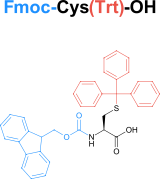
Fmoc-Cys(Trt)-OH
Trityl is the default. Every major supplier stocks Fmoc-Cys(Trt)-OH at high purity, and it is the building block for free-thiol peptides and for all-trityl oxidative folding.
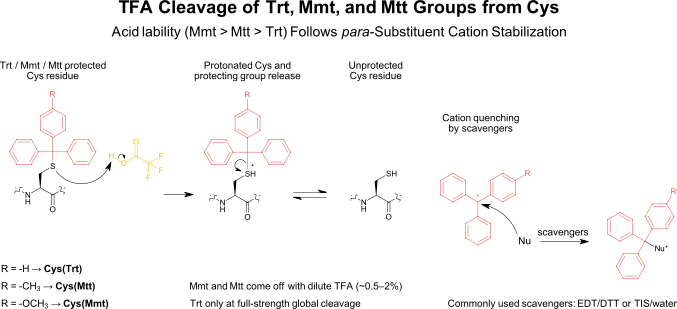
Removal is acidolytic: the trityl cation leaves during global cleavage with TFA plus scavengers. Add a thiol scavenger — 1,2-ethanedithiol (EDT) or DTT — to protect the liberated thiol and any Met from the reactive cation pool. The bulky cation is the main reason Cys-containing cleavages need a richer scavenger cocktail than standard sequences.
Trt is stable to routine piperidine treatment but can undergo cumulative partial loss during repeated exposure to dilute TFA. The extent depends on TFA concentration, exposure time, solvent, scavenger and sequence environment.
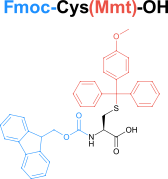
Fmoc-Cys(Mmt)-OH
Monomethoxytrityl is the on-resin selective group. It comes off under mild acid — 1–2% TFA in DCM — while tert-butyl-type side-chain groups stay protected. That selectivity lets you unmask one cysteine on the resin for on-resin disulfide formation, cyclization, or thiol conjugation.
Mmt is the first-bridge partner in Mmt + Acm strategies. Its weakness is the mirror of its strength: it can be lost prematurely under incidental acid, so keep it away from TFA until the intended step.
Fmoc-Cys(Mtt)-OH
4-Methyltrityl is Mmt’s 4-methyl variant — the same dilute-acid trigger and the same trityl-cation mechanism, one step less acid-labile. The para-methyl stabilises the trityl cation less than the para-methoxy of Mmt, so acid lability runs Mmt > Mtt > Trt. At the bench it comes off with 1–2.5% TFA in DCM plus a silane scavenger (TIS or TES), while tert-butyl-type side-chain groups stay protected — the same on-resin selective unmasking described for Mmt above.
Its one independent advantage is a TFA-free route: Mtt can also be removed using hexafluoroisopropanol (HFIP)/DCM, typically around 3:1, at room temperature, which keeps acid-sensitive modifications away from TFA. HFIP removal of Mmt is reported but less established, so treat HFIP as the Mtt-specific option.
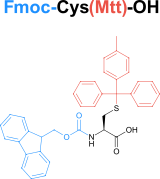
The trityl variants do not separate cleanly from each other, and none separates reliably from Trt — the acid-lability gaps are too narrow. Use Mtt where you would use Mmt but want the HFIP option; for a second independent cysteine, switch triggers to Acm or StBu, not to another trityl.
Fmoc-Cys(Acm)-OH
Acetamidomethyl is the orthogonal partner that makes regioselective disulfides routine. It is stable to piperidine and to TFA under standard cleavage conditions, so it survives onto the crude peptide and can be carried through purification before cyclization.
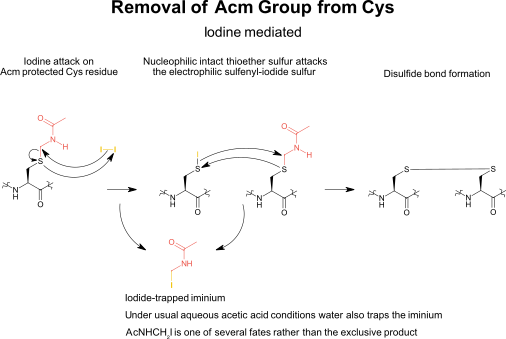
Acm can be removed using iodine or selected metal-mediated methods. Depending on the reagent, stoichiometry and work-up, the immediate product may be a free thiol, a metal-bound intermediate or a disulfide. Mercury- and thallium-based methods are now mainly of historical interest because of their toxicity and waste-handling burden.
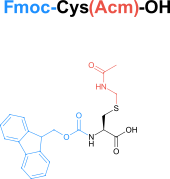
One caution drives a real decision: for a C-terminal Cys anchored to a hydroxyl resin, prefer Cys(Trt) over Cys(Acm). Acm raises the risk of base-induced β-elimination and epimerization, and the risk increases next to Ser or Thr.
Fmoc-Cys(StBu)-OH
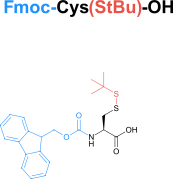
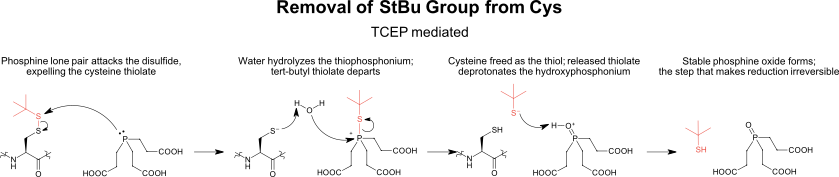
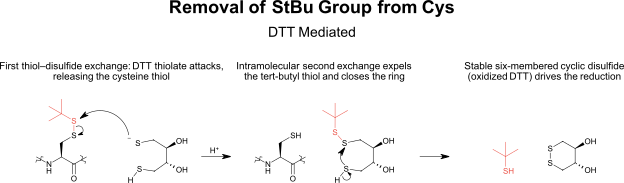
S-tert-butylthio protects the thiol as a mixed disulfide and answers only to reduction: tributylphosphine, TCEP, DTT, β-mercaptoethanol, or thiophenol. It is stable to both TFA and piperidine, which makes it orthogonal to the acid- and iodine-labile groups.
The known failure mode is incomplete reduction of buried or hindered S-StBu, which leaves a retained-group mass in the crude (see the LC-MS section). Newer disulfide-type groups such as STmp were designed to remove under milder thiolysis for exactly this reason.
Hard-Acid and Legacy Building Blocks
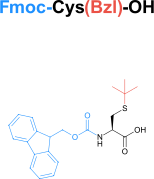
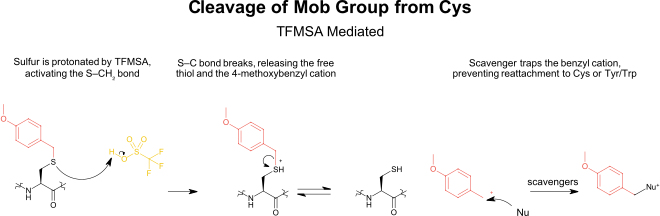
Fmoc-Cys(Mob)-OH and Fmoc-Cys(tBu)-OH
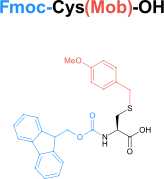
4-Methoxybenzyl (Mob) and S-tert-butyl (tBu) are commercially available, but both belong mainly to Boc chemistry. Mob and tBu need strong acid for removal — anhydrous HF or TFMSA — or 2,2′-dithiobis(5-nitropyridine) (DTNP) in TFA. Standard TFA cleavage leaves them largely intact. In an Fmoc workflow they are niche: useful only when a deliberately acid-stable thiol is required and a hard-acid or DTNP step is acceptable.
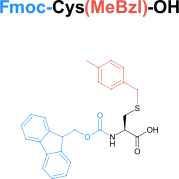
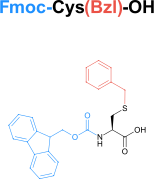
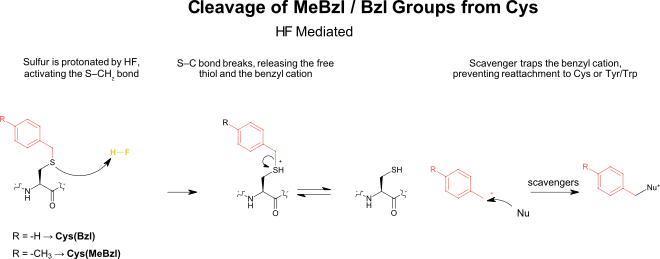
Fmoc-Cys(MeBzl)-OH and Fmoc-Cys(Bzl)-OH
4-Methylbenzyl and benzyl are Boc/HF-era groups, removed by anhydrous HF. They have no routine role in Fmoc-SPPS and appear here for completeness and for chemists maintaining legacy Boc protocols. Treat them as legacy unless an HF cleavage is already part of the plan.
Newer Commercial Building Blocks
These are commercially available but are not the default. Their selling points differ: lower cysteine racemization, better solubility of protected fragments, faster reductive removal, or an orthogonal trigger the four standard groups do not provide.
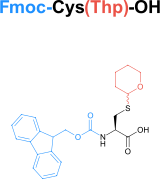
Fmoc-Cys(Thp)-OH
Tetrahydropyranyl is a non-aromatic S,O-acetal. It is acid-labile and removed during cleavage (TFA/TIS/DCM, ~5 min), yet stable to 1% TFA in DCM, so it survives mild on-resin acid steps on 2-chlorotrityl or HMPB resins for protected-fragment synthesis.
Its reported advantage is racemization. In one study, DIC/OxymaPure coupling of Fmoc-Cys(Thp)-OH gave 0.74% D-isomer against 3.3% for Fmoc-Cys(Trt)-OH, with reduced C-terminal 3-(1-piperidinyl)alanine formation and improved solubility. Treat these as single-study reported values, not universal constants.
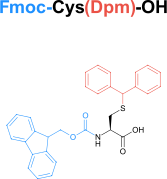
Fmoc-Cys(Dpm)-OH
Diphenylmethyl (benzhydryl) is the acid-lability tuning group, not a racemization fix. In the same study, Dpm showed 6.8% racemization under DIC/OxymaPure coupling — higher than trityl — so it is a poor choice where epimerization is the concern.
Its value is orthogonality by acid strength: Dpm is stable to 1–3% TFA but removed by 95% TFA, in contrast to trityl, which is slowly cleaved even by dilute acid. That gap makes Dpm + Mmt a clean two-disulfide pair — dilute acid removes Mmt while Dpm holds, then full TFA removes Dpm.
A close relative, Fmoc-Cys(Ddm)-OH (di(4-methoxyphenyl)methyl), tunes the same acid-lability axis further. The two methoxy groups stabilise the benzhydryl cation more than Dpm, so Ddm comes off under milder acid. Retention of the Ddm group gives an approximate mass increase of +226 Da relative to the free thiol. It widens the acid-strength window when Dpm and trityl sit too close.
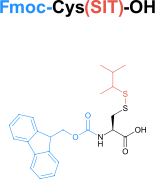
Fmoc-Cys(SIT)-OH
SIT (sec-isoamyl mercaptan) protects the thiol as a mixed disulfide, in the same family as S-StBu and STmp, and answers only to reduction. It is stable to TFA and to piperidine, so it holds through assembly and cleavage and is unmasked on demand by a reductant.
Its advantage over S-StBu is rate. The sec-isoamyl group is less hindered than tert-butylthio, so DTT clears it faster — reported at under 40 minutes with 5% added water, against roughly 250 minutes for S-StBu under matched conditions. That speed targets the incomplete-reduction failure mode that dogs buried S-StBu (see the LC-MS section). The freed thiol can also be directed into a specific disulfide by thiol–disulfide exchange rather than left to air oxidation.
Fmoc-Cys(Phacm)-OH
Phacm (phenylacetamidomethyl) is Acm with the acetyl replaced by phenylacetyl. It shares Acm’s stability profile: it resists piperidine and standard TFA cleavage, carries onto the crude peptide, and is removed by iodine like Acm.
What sets it apart is a second, selective trigger. Penicillin G acylase cleaves the phenylacetyl amide in aqueous buffer near pH 7, unmasking the thiol under conditions that leave acid-, oxidation-, and reduction-labile groups intact. Because the enzyme reads the phenylacetyl group and not the acetyl of Acm, Phacm and Acm come off independently — the basis of the orthogonal Acm/Phacm pair for a defined disulfide.
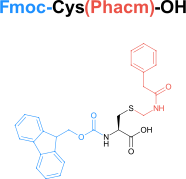
The cost is operational. Enzymatic removal needs the acylase, a buffered aqueous step, and a peptide the enzyme will accept, which is less routine than a reagent addition. Reach for it when a reagent-free, enzyme-selective unmasking earns its place — usually one bridge of a regioselective disulfide plan.
STmp, MBom, and Npys
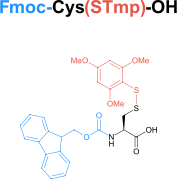
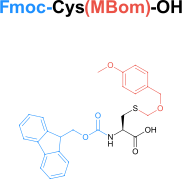
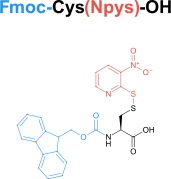
S-(2,4,6-trimethoxyphenylsulfenyl) (STmp) is a disulfide-type group, largely piperidine-stable and removed by mild thiolysis (DTT, or dilute N-methylmorpholine with a thiol) — a milder alternative to S-StBu for multi-Cys sequences. 4-Methoxybenzyloxymethyl (MBom) is acid-labile and suppresses racemization during incorporation and base treatment; the MBom group is catalog-available on histidine, but the cysteine derivative remains largely a research-grade compound rather than a stocked building block. 3-Nitro-2-pyridinesulfenyl (Npys) is an activated mixed disulfide that reacts directly with a free thiol to form a directed disulfide; it can be installed post-synthetically on a Trt-protected Cys using DTNP. STmp and Npys are commercially available but niche; Fmoc-Cys(MBom)-OH is not routinely stocked.
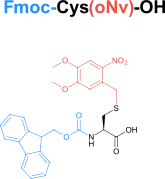
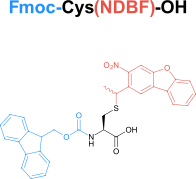
Photolabile Blocks: Fmoc-Cys(oNv)-OH and Fmoc-Cys(NDBF)-OH
Two photocleavable thiol groups round out the commercial set. o-Nitroveratryl (oNv) and nitrodibenzofuranyl (NDBF) are removed by UV light or, for NDBF, two-photon excitation — light replaces acid, oxidant, or reductant as the trigger. Both are stable to piperidine and TFA, so they survive assembly and cleavage. Uses are narrow: spatially or temporally controlled thiol release for caged peptides, surface chemistry, or photo-triggered folding, not routine disulfide work.
Removal Conditions and Orthogonality
The four standard groups are orthogonal because each leaves under a different reagent class. Acidolytic removal (trityl, Mmt, Thp, Dpm) and reductive removal (StBu, STmp) are independent, and iodine/metal removal (Acm) is independent of both. The acid-labile groups separate further by acid strength: Mmt and Thp at dilute TFA, trityl and Dpm at full TFA.
Two compatibility points govern real planning. First, palladium(0) Alloc/OAllyl chemistry tolerates trityl, Acm, Mmt, and StBu, so plan allyl removal and cysteine unmasking as separate steps; palladium can also remove Acm under different conditions, so keep the two palladium uses distinct. Second, Iodine is especially problematic for Met and Trp and can also modify Tyr under prolonged or forcing conditions. Control iodine excess, reaction time and quenching whenever oxidation-sensitive residues are present.
Removal Conditions of Cysteine Protecting Groups
| Group | Removal mechanism | Typical conditions | TFA-stable | Piperidine-stable |
|---|---|---|---|---|
| Trt | Acidolysis | TFA + TIS/H₂O, with EDT or DTT | No | Yes |
| Mmt | Mild acidolysis | 1–2% TFA in DCM; on-resin | No (very labile) | Yes |
| Mtt | Mild acidolysis | 1–2.5% TFA in DCM, or HFIP/DCM; on-resin | No (labile) | Yes |
| Thp | Acidolysis | TFA/TIS/DCM; stable to 1% TFA/DCM | No | Yes |
| Dpm | Acidolysis | 95% TFA; stable to 1–3% TFA | No (at full TFA) | Yes |
| Acm | Oxidation / metal | I₂; Hg/Ag/Tl; Pd; NCS | Yes | Yes |
| StBu | Reduction | TCEP, R₃P, DTT, RSH | Yes | Yes |
| Phacm | Enzymatic / oxidation | Penicillin G acylase (aq. buffer, ~pH 7); also I₂ | Yes | Yes |
| SIT | Reduction | DTT (+5% H₂O accelerates); faster than StBu | Yes | Yes |
| STmp | Mild thiolysis | DTT; NMM + thiol | Yes | Largely |
| Npys | Thiol exchange | Free thiol (directed disulfide); reductants | Yes | No (base-sensitive) |
| Mob | Hard acidolysis | HF, TFMSA; DTNP/TFA | Mostly | Yes |
| tBu | Hard acidolysis | HF, TFMSA; DTNP/TFA | Yes | Yes |
| MeBzl / Bzl | Hard acidolysis | HF | Yes | Yes |
| Group | Full TFA | Dilute TFA | I₂ / oxidation | Reduction | Pd(0) |
|---|---|---|---|---|---|
| Trt | Removed | Slowly removed | Survives | Survives | Tolerates |
| Mmt | Removed | Removed | Survives | Survives | Tolerates |
| Mtt | Removed | Removed | Survives | Survives | Tolerates |
| Dpm | Removed | Survives | Survives | Survives | Tolerates |
| Acm | Survives | Survives | Removed | Survives | Removed (Pd) |
| StBu | Survives | Survives | Survives | Removed | Tolerates |
| SIT | Survives | Survives | Survives | Removed | Tolerates |
Cysteine Protecting Groups Removal Chemistry in Depth
Acidolytic Removal
Trityl, Mmt, Thp, and Dpm all leave as stabilised carbocations under acid. The differences are kinetic: Mmt, Mtt, and Thp go at dilute TFA, trityl and Dpm need full TFA. Run dilute-acid removals on the resin to keep tert-butyl side-chain protection in place, and reserve full-TFA removal for global cleavage. Always include a thiol scavenger so the liberated thiol is not re-trapped by cations. For the scavenger logic shared with arginine deprotection, see Arg-sulfonyl side reactions.
Oxidative and Metal-Assisted Removal of Acm
Iodine is especially problematic for Met- and Trp-containing sequences and can also modify Tyr under sufficiently forcing or prolonged conditions. Reaction time, iodine excess, solvent, and quenching therefore require control. N-Chlorosuccinimide can remove Acm and promote disulfide formation rapidly under specific protocols. Lower scrambling than with iodine has been reported in some systems, but selectivity depends strongly on solvent, stoichiometry, reaction time, sequence, and whether the step is performed on resin or in solution. Palladium and silver routes remove Acm with milder side-reaction profiles than the older thallium and mercury methods, which are toxic and now legacy.
An allyl-based variant, Fmoc-Cys(Allocam)-OH (allyloxycarbonylaminomethyl), is removed under Pd(0)/allyl-scavenger conditions instead of iodine, giving a palladium-triggered route to the free thiol that spares Met, Trp, and Tyr. It is stocked but costly, so it stays a specialty option.
Reductive Removal
S-StBu and STmp are mixed disulfides cleaved by reduction: phosphines (TCEP, tributylphosphine) or thiols (DTT, β-mercaptoethanol). Reduction of hindered S-StBu can be slow, so confirm complete removal by mass before oxidation. STmp lowers the barrier by going under mild thiolysis, which matters when several cysteines must be unmasked together.
Disulfide Formation Strategy
One Disulfide: Oxidative Folding
For a single disulfide, deprotect all cysteines at cleavage and let the free thiols oxidise. Typical conditions: dilute peptide at roughly 0.1–1 mM in 0.05 M ammonium acetate or dilute acetic acid, pH 7.5–8.0, at room temperature under air. DMSO or a glutathione redox buffer can accelerate oxidation and may improve the distribution of folded products. This route is the cheapest and lowest in step count, and it works when the native fold is thermodynamically preferred.
Two Disulfides: Regioselective
For two defined bridges, use two triggers. The default pair is Trt + Acm: trityl comes off at cleavage and the first bridge forms by air or DMSO oxidation, then iodine removes the Acm pair and forms the second bridge in one step. When Met or Trp is present, avoid or tightly control iodine. Consider a validated palladium-, silver-, or NCS-based Acm-removal protocol, depending on the other protecting groups and sequence. NCS can remove Acm and promote disulfide formation under specific conditions, but it should not be treated as a universal substitute for iodine.
Three Disulfides and When It Is Worth It
Three defined disulfides require six cysteines divided into three protection sets, with one independently addressable trigger assigned to each pair. A possible design uses an early selectively acid-labile pair, a pair released during global cleavage, and an Acm-protected pair removed last. The exact combination and order must be validated because partial acid lability, disulfide scrambling, and oxidant compatibility can compromise practical orthogonality.
Conotoxins and cyclotides are the canonical cases. Each added pair costs steps and yield and, where iodine is used, risks side-chain damage. Go regioselective only when oxidative folding gives the wrong connectivity, several isomers, or low yield, or when a non-native framework or an analytical standard is required. For most native sequences, oxidative folding is the better first attempt.
Choosing the Oxidant
Air is mild but slow. DMSO is a general-purpose oxidant. Iodine is fast and removes Acm at the same time, at the cost of a substantial Met and Trp oxidation risk, with Tyr modification also possible under forcing conditions. NCS can provide rapid Acm removal and disulfide formation under validated conditions, with lower scrambling reported in some systems. Its performance depends on solvent, stoichiometry, reaction time, peptide sequence, and whether the reaction is performed on resin or in solution. Thallium(III) is effective but toxic and legacy. Match the oxidant to the sequence: avoid iodine and thallium where oxidation-sensitive residues are present.
The Chemist’s Perspective in Cysteine Protecting Groups
Cysteine peptides can appear successful by intact-mass analysis while still containing the wrong disulfide connectivity. The analytical stage therefore becomes a frequent source of false confidence. The trap is the scrambled disulfide isomer: it has the same mass as your target and only separates on the column. A clean mass is not a clean product when disulfides are involved — confirm connectivity by retention time, co-injection, or MS/MS, not by mass alone.
Three more traps recur. Over-oxidation to the sulfonic acid (+48 Da) is irreversible, so handle free-thiol crudes under inert gas and minimise air exposure. Iodine used to remove Acm quietly oxidises Met and Trp — design iodine out of those syntheses rather than chasing the damage afterward. Incomplete S-StBu reduction leaves a +88 Da shoulder that looks like an impurity but is unreduced starting material; confirm reduction by mass before you oxidise.
LC-MS and analytical signatures
Mass tells you which state a cysteine is in, provided you know the shifts. The values below are approximate monoisotopic shifts; calibrate against your own internal standard. For disulfide counting, each intramolecular bridge removes two hydrogens, so the net change on forming n bridges is:
\[\Delta M = -2.016\,n\]| State | Δmass (Da) | Note |
|---|---|---|
| Disulfide formed (per S–S) | −2 | vs two free thiols; subtle in large peptides |
| Cys sulfenic acid | +16 | often transient; isobaric with oxidation of Met and some Trp products |
| Cys sulfinic acid | +32 | generally not reversed by routine peptide reducing agents |
| Cys sulfonic acid | +48 | irreversible under routine peptide-handling conditions |
| Retained tBu | +56 | needs hard acid |
| Retained Acm | +71 | iodine/metal step underperformed |
| Retained Thp | +84 | incomplete acidolysis |
| Retained StBu | +88 | incomplete reduction |
| Retained Bzl | +90 | needs hard acid (HF) |
| Retained SIT | +102 | incomplete reduction; clears faster than StBu |
| Retained MeBzl | +104 | needs hard acid (HF) |
| Retained Mob | +120 | needs hard acid |
| Retained Phacm | +147 | enzyme/iodine step underperformed |
| Retained Dpm | +166 | incomplete full-TFA removal |
| Retained STmp | +198 | incomplete reduction/thiolysis |
| Retained Trt | +242 | incomplete acidolysis |
| Retained Mtt | +256 | incomplete acidolysis |
| Retained Mmt | +272 | incomplete acidolysis |
The interpretation traps follow from the table. A −2 Da change is easy to miss on a large peptide; confirm the disulfide count by reduction, where the mass should climb by +2 per bridge. A +16 Da shift alone does not identify the oxidised residue. Reduction with DTT or TCEP may reverse disulfides and some reversible cysteine oxidation products, but it does not normally reverse methionine sulfoxide. Use MS/MS or residue-specific comparison to localise the modification. A scrambled isomer shows zero mass change, so retention time and MS/MS are the readout. A cross-index of common shifts will live in the planned Peptide Mass Shift Index.
Practical Ranking
The usefulness scores and class labels below are an editorial judgement based on current removal chemistry and commercial availability, not a measured quantity.
| Group | Example block | Removal | Best use | Main risk | Use (1–5) | Class |
|---|---|---|---|---|---|---|
| Trt | Fmoc-Cys(Trt)-OH | Full TFA | Free thiol; all-Trt folding | Scavenger-heavy cleavage | 5 | Default |
| Acm | Fmoc-Cys(Acm)-OH | I₂ / metal / Pd / NCS | 2nd–3rd disulfide; purify before cyclize | Met/Trp oxidation; possible Tyr modification | 5 | Default |
| Mmt | Fmoc-Cys(Mmt)-OH | 1–2% TFA | On-resin selective; conjugation | Premature acid loss | 4 | Niche-standard |
| Thp | Fmoc-Cys(Thp)-OH | TFA; stable to 1% TFA | Low-racemization Cys; fragments | Less established | 3 | Niche (growing) |
| StBu | Fmoc-Cys(StBu)-OH | Reduction | On-resin reduce → oxidise | Incomplete reduction | 3 | Niche |
| SIT | Fmoc-Cys(SIT)-OH | Reduction (DTT) | Faster StBu replacement; multi-Cys | Newer, less validated | 3 | Niche (growing) |
| Dpm | Fmoc-Cys(Dpm)-OH | 95% TFA | Dpm + Mmt two-disulfide pair | Higher racemization (reported) | 2 | Niche/research |
| Npys | Fmoc-Cys(Npys)-OH | Thiol exchange | Directed asymmetric disulfide | Handling | 2 | Niche |
| Phacm | Fmoc-Cys(Phacm)-OH | Enzyme (PGA) | Orthogonal enzymatic bridge | Needs enzyme step | 2 | Niche |
| STmp | Fmoc-Cys(STmp)-OH | Mild thiolysis | StBu replacement, multi-Cys | Supply | 2 | Research |
| MBom | Fmoc-Cys(MBom)-OH | TFA | Racemization-resistant | Supply | 2 | Research |
| Mob | Fmoc-Cys(Mob)-OH | HF / TFMSA | Boc strategy | Needs hard acid | 2 | Legacy |
| tBu | Fmoc-Cys(tBu)-OH | HF / TFMSA / DTNP | Acid-stable thiol | Hard to remove | 1 | Legacy |
| MeBzl / Bzl | Fmoc-Cys(MeBzl)-OH | HF | Boc/HF only | HF required | 1 | Legacy |
Bench Decision Workflow
Work down to the first line that matches your synthesis.
- Free thiol only: Fmoc-Cys(Trt)-OH.
- One intramolecular disulfide: all trityl, then oxidative folding. Go regioselective only if folding misbehaves.
- Two disulfides: Trt + Acm by default. If Met or Trp is present, avoid or tightly control iodine and use a validated palladium-, silver-, or NCS-based Acm-removal protocol, depending on the sequence and the other protecting groups. An acid-selective strategy such as Dpm + Mmt may provide another option.
- Three disulfides: three independently addressable Cys pairs, commonly combining selective acidolysis, global cleavage and an Acm-removal step.
- Met or Trp in the sequence: design iodine and thallium out of any Acm removal; add a reducing scavenger at cleavage.
- Many cysteines or a Cys-rich chain: check assembly difficulty in Peptalyzer™ before disulfide planning; consider backbone modification for the assembly step.
- Site-selective conjugation: Mmt for on-resin selective unmasking, or Npys for a directed disulfide.
- Low racemization, especially at a C-terminal Cys: Thp or MBom.
- Simplest commercial route: Trt for thiol or folding; Trt + Acm for two bridges.
How Peptalyzer™ Handles Cysteine-Rich Sequences
Peptalyzer™ supports two cysteine-relevant tasks, and it is worth stating the boundary plainly. It accounts for disulfide topology in the mass and molecular formula: each intramolecular bond is modelled as a 2 H loss, and disulfide state feeds the molecular formula and the ε280 estimate through the cystine contribution. Moreover,Peptalyzer™ also evaluates sequence-based aggregation and assembly-risk signals in Cys-rich peptides through its SPPS Difficulty Prediction profile.
Peptalyzer™ does not model protecting-group removal, predict disulfide connectivity, or recommend a protection scheme. It answers one upstream question — whether a Cys-rich sequence will be hard to assemble before connectivity is even in play. For that workflow, see SPPS difficulty prediction and, for assembly aids on aggregation-prone chains, peptide backbone modifications.
The SPPS Difficulty Prediction in Peptalyzer™ is a statistical estimate derived from sequence-based aggregation and steric models. It predicts assembly difficulty from amino-acid composition and local sequence patterns, not from direct measurement of this peptide. Values should be interpreted as probability signals, not chemical guarantees. Experimental validation is required for any synthesis or formulation decision.
Cysteine Protecting Groups — FAQ
Fmoc-Cys(Trt)-OH for a free thiol or all-trityl oxidative folding, and Fmoc-Cys(Trt)-OH paired with Fmoc-Cys(Acm)-OH for two regioselective disulfides. These two blocks cover most routine work at high commercial availability.
Yes. Acm is stable to TFA under standard cleavage and to piperidine, so it carries onto the crude peptide. It is removed afterward by iodine, palladium, silver, or NCS, with iodine also forming the disulfide in the same step.
A −2 Da shift signals one formed disulfide bond, from the loss of two hydrogens. Confirm the bridge count by reduction, where the mass should rise by 2 Da per disulfide.
Avoid iodine where methionine oxidation is unacceptable. Consider a palladium-, silver-, or validated NCS-based Acm-removal method, depending on the other protecting groups present. During TFA cleavage, use an appropriate scavenger cocktail to limit additional oxidation, but do not expect DTT to reverse methionine sulfoxide that has already formed.
Thp and MBom are reported to lower racemization relative to trityl; in one study Thp gave 0.74% against 3.3% for trityl under DIC/OxymaPure coupling. Dpm is not a racemization fix — it showed 6.8% in the same study.
Prefer Fmoc-Cys(Trt)-OH over Fmoc-Cys(Acm)-OH to reduce base-induced β-elimination and epimerization, which worsen next to Ser or Thr. Thp and MBom further reduce C-terminal racemization.
References
Reviews and Overviews
Isidro-Llobet, A., Álvarez, M., & Albericio, F. (2009). Amino acid-protecting groups. Chemical Reviews, 109(6), 2455–2504.
- Comprehensive reference on protecting-group strategy across the amino acids, including the cysteine thiol.
- DOI: 10.1021/cr800323s
Góngora-Benítez, M., Tulla-Puche, J., & Albericio, F. (2014). Multifaceted roles of disulfide bonds. Peptides as therapeutics. Chemical Reviews, 114(2), 901–926.
- Review of disulfide-rich therapeutic peptides covering protecting-group selection and regioselective disulfide formation.
- DOI: 10.1021/cr400031z
Chakraborty, A., Mthembu, S. N., de la Torre, B. G., & Albericio, F. (2024). Ready to use cysteine thiol protecting groups in SPPS, a practical overview. Organic Process Research & Development, 28(1), 26–45.
- Current practical survey comparing cysteine thiol protecting groups for solid-phase peptide synthesis.
- DOI: 10.1021/acsoprd.3c00425
Acid-Labile Groups and Acid Lability
Góngora-Benítez, M., Mendive-Tapia, L., Ramos-Tomillero, I., Breman, A. C., Tulla-Puche, J., & Albericio, F. (2012). Acid-labile Cys-protecting groups for the Fmoc/tBu strategy: filling the gap. Organic Letters, 14(21), 5472–5475.
- Introduces the diphenylmethyl (Dpm) group and defines the acid-lability window between trityl and acid-stable thiol protection.
- DOI: 10.1021/ol302550p
Ramos-Tomillero, I., Rodríguez, H., & Albericio, F. (2015). Tetrahydropyranyl, a nonaromatic acid-labile Cys protecting group for Fmoc peptide chemistry. Organic Letters, 17(7), 1680–1683.
- Introduces the Thp group and reports lower cysteine racemization and improved solubility relative to trityl.
- DOI: 10.1021/acs.orglett.5b00444
Ramos-Tomillero, I., Mendive-Tapia, L., Góngora-Benítez, M., Nicolás, E., Tulla-Puche, J., & Albericio, F. (2013). Understanding acid lability of cysteine protecting groups. Molecules, 18(5), 5155–5162.
- Quantifies relative acid lability of cysteine protecting groups, supporting orthogonal removal design.
- DOI: 10.3390/molecules18055155
Hibino, H., & Nishiuchi, Y. (2012). 4-Methoxybenzyloxymethyl group, a racemization-resistant protecting group for cysteine in Fmoc solid phase peptide synthesis. Organic Letters, 14(8), 1926–1929.
- Introduces the MBom group and reports suppressed cysteine racemization during incorporation and base treatment.
- DOI: 10.102/ol300592w
Orthogonal and Disulfide-Based Groups
Royo, M., Alsina, J., Giralt, E., Slomczynska, U., & Albericio, F. (1995). S-Phenylacetamidomethyl (Phacm): an orthogonal cysteine protecting group for Boc and Fmoc solid-phase peptide synthesis strategies. Journal of the Chemical Society, Perkin Transactions 1, (9), 1095–1102.
- Introduces the Phacm group and its removal by penicillin G acylase, orthogonal to the acid- and oxidation-labile cysteine groups.
- DOI: 10.1039/P19950001095
Chakraborty, A., Sharma, A., Albericio, F., & de la Torre, B. G. (2020). Disulfide-based protecting groups for the cysteine side chain. Organic Letters, 22(24), 9644–9647.
- Introduces the SIT and MOT disulfide-type groups as faster-reducing replacements for S-StBu in Fmoc-SPPS.
- DOI: 10.1021/acs.orglett.0c03705