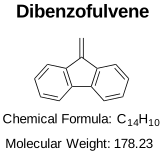
Dibenzofulvene peptide alkylation (DBF) is a known side reaction that can occur during Fmoc deprotection in solid-phase peptide synthesis.
Fmoc deprotection is a critical step in peptide synthesis, liberating the free amine needed for subsequent couplings. During this process, dibenzofulvene (DBF) is formed as a byproduct through β-elimination. Under ideal conditions, DBF is rapidly quenched by nucleophilic scavengers, most commonly piperidine. However, when residual DBF is not effectively removed or neutralized, it may act as a Michael acceptor, leading to undesired side reactions — most notably N-alkylation of the peptide backbone.
📘 What will you learn here?
The Chemistry of Dibenzofulvene (DBF)
| Property | Value |
|---|---|
| IUPAC Name | 9-methylene-fluorene |
| Abbreviation | DBF |
| CAS Number | 4425-82-5 |
| Chemical Formula | C14H10 |
| Mass Shift | +178 Da |
Mechanism of Dibenzofulvene Peptide Alkylation
DBF, being electrophilic at the methylene position, readily undergoes Michael-type addition with nucleophiles such as the free amine on the N-terminal residue or lysine side chains. If not quenched by excess piperidine or other scavengers, DBF can covalently attach to the peptide, forming a stable N-alkylated adduct.
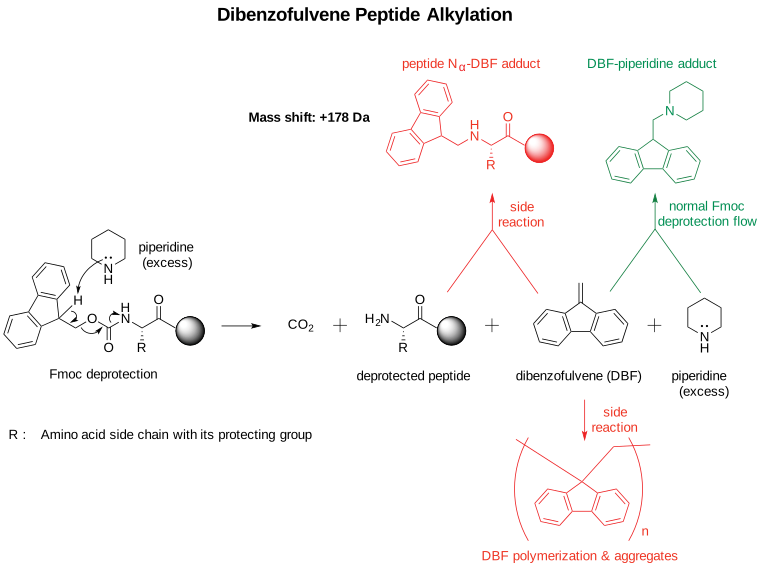
In MS-based workflows, this is detected as a +178 Da mass shift, corresponding to the addition of a single DBF molecule.
Synthetic and Analytical Implications
This reaction can lead to:
- DBF peptide alkylation introduces +178 Da mass shift modification, which can mimic other adducts or complicate the interpretation of MS spectra.
- Loss of N-terminal reactivity. Namely, N-alkylation reduces the number of reactive amines, negatively impacting synthesis yield and peptide length fidelity.
- Potential peptide polymerization or aggregation since polymeric DBF-peptide adducts can precipitate and lead to resin clogging or purification challenges.
Preventing DBF Side Reactions
To minimize DBF alkylation:
- Use excess piperidine (≥20%) during Fmoc deprotection, as it acts as both the base and the primary nucleophilic scavenger.
- Consider Alternative Bases: If avoiding DEA List I chemicals like piperidine, sterically hindered alternatives like dipropylamine (DPA), 4-methylpiperidine, or piperazine/DBU can be used, though they may require additional scavenging support.
- Apply “Soft” Nucleophilic Scavengers: DBF is a Michael acceptor. Soft nucleophiles like thiols (e.g., DTT, β-mercaptoethanol) or carbon nucleophiles (like dimedone) react much faster with the soft electrophilic double bond of DBF than the “hard” N-terminal amine does, effectively acting as chemical sponges to protect the peptide.
- Perform thorough washing after deprotection to remove residual DBF.
- Avoid delays between deprotection and the next coupling step.
Monitoring BDF in Automated SPPS
While DBF is a nuisance side-product, the DBF-piperidine adduct it forms is actually highly useful. Automated peptide synthesizers monitor the UV absorbance of this specific adduct at 301 nm. By measuring the area under this peak in the reaction waste, chemists can perfectly track the efficiency of every single Fmoc removal in real-time.
Final Thoughts on Dibenzofulvene-Induced Peptide Alkylation
DBF-induced alkylation is a well-documented but often underappreciated side reaction in peptide synthesis. It serves as a reminder of the importance of precise reaction quenching and rapid purification. By recognizing the +178 Da mass shift, chemists can better diagnose and prevent contamination, improving synthesis quality and reproducibility. Finally, the DBF-piperidine adduct can be used to monitor Fmoc deprotection in SPPS.
Why doesn’t Peptalyzer™ predict DBF alkylation?
Unlike pyroglutamate or aspartimide, which are driven by specific sequence motifs (like N-terminal Gln or Asp-Gly), DBF alkylation is a sequence-independent risk. Every single time an Fmoc group is removed, a molecule of DBF is generated. Prevention relies entirely on your reagent choice, scavengers, and washing protocols, rather than sequence optimization.
Dibenzofulvene-Induced Peptide Alkylation – FAQs
Dibenzofulvene is a byproduct formed during Fmoc deprotection in peptide synthesis. It has the formula C₁₄H₁₀ and a mass of 178.23 Da
DBF acts as a Michael acceptor and can react with free amines on the peptide backbone, especially the N-terminal amine or lysine residues, forming a covalent adduct.
The mass shift is +178 Da, corresponding to the molecular weight of one dibenzofulvene molecule added to the peptide.
Use excess piperidine, include scavengers like HOBt or thiols, perform rapid wash cycles, and avoid delays between deprotection and coupling.
Because dibenzofulvene contains three conjugated rings, it is highly hydrophobic. A DBF-alkylated peptide will almost always elute significantly later (more non-polar) on a reverse-phase HPLC column compared to the desired product.
Practically, no. The Michael addition of a primary amine (like the N-terminus) to the DBF double bond forms a highly stable secondary amine covalent linkage. Once the DBF adduct forms, it cannot be easily removed during standard cleavage or purification steps, which is why prevention is critical.
The unshielded N-terminal α-amine is the primary target immediately following Fmoc removal. However, unprotected or prematurely deprotected side-chain amines, such as the ε-amine of Lysine, are also highly susceptible to DBF alkylation.
No. Dibenzofulvene is exclusively generated from the β-elimination of the Fmoc protecting group under basic conditions. Boc-SPPS relies on acid-labile protecting groups and does not produce DBF, meaning this specific side reaction is entirely unique to Fmoc chemistry.
References
Mechanistic Foundations: Fmoc & Dibenzofulvene Peptide Alkylation (DBF)
Carpino, L. A., Han, G. Y. (1972). The 9-Fluorenylmethoxycarbonyl Amino-Protecting Group. The Journal of Organic Chemistry, 37(22), 3404–3409.
- Introduced the Fmoc group and experimentally confirmed dibenzofulvene (DBF) as the elimination byproduct, capable of reacting with nucleophilic amines to form covalent adducts — the mechanistic basis for N-alkylation during peptide synthesis.
- DOI: 10.1021/jo00795a005
Carpino, L. A. (1987). The 9-fluorenylmethyloxycarbonyl family of base-sensitive amino-protecting groups. Accounts of Chemical Research, 20(11), 401–407.
- Describes DBF generation during Fmoc deprotection, its reactivity with nucleophiles, and the role of amine adduct equilibria in persistent peptide modifications.
- DOI: 10.1021/ar00143a003
SPPS Side-Reactions & Scavenging Overview
Fields, G. B. (1994). Methods for removing the Fmoc group. Methods in Molecular Biology, 35, 17–27.
- This paper defines the formation and scavenging of dibenzofulvene (DBF) as a direct consequence of Fmoc deprotection and outlines how incomplete quenching can lead to DBF-mediated side reactions — providing foundational context for peptide N-alkylation mechanisms.
- DOI: 10.1385/0-89603-273-6:17
Yang, Y. (2016). In Side Reactions in Peptide Synthesis (pp. 163-201). Academic Press.
Comprehensive overview of side reactions involving unprotected amines during Fmoc SPPS. Includes detailed descriptions of dibenzofulvene adducts and strategies to suppress N-alkylation.
DOI: 10.1016/B978-0-12-801009-9.00007-0
Behrendt, R., White, P., & Offer, J. (2016). Advances in Fmoc solid‑phase peptide synthesis. Journal of Peptide Science, 22(4), 4–27.
- Provides a modern, in‑depth overview of current Fmoc‑SPPS methodology, including detailed discussions on dibenzofulvene reactivity, amine scavenging strategies, and common side products.
- DOI: 10.1002/psc.2836
Alternative Bases for Deprotection
Vergel Galeano, C. F., Rivera Monroy, Z. J., Rosas Pérez, J. E., & García Castañeda, J. E. (2014). Efficient synthesis of peptides with 4-methylpiperidine as Fmoc removal reagent by solid phase synthesis. Journal of the Mexican Chemical Society, 58(4), 386–392.
- Demonstrates that 4-methylpiperidine efficiently removes Fmoc and forms DBF adducts comparably to piperidine, supporting efforts to control DBF-induced side reactions.
- DOI: 10.29356/jmcs.v58i4.47
Luna, O. F., Gómez, J., Cárdenas, C., Albericio, F., Marshall, S. H., & Guzmán, F. (2016). Deprotection reagents in Fmoc solid‑phase peptide synthesis: Moving away from piperidine? Molecules, 21(11), 1542.
Compares deprotection bases—piperidine, 4‑methylpiperidine, and piperazine—under microwave-assisted conditions. Analyzes how effectively each traps dibenzofulvene, correlates base choice with peptide yield/purity, and offers insight into managing DBF-induced side reactions
DOI: 10.3390/molecules21111542
Personne, H., Siriwardena, T. N., Javor, S., & Reymond, J.-L. (2023). Dipropylamine for 9-Fluorenylmethyloxycarbonyl (Fmoc) Deprotection with Reduced Aspartimide Formation in Solid-Phase Peptide Synthesis. ACS Omega, 8(5), 5050–5056.
- Demonstrates that dipropylamine (DPA) minimizes aspartimide formation and DBF adduct side reactions in Fmoc-SPPS, offering a milder, low-toxicity alternative to piperidine. The study includes comparative data on DBF release and adduct profiles with various bases and validates DPA’s performance across multiple peptide types.
- DOI: 10.1021/acsomega.2c07861
DBF Aggregation / Chemical Stability
Paolino, M., Moresco, L., Mondini, M., & Pilati, F. (2018). Structural manipulation of the conjugated phenyl moiety in 3-phenylbenzofulvene monomers: Effects on spontaneous polymerization. Polymers, 10(7), 752.
- Explores polymerization behavior of DBF analogs, offering insight into potential aggregation and fouling issues in SPPS due to DBF reactivity.
- DOI: 10.3390/polym10070752
Mechanistic Supplement: Michael Acceptor Reactivity
Mather, B. D., Viswanathan, K., Miller, K. M., & Long, T. E. (2006). Michael addition reactions in macromolecular design for emerging technologies. Progress in Polymer Science, 31(5), 487–531.
- Reviews Michael addition chemistry in polymers — indirectly relevant to DBF’s electrophilic reactivity with nucleophiles in peptide synthesis.
- DOI: 10.1016/j.progpolymsci.2006.03.001