Terminal modifications peptide handling in Peptalyzer™ is feature-specific. Some calculations include terminal chemistry directly, some include it only partly, and some remain residue-only. This reflects chemical reality: a terminal group affects mass, formula, and charge directly, but it does not always behave like a standard amino acid in residue-based models.
For the user, the practical rule is simple: trust terminal effects strongly for mass, formula, charge, and pI; interpret residue-based profiles more carefully when a peptide is capped, labeled, lipidated, or otherwise modified.
Analyze Terminal Modifications with Peptalyzer™
Use Peptalyzer™ to see how N- and C-terminal modifications affect peptide mass, formula, charge, pI, and size-related estimates before synthesis or analysis.
📘 What will you learn here?
Why Terminal Modifications are Handled Differently
Peptalyzer™ does not treat terminal modifications as a single global correction. Each feature uses the level of terminal chemistry that makes sense for that calculation.
For physical properties, terminal groups are part of the molecule. They change the elemental composition, molecular weight, ionizable groups, and charge state. For this reason, outputs such as mass, formula, net charge, pI, and net charge versus pH include terminal modifications directly when the required chemical data are available.
For residue-based descriptors, the situation is different. Many peptide descriptors were originally defined for amino acid residues, not for terminal labels, lipids, quenchers, or affinity tags. GRAVY, Hopp–Woods hydrophilicity, Z-scales, aromaticity, Boman index, aliphatic index, and instability index are examples of sequence-derived models. They describe the amino acid sequence, not necessarily the complete modified molecule.
This distinction prevents false precision. A terminal palmitoyl group, for example, strongly changes real chromatographic behavior, but it is not a standard amino acid residue in the Kyte–Doolittle scale. Adding it artificially to GRAVY without a validated parameter would make the result look more complete while making the model less defensible.
For that reason, Peptalyzer™ separates terminal-aware outputs from residue-only outputs. This keeps the physical calculations chemically direct, while preserving the original meaning of residue-based descriptors.
How Peptalyzer™ Handles Terminal Modifications
Peptalyzer™ includes terminal effects in its core physicochemical calculations (mass, pI, charge, formula), while many sequence-derived or statistical features remain residue-based.
Use the table below as the main interpretation guide.
| Feature | Impact | What it means in practice |
|---|---|---|
| Monoisotopic and average mass | Full | Terminal groups are part of the molecule, so their mass is added directly. |
| Molecular formula | Full | Terminal atomic composition is included in the final empirical formula. |
| Net charge | Full | Free or blocked termini, and terminal ionizable groups, directly affect calculated charge. |
| Net charge vs pH | Full | The titration curve includes terminal ionizable groups across the full pH range. |
| Isoelectric point (pI) | Full | Because pI depends on all ionizable groups, terminal modifications can shift it significantly. |
| Charge distribution | Full | Terminal acidic and basic groups contribute to the electrostatic balance. |
| Molecular size metrics | Partial | Terminal groups contribute via modeled volume increments, but values remain derived estimates. |
| Extinction coefficient (ε280) | Full (when curated) | Terminal chromophores are included directly when UV data are available. |
| Extinction coefficient (ε205) | Partial | Backbone term dominates; terminal contributions are included only when modeled. |
| Wimley–White profile | Partial | Accounts for terminal cap state, but not full descriptor replacement for large groups. |
| Peptide fingerprint | Partial | Some axes (charge-related) include termini; others remain residue-based. |
| SPPS difficulty profile | Residue-driven | The risk profile is sequence-based; terminal effects are handled separately in model context. |
| Sequence auditor | Targeted terminal rules | Most checks are sequence-based, with specific terminal warnings where relevant. |
| GRAVY / Kyte–Doolittle | Residue-only | Hydropathy is calculated from amino acid residues; terminal groups are not included. |
| Hopp–Woods profile | Residue-only | Hydrophilicity model based on residues only. |
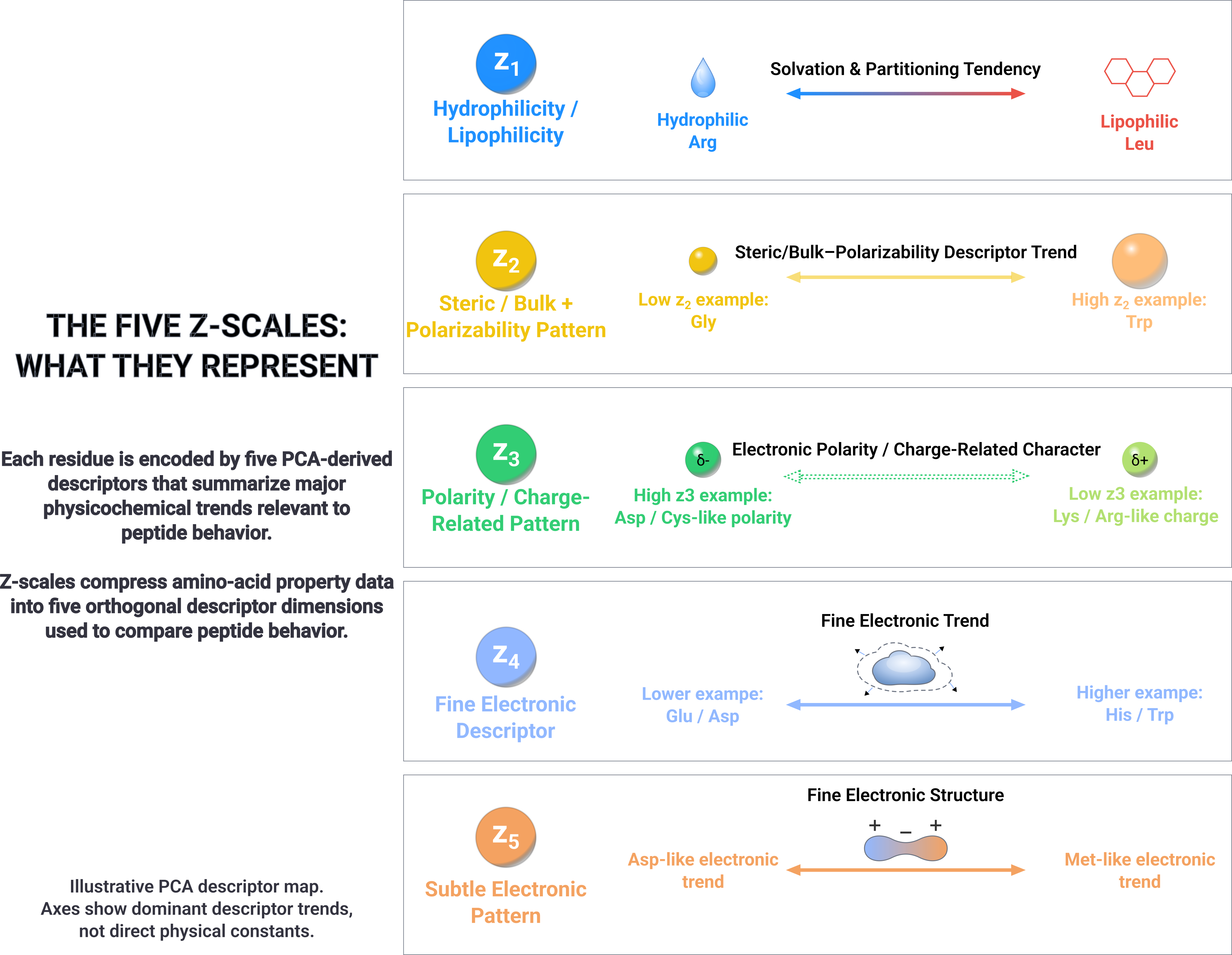
| Z-scales | Residue-only | Defined only for amino acid descriptors; terminal chemistry is excluded. |
| Polarity matrix | Partial | Termini-aware when curated terminal hydropathy constants are available (Htot includes terminal constants; fc includes terminal charge groups). If any active terminal constant is missing, mixed fallback is used: fc remains termini-aware while Htot stays residue-based. |
| Eisenberg moment | Residue-only | Hydrophobic moment is computed from residue patterns. |
| Secondary structure / topology | Residue-only | Models assume standard peptide backbone without explicit terminal chemistry. |
| Aromaticity | Residue-only | Calculated from aromatic amino acid content. |
| Boman index | Residue-only | Binding potential estimated from residue solubility energies. |
| Aliphatic index | Residue-only | Based on aliphatic residue content only. |
| Instability index | Residue-only | Derived from dipeptide statistics; terminal groups are not part of the model. |
| Residue visualization | Residue-only | Displays amino acid sequence composition, not terminal chemistry. |
| Residue nature distribution | Residue-only | Based on residue classification only. |
| Residue class distribution | Residue-only | Derived from amino acid grouping. |
| Coupling strategy | Residue-driven | Based on sequence composition and synthesis heuristics. |
| Process planning alerts | Residue-driven | Generated from sequence rules and synthesis risk patterns. |
Peptide Charge Properties
Terminal modifications directly affect the Peptide Charge Properties card. In Peptalyzer™, terminal charge/pI behavior is metadata-driven and applied consistently across: Net Charge at selected pH, pI (IPC 2.0, Bjellqvist, EMBOSS, Lehninger), Method Agreement (range across pI scales), Charge Density (net charge per residue at selected pH), Net Charge vs. pH curve, and the Charge Group Composition and Ionic Composition table.
For each terminus, the model preserves native terminal ionization when blocks_native_terminal_charge = false (free H- and -OH), suppresses it when blocks_native_terminal_charge = true (capped termini), adds any explicit terminal ionizable or fixed sites defined in terminal metadata, and uses the same charge function for both net-charge calculation and pI root finding (bisection), ensuring internal consistency.
| N-term Code | Native N-term Amine Kept? | Added Terminal Site(s) | Charge/pI Support |
|---|---|---|---|
| H | Yes | None | supported |
| Ac | No | None | supported |
| Biotin | No | None | supported |
| Myr | No | None | supported |
| Palm | No | None | supported |
| Stear | No | None | supported |
| Suc | No | 1 acidic carboxyl (pKa 4.2) | supported |
| 5-FAM | No | None (currently treated as neutral cap) | partial_support |
| 5-TAMRA | No | 1 fixed cation (+1) + 1 acidic carboxyl (pKa 3.5) | partial_support |
| DABCYL | No | 1 basic dimethylamino site (pKa 3.0) | partial_support |
| C-term Code | Native C-term Carboxyl Kept? | Added Terminal Site(s) | Charge/pI Support |
|---|---|---|---|
| OH | Yes | None | supported |
| NH2 | No | None | supported |
| OMe | No | None | supported |
| OEt | No | None | supported |
| EDANS | No | 1 acidic sulfonate (pKa −1.5) | supported |
Suppressed native termini are removed from acidic/basic terminal-group counting. Explicit terminal sites are added to group counts (acidic, basic, fixed positive, fixed negative). Fully capped termini with no explicit ionizable sites are counted as Neutral / Capped. Terminal choice can therefore shift both absolute net charge and pI scale spread (Method Agreement), and can change ionic composition percentages even when sequence residues are unchanged.
Fluorophore and quencher microstate chemistry is simplified for 5-FAM, 5-TAMRA, and DABCYL; treat charge/pI output as model-based approximations for these modifications. No environment-dependent pKa correction is applied — the model uses intrinsic sequence and terminal-state parameters only. Terminal effects are explicit and deterministic, but still theoretical; experimental behavior can shift with buffer composition, ionic strength, and solvent conditions.
Wimley–White Interfacial Free Energy
Peptalyzer™ computes the Wimley–White output as a thermodynamic sum of residue-level interfacial transfer energies (ΔG°), then applies terminal-state adjustments based on whether termini are free or capped. Terminal modifications affect Wimley–White primarily through free-vs-capped terminal behavior, not by adding the full terminal moiety as an extra residue term in the profile.
For the total sequence score, the calculation is:
\[\Delta G^{\circ}{\mathrm{total}} = \sum \Delta G^{\circ}{\mathrm{residue}} + \delta_N + \delta_C
\]
Where:
- δN = +1.15 kcal/mol if the N-terminus is free (native free amine), otherwise 0
- δC = +1.20 kcal/mol if the C-terminus is free (native carboxylic acid), otherwise 0
For windowed profiles (9-mer and 19-mer), the same logic applies: the N-terminal adjustment is added only to windows that include the sequence start, and the C-terminal adjustment is added only to windows that include the sequence end.
Free termini keep native Wimley–White terminal adjustments active. Capped termini — including N-acetyl, C-amide, esters, and fluorophore or lipid caps — suppress native terminal adjustments. Terminal modifications are handled as terminal-state metadata in this model; the modification group itself is not treated as an extra residue in the residue-based Wimley–White profile.
Capping one or both termini generally shifts ΔG° downward (more membrane-favorable) by removing positive terminal penalties. Leaving termini free retains those penalties and shifts ΔG° upward (more aqueous preference).
The model uses interfacial whole-residue constants and fixed terminal adjustments; it does not model dynamic pH-dependent insertion-state pKa shifts. Noncanonical residue support follows strict/exploratory feature gating independently of terminal-state logic.
Solubility & Polarity Matrix
Peptalyzer™ currently uses termini hydropathy constants for the Solubility & Polarity Matrix in the default (value_default) profile.
| Terminus | Code | Constant (value_default) | Description |
|---|---|---|---|
| N-terminus | H | 0.0 | Free amine |
| N-terminus | Ac | +0.4 | N-acetyl |
| N-terminus | Suc | −1.4 | N-succinyl |
| N-terminus | Myr | +3.8 | N-myristoyl |
| N-terminus | Palm | +4.6 | N-palmitoyl |
| N-terminus | Stear | +5.1 | N-stearoyl |
| N-terminus | Biotin | +0.9 | N-biotin |
| N-terminus | DABCYL | +2.3 | N-DABCYL |
| N-terminus | 5-FAM | −0.3 | N-5-FAM |
| N-terminus | 5-TAMRA | +1.4 | N-5-TAMRA |
| C-terminus | OH | 0.0 | Free acid |
| C-terminus | NH2 | +0.5 | C-amide |
| C-terminus | OMe | +1.0 | C-methyl ester |
| C-terminus | OEt | +1.3 | C-ethyl ester |
| C-terminus | EDANS | +1.2 | C-EDANS |
These are empirical terminal corrections applied in the Peptalyzer™ polarity matrix. They modify matrix hydropathy placement for terminally modified peptides and are not canonical residue KD values.
Extinction Coefficients (ε280 and ε205)
Terminal modifications affect Extinction Coefficients in a feature-specific way in Peptalyzer™. For ε280, terminal UV contributions are added directly when curated in terminal metadata. For ε205, the model is backbone-dominant and a separate terminal term is added only if a curated terminal ε205 value exists.
The calculations are:
\[\varepsilon_{280,\mathrm{total}} = \sum \varepsilon_{280,\mathrm{residue}} + 125 \cdot n_{\mathrm{SS}} + \varepsilon_{280,\mathrm{N\text{-}term}} + \varepsilon_{280,\mathrm{C\text{-}term}}
\] \[
\varepsilon_{205,\mathrm{total}} = 2780 \cdot (n – 1) + \sum \varepsilon_{205,\mathrm{residue}} + \varepsilon_{205,\mathrm{N\text{-}term}} + \varepsilon_{205,\mathrm{C\text{-}term}}
\]
Where nSS is the number of disulfide bonds and n is the number of residues.
| N-term Code | ε280 Terminal Contribution | ε205 Terminal Contribution | Support Interpretation |
|---|---|---|---|
| H | 0.0 | not curated | ε280 supported; ε205 residue/backbone-driven |
| Ac | 0.0 | not curated | ε280 supported; ε205 residue/backbone-driven |
| Biotin | 0.0 | not curated | ε280 supported; ε205 residue/backbone-driven |
| Myr | 0.0 | not curated | ε280 supported; ε205 residue/backbone-driven |
| Palm | 0.0 | not curated | ε280 supported; ε205 residue/backbone-driven |
| Stear | 0.0 | not curated | ε280 supported; ε205 residue/backbone-driven |
| Suc | 0.0 | not curated | ε280 supported; ε205 residue/backbone-driven |
| 5-FAM | 14774.0 | not curated | ε280 includes direct terminal absorbance; ε205 remains residue/backbone-driven |
| 5-TAMRA | 16020.0 | not curated | ε280 includes direct terminal absorbance; ε205 remains residue/backbone-driven |
| DABCYL | 16512.0 | not curated | ε280 includes direct terminal absorbance; ε205 remains residue/backbone-driven |
| C-term Code | ε280 Terminal Contribution | ε205 Terminal Contribution | Support Interpretation |
|---|---|---|---|
| OH | 0.0 | not curated | ε280 supported; ε205 residue/backbone-driven |
| NH2 | 0.0 | not curated | ε280 supported; ε205 residue/backbone-driven |
| OMe | 0.0 | not curated | ε280 supported; ε205 residue/backbone-driven |
| OEt | 0.0 | not curated | ε280 supported; ε205 residue/backbone-driven |
| EDANS | 631.3 | not curated | ε280 includes direct terminal absorbance; ε205 remains residue/backbone-driven |
In the current terminal library, the active terminal set has curated ε280 values — including non-zero values for fluorophore and quencher labels — while separate terminal ε205 values are not curated. As a result, ε205 is computed from the peptide backbone and residue side-chain terms unless terminal ε205 metadata is added in a future update.
Peptide Size Metrics
Peptalyzer™ size outputs split into two classes: global peptide-size metrics and residue-composition metrics. Terminal modifications are explicitly modeled for global size through calibrated terminal volume increments, while residue-composition averages remain residue-only.
Free termini (N: H, C: OH) are the baseline state with no added terminal volume increment. Global size metrics computed under this baseline are: Estimated Molecular Volume, Equivalent Sphere Radius (Compact), Flexible-Chain Radius (Extended), and Expansion Ratio. Residue-composition metrics — Average Residue Volume and Average Side-Chain Volume — are computed from sequence residues only and exclude terminal groups in all cases.
When a selected terminal group has a calibrated size increment, that increment is added to global size metrics and scaled by peptide unit count. The current calibrated N-terminal set covers Ac, Biotin, DABCYL, 5-FAM, 5-TAMRA, Myr, Palm, Stear, and Suc. The current calibrated C-terminal set covers EDANS, OMe, and OEt. If an active terminal modification has no calibrated increment, global size calculations use +0.0 ų for that terminus and return an explicit warning note.
Global size is an approximation model, not a direct experimental measurement. Flexible-Chain Radius is length-based and does not directly encode terminal chemistry; terminal effects enter primarily through volume-derived terms such as compact radius and expansion ratio context. In multi-unit topology workflows, chemistry metrics use Unit 1 terminal picks as the effective global terminals in the current implementation.
| Output | Terminal Handling Status | How Terminals Affect Result | Notes |
|---|---|---|---|
| Estimated Molecular Volume | partial (when calibrated termini active) | Adds calibrated N/C terminal volume increments | Uncalibrated active termini treated as +0.0 ų with warning |
| Equivalent Sphere Radius (Compact) | indirect terminal-aware | Derived from estimated molecular volume; changes when terminal increments change volume | Compact-envelope proxy |
| Flexible-Chain Radius (Extended) | residue/length-only | No direct terminal increment term | Length-scaling approximation |
| Expansion Ratio | indirect terminal-aware | Uses compact radius term; can shift when terminal increments alter compact estimate | Ratio interpretation remains model-based |
| Average Residue Volume | residue-only | No terminal contribution | Sequence-residue composition metric |
| Average Side-Chain Volume | residue-only | No terminal contribution | Side-chain composition metric only |
| Terminal Code | Increment (ų) |
|---|---|
| Ac | 57.3 |
| Biotin | 224.2 |
| DABCYL | 268.8 |
| 5-FAM | 312.4 |
| 5-TAMRA | 415.6 |
| Myr | 376.5 |
| Palm | 429.7 |
| Stear | 482.9 |
| Suc | 92.4 |
| Terminal Code | Increment (ų) |
|---|---|
| EDANS | 238.1 |
| OMe | 26.6 |
| OEt | 53.2 |
The Chemist’s Perspective
The main trap is to assume that every Peptalyzer™ output “sees” a terminal modification in the same way. That is not chemically realistic.
Small terminal caps, such as N-terminal acetylation or C-terminal amidation, change the molecular composition and ionization model directly. Mass, formula, net charge, and pI therefore respond to these modifications. These outputs should be used for physical interpretation.
By contrast, terminal lipids, fluorophores, quenchers, or affinity tags do not automatically belong inside classical amino acid descriptor scales. GRAVY, Z-scales, Hopp–Woods hydrophilicity, Eisenberg moment, and several structural views are built from residue-level parameters. If these models ignore a terminal group, the output can still be useful, but only as a description of the amino acid sequence, not as a complete molecular model.
This matters in practice. A lipidated peptide may behave as much more hydrophobic on RP-HPLC than its GRAVY profile suggests. A terminal fluorophore may change UV behavior, charge, polarity, or chromatographic retention without being reflected across all sequence-based plots. C-terminal amidation can raise pI and alter apparent solubility behavior even when the amino acid sequence itself is unchanged.
The chemist’s rule is simple: use terminal-aware outputs for full-molecule interpretation, and use residue-only outputs as local sequence descriptors. Do not treat residue-only plots as full-molecule surrogates for capped, labeled, or lipidated peptides.