Synthesizing complex peptides requires more than just a sequence; it requires a deep understanding of the physical and chemical barriers that occur on the resin bead. Solid-Phase Peptide Synthesis (SPPS) has evolved significantly since its inception, yet the tools used to predict SPPS difficulty have largely remained stagnant. To bridge the gap between 1993 swellographic data and today’s chemical reality, Peptalyzer™ introduces a modernized approach to predicting SPPS synthesis difficulty.
Simulate Your Synthesis with Peptalyzer™
Bridge the gap between sequence and reality. Peptalyzer™ calculates the Composite Risk of your assembly, accounting for protected mass overhead and the 5000 Da physical diffusion limit.
📘 What will you learn here?
How Does Peptalyzer™ Approach SPPS Difficulty Prediction
Peptalyzer™ combines two “engines” to perform SPPS difficulty prediction:
- Engine A: Modernised Krchnak-Vagner values and the sliding window approach to calculate Raw Potential (Pa). It measures inter-chain H-bonding, answering the question: “Will the peptide collapse?”.
- Engine B: Dynamic Penalty Multiplier used to model physical/steric/kinetic barriers. It measures physical/steric hindrance, answering the question “Will the reagents get in?”. Proline Rescue is applied in Engine A as a subtraction from Raw Potential (Pa) before multiplication.
Combining the Engine A and Engine B results in the final integrated risk—Composite Risk. Composite Risk is the final integrated SPPS difficulty metric, answering: “How likely is this step to fail?”.
In short: Peptalyzer™ doesn’t just “add up” the values because that would imply a 50-mer is always 5x “stickier” than a 10-mer, which isn’t true in the lab. By combining Engine A and Engine B, Peptalyzer™ accurately identifies the exact moment a hydrophobic core forms on your resin, regardless of how long the total peptide is.
Modernizing the Krchnak-Vagner — Engine A
Traditional difficulty prediction relied on the Krchnak-Vagner Scale (1993), which assigned intrinsic “stickiness” values to amino acids based on their propensity to form inter-chain hydrogen bonds during on-resin synthesis. While revolutionary for identifying β-sheet nucleation, this 20th-century model required a modern overhaul to remain relevant for modern SPPS.
Peptalyzer™ rectifies the following limitations:
- The Protection Evolution: While the 1993 model accounted for the protecting groups of its time, modern SPPS uses significantly bulkier and more hydrophobic “shields” (e.g., Pbf instead of Mtr, Trityl for Asn/Gln/His). Peptalyzer™ updates the baseline values to reflect this increased “greasiness”.
- The Mass Ceiling: The original model viewed every coupling as an isolated thermodynamic event. Peptalyzer™ introduces a physical layer that accounts for how increasing chain length and cumulative mass restrict reagent diffusion as the peptide approaches the 5000 Da limit.
- Kinetic Blindness: The 1993 scale measures structural aggregation (thermodynamics) but ignores the activation energy barriers of the coupling reaction itself (kinetics). Peptalyzer™ separates these into Raw Potential and Max Kinetic Penalties. By employing a Maximum Kinetic Barrier logic, the engine selects the single highest energetic hurdle for a specific step rather than summing them, preventing unrealistic risk inflation.
Modernized Krchnak-Vagner Values
| Amino Acid | Original ⟨Pa⟩ (1993) | Peptalyzer™ Value | Rationale for Update |
|---|---|---|---|
| Arg (R) | 0.49 | 1.05 | Original used Mtr. Modern Pbf is significantly more hydrophobic than Mtr. See the Arginine Trap guide. |
| His (H) | 0.40 | 0.85 | 1993 study noted low statistical significance for His. Modern Trityl (Trt) protection adds more hydrophobic bulk than predicted in 1993. |
| Asn (N) | 0.96 | 1.10 | Modern use of Trt protection (vs. unprotected/small groups in 1993) increases “greasiness,” pushing it into the “Difficult” threshold. |
| Gln (Q) | 0.82 | 1.00 | Similar to Asn, modern Trt side-chain protection increases propensity for interchain aggregation via hydrophobic interactions. |
| Cys (C) | 1.07 | 1.15 | Original used Trt. Modern SPPS confirms Cys-rich sequences are high-risk for aggregation and requires higher weighting. |
| Ile (I) | 1.53 | 1.53 | Unchanged. Correctly identified as the strongest aggregator. |
| Val (V) | 1.45 | 1.45 | Unchanged. Primary driver of β-sheet formation. |
| Met (M) | 1.34 | 1.34 | Unchanged. High propensity to aggregate confirmed in 1993. |
| Ala (A) | 1.32 | 1.32 | Unchanged. Surprisingly strong aggregator for its size. |
| Lys (K) | 1.19 | 1.19 | Unchanged. Boc-protected Lys was already identified as an aggregator. |
| Leu (L) | 1.18 | 1.18 | Unchanged. Standard hydrophobic β-sheet former. |
| Glu (E) | 1.16 | 1.16 | Unchanged. tBu protection contributes to aggregation. |
| Phe (F) | 1.16 | 1.16 | Unchanged. Aromaticity drives interchain H-bonding. |
| Thr (T) | 1.10 | 1.10 | Unchanged. Only Thr(tBu) among Ser/Thr showed clear aggregation. |
| Tyr (Y) | 1.03 | 1.03 | Unchanged. Neutral/Borderline aggregator. |
| Gly (G) | 0.96 | 0.96 | Unchanged. Statistically neutral in the 5-residue window. |
| Trp (W) | 0.91 | 0.91 | Unchanged. Bulky but not a primary aggregation driver in the study. |
| Ser (S) | 0.89 | 0.89 | Unchanged. Generally non-aggregating with tBu protection. |
| Asp (D) | 0.73 | 0.73 | Unchanged. tBu protection is non-aggregating. |
| Pro (P) | 0.49 | 0.49 | Unchanged. Classic β-sheet breaker due to fixed phi-angle. |
The Sliding Window in SPPS Difficulty Prediction Calculation
Peptalyzer™ does not simply add up the Krchnak-Vagner values for the whole peptide to perform SPPS difficulty prediction. Instead, the engine looks at a 5-residue frame (the “aggregation nucleus”) at every step i of the synthesis.
- Lookback: At any given coupling step, the engine looks at the current amino acid and the 4 residues immediately preceding it on the resin.
- Averaging: It takes the Peptalyzer™ Aggregation Potential Values for those 5 residues and calculates their arithmetic mean.
- Result: This mean is your Raw Potential (Pa) for that specific step.
Why a “Window” instead of a “Sum”?
- Thermodynamic Reality: Aggregation (stickiness) is a local phenomenon. A very “sticky” 5-residue stretch (like ILVAI) will cause the peptide to collapse even if the rest of the 50-mer is made of “safe” Glycines.
- The Threshold: If the Raw Potential (Pa) stays ≥1.1 for three consecutive residues, Peptalyzer™ triggers the “Rule of Three” Sticky Flag. This alert indicates that the thermodynamic propensity for β-sheet collapse has likely nucleated on the resin. For the chemist, this serves as a critical warning that a stable β-sheet structure has formed, physically shielding the growing N-terminus and blocking reagents from reaching the coupling site.
- The Rule of Three: It automatically flags local failure zones where Pa>1.1 for 3 consecutive residues, regardless of total chain mass.
Using the logic described above the Engine A, i.e., the Raw Potential (Pa) is calculated as follows:
\[P_{a}(i) = \frac{1}{5} \sum_{j=i-4}^{i} \text{Value}_{j}\]Where:
- Pa(i): The Raw Potential at synthesis step i.
- i: The current coupling step in the synthesis, moving from the C-terminus to the N-terminus.
- ∑ji=i−4i: The summation operator defining the 5-residue sliding window. It tells the engine to look at the amino acid currently being added (i) and the four residues immediately preceding it on the resin (i−1 through i−4).
- Valuej: The modernized Peptalyzer™ Aggregation Potential Value for each specific amino acid within that window.
- 1/5: The averaging factor. By dividing the sum by 5, the engine calculates the arithmetic mean of the “stickiness” within that 5-residue frame.
For the first 4 residues of any synthesis, the engine defaults to a safe Pa of 0.9, as literature confirms aggregation rarely nucleates before the fifth residue is added.
The Peptalyzer™ Calculation Logic — Engine B
The Peptalyzer™ SPPS Difficulty Prediction engine is not a static sequence analyzer; it is a high-fidelity digital twin of the laboratory synthesis process. While the local aggregation propensities are rooted in modernized thermodynamic scales, the Composite Risk logic—including the dynamic penalty multiplier—is a proprietary invention of Peptalyzer™.
This engine performs an iterative, step-by-step simulation, recalculating the synthesis environment every time a new amino acid is coupled.
The Dynamic Penalty Multiplier Formula
The core of the logic is the Penalty Multiplier, which scales the intrinsic risk based on the physical state of the resin-bound chain. Unlike static models, Peptalyzer™ 2.0 uses a Maximum Kinetic Barrier approach to ensure penalties do not “pile up” into unrealistic values.
The formula is expressed as:
\[\text{Multiplier} = 1 + M_{p} + (1.2 \times H_{p}) + (1.0 \times A_{p}) + \max(K_{p1}, K_{p2}, \dots, K_{pn})\]Where:
- Mp: The normalization factor Mp=Mcum/5000
- Mcum: The total protected molecular weight.
- Hp: Weighted hydrophobicity.
- Ap: Density of aromatic residues.
- max(Kpn): The Maximum Kinetic Barrier logic, which selects the single highest energetic hurdle (such as the +0.5 Secondary Amine Penalty) for the current step.
This ‘Max Logic’ ensures that if multiple kinetic traps are triggered simultaneously—such as a bulky-on-bulky coupling (+0.4) that also happens to be onto a Proline (+0.5)—the engine correctly identifies the single highest energetic hurdle (0.5) rather than summing them to an unrealistic 0.9.
Composite Risk Formula
The final Composite Risk integrates the thermodynamic Raw Potential (Pa), the Proline Rescue Credit, and this Multiplier:
\[\text{Composite Risk} = \max\!\big(0,\;P_{a} – \text{Rescue}_{pro}\big)\times \max(1.0,\text{Multiplier})\]Where:
- Pa: The modernized thermodynamic “Raw Potential,” representing the intrinsic aggregation propensity of the sequence.
- RescuePro: The structural rescue credit (fixed at 0.3), which simulates the disruption of β-sheet nucleation by Proline’s fixed ϕ angle.
- Multiplier: The dynamic penalty factor derived from mass (Mp), hydrophobicity (Hp), aromaticity (Ap), and kinetic traps (Kp)
Each element of this formula is calculated at every coupling step (i) as the chain grows from the C-terminus to the N-terminus.
Detailed Element Breakdown in SPPS Difficulty prediction
The 5000 Da Normalization Threshold (Mp)
- The Calculation: Peptalyzer™ tracks the total physical mass of the protected intermediate (Mcum), including modern, bulky shields like Pbf and Trityl, which often double the mass of the ‘naked’ amino acid.
- The Normalized Factor: Mp=Mcum/5000. This calculates the ‘mass overhead’ for every step; for example, a peptide with a cumulative protected mass of 2500 Da carries a +0.5 multiplier penalty.
- Decision Rationale: We selected 5000 Da as our proprietary normalization anchor. In SPPS, this represents the “Diffusion Limit”—the point where the sheer physical volume of the protected peptide starts to occupy a critical percentage of the resin pore volume. Beyond this point, reagent entry is significantly slowed, and the risk of resin “choking” increases.
Weighted Hydrophobicity (1.2×Hp)
- The Calculation: This tracks the running average of Kyte-Doolittle hydropathy scores for the building chain.
- The 1.2x Scaling Rationale: Standard hydropathy scales reflect “naked” amino acids. Because SPPS uses hydrophobic protecting groups to “shield” side chains, the “real-world” greasiness of the peptide is higher than theoretical values suggest. Peptalyzer™ applies a 1.2x multiplier to ensure the engine accounts for the hydrophobic contribution of these modern shields like Trityl and tBu. Mathematically, this is expressed as the normalized average hydropathy: ((Hcum/step)/4.5)×1.2. This 1.2x scaling factor effectively corrects for the massive hydrophobic contribution of trityl-based and sulfonyl-based protecting groups not present in the original 1993 study.
Average Aromaticity (1.0×Ap)
- The Calculation: This tracks the density of aromatic residues (F, W, Y) in the growing chain.
- Decision Rationale: Aromaticity is weighted at 1.0x because it drives π-π stacking. These flat, ring-based interactions create “inter-chain stickiness” that the standard sliding window model cannot detect.
Kinetic Penalties (Kp – Local Steric Traps)
Peptalyzer™ performs a unique “neighbor check” at every step, looking at the residue being added versus the one already on the resin:
- Secondary Amine Penalty (+0.5): Applied specifically when coupling onto a resin-bound proline.
- Rationale: The secondary amine of Proline is a poor nucleophile with high steric hindrance. This is the highest energetic barrier in the engine, flagging the absolute need for double-coupling or specialized reagents. In the lab, this translates to the i+1 coupling. While Proline’s own carboxylic acid reacts normally with the resin, its secondary amine (now on the resin) is a poor nucleophile that creates a kinetic bottleneck for the next incoming amino acid
- Bulky-on-Bulky (+0.4): Applied when coupling β-branched residues (V, I, T) onto another β-branched residue. This flags the specific need for microwave heating or high-energy activators like HATU to overcome steric clash.
- Rationale: This represents a significant kinetic barrier; the +0.4 value flags the need for microwave heating or high-energy activators like HATU.
- Aromatic-on-Bulky (+0.3): Applied when adding W, F, or Y onto a bulky residue.
- Rationale: These pairings create “side-chain congestion” that shadows the reactive amine, slowing the reaction.
The Proline Structural Rescue Credit (RescuePro)
While Proline is kinetically difficult to couple onto, its incorporation provides structural relief.
- The Credit: For the 5 residues following a Proline incorporation, a fixed -0.3 credit is subtracted from the Raw Potential (Pa).
- Saturation Logic: This is non-stackable. If a new Proline is added within the 5-residue window, the timer resets to 5, but the credit remains capped at -0.3. This simulates the “kink” in the backbone that disrupts β-sheet nucleation.
Integration into the Dual-Trigger Status
Once the Composite Risk is calculated, Peptalyzer™ evaluates the overall “Bench Utility” of the sequence:
- Global Failure (Black Line): If the Composite Risk ≥2.5, the synthesis is ‘Difficult’ due to the cumulative physical environment. A risk ≥1.5 flags ‘High Steric Risk,’ requiring kinetic interventions.
- Local Thermodynamic Failure (Blue Dashed Line): If Pa≥1.1 for 3 consecutive residues, the sequence is ‘Sticky,’ signaling that the thermodynamic propensity for β-sheet collapse has overwhelmed the solvation.
Case Studies and Validation — Peptalyzer™ SPPS Difficulty Prediction vs. Laboratory Reality
To bridge the gap between theoretical prediction and benchtop success, the Peptalyzer™ engine was validated against historically “difficult” sequences established in peptide literature. These case studies demonstrate how the interaction between Engine A (Raw Potential) and Engine B (Penalty Multiplier) identifies the specific physical and chemical failures reported by researchers over the last three decades.
ACP (65-74): The Thermodynamic Collapse Benchmark
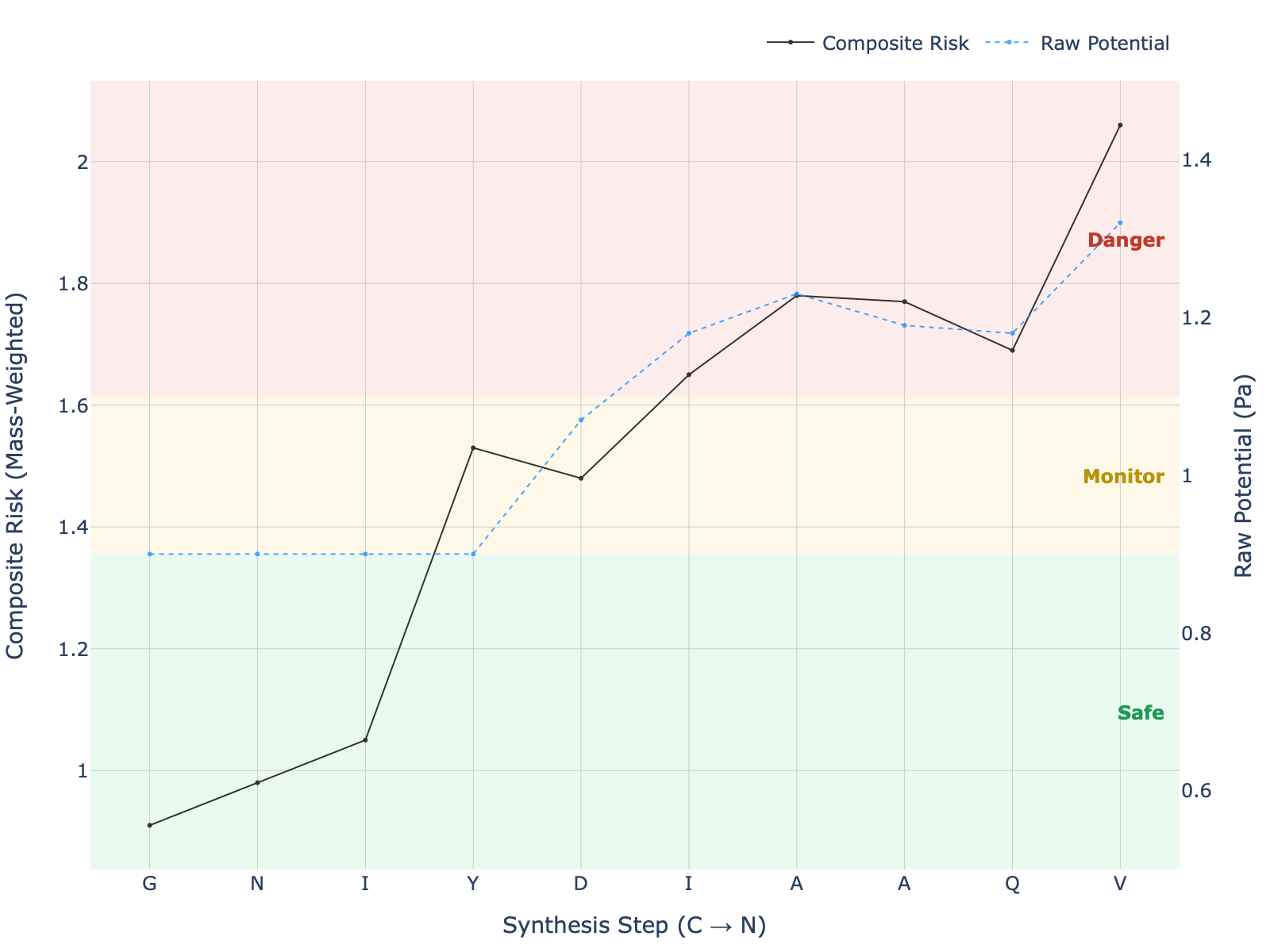
The 65-74 fragment of the Acyl Carrier Protein (ACP), sequence VQAAIDYING, is the gold standard for testing SPPS difficulty.
- Lab Reported Reality: Synthesis typically proceeds smoothly until the Ile-Asp (ID) region, where coupling efficiency drops sharply due to the formation of a stable β-sheet.
- Peptalyzer™ Prediction:
- Engine A: Correctly triggers the Rule of Three flag. As the sliding window hits the
IDYINcore, the Raw Potential (Pa) spikes above 1.1 for consecutive steps, identifying the exact nucleation point of the β-sheet. - Engine B: The Composite Risk enters the “Danger” zone toward the N-terminus as the hydrophobic bulk of the protecting groups (Pbf on Arg, tBu on Asp/Tyr) begins to “choke” the resin pores.
- Engine A: Correctly triggers the Rule of Three flag. As the sliding window hits the
Amyloid Beta (1-42): The Global Physical Barrier
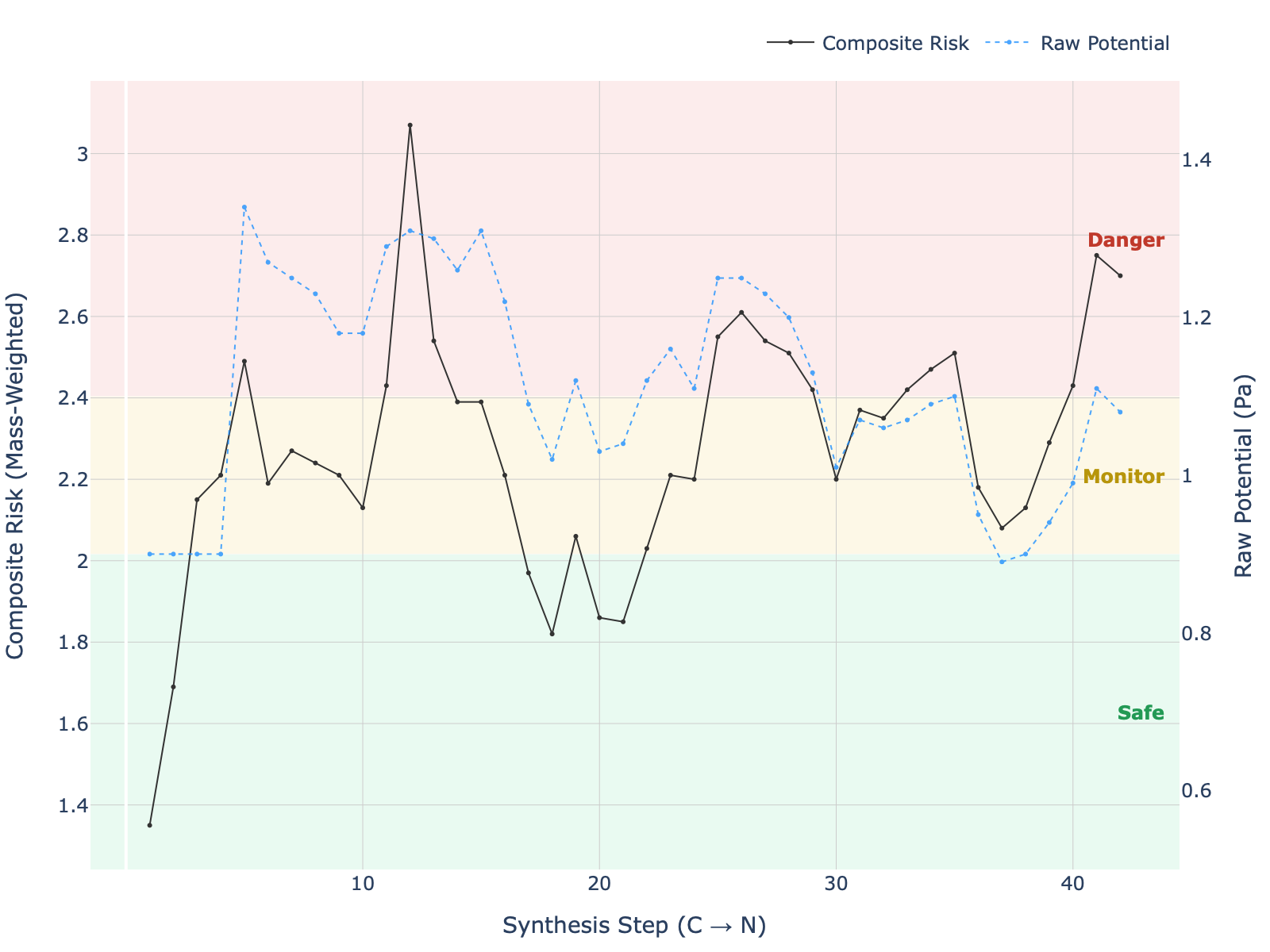
DAEFRHDSGYEVHHQKLVFFAEDVGSNKGAIIGLMVGGVVIA, the β-42 peptide is the ultimate test for the Dynamic Multiplier and Mass Ceiling logic.
- Lab Reported Reality: Synthesis is hindered by both intense local aggregation in the C-terminal region (29-42) and global reagent diffusion issues as the chain grows.
- Peptalyzer™ Prediction:
- Engine B: As the cumulative protected mass (Mcum) approaches and exceeds the 5000 Da Diffusion Limit, the Composite Risk climbs into the “Danger” zone (≥2.5).
- Kinetic Interaction: Hydrophobic patches like
LVFFAtrigger high Weighted Hydrophobicity (1.2×Hp) penalties, which amplify the already high mass risk.
Poly-Alanine: The Beta-Sheet Nucleation Trap
Literature often identifies Poly-alanine ≈ as a paradox; while Chou-Fasman predicts high helicity, SPPS reality shows extreme aggregation.
- Lab Reported Reality: Poly-alanine stretches (e.g., n>6) form notoriously insoluble β-sheets in organic solvents like DMF.
- Peptalyzer™ Prediction:
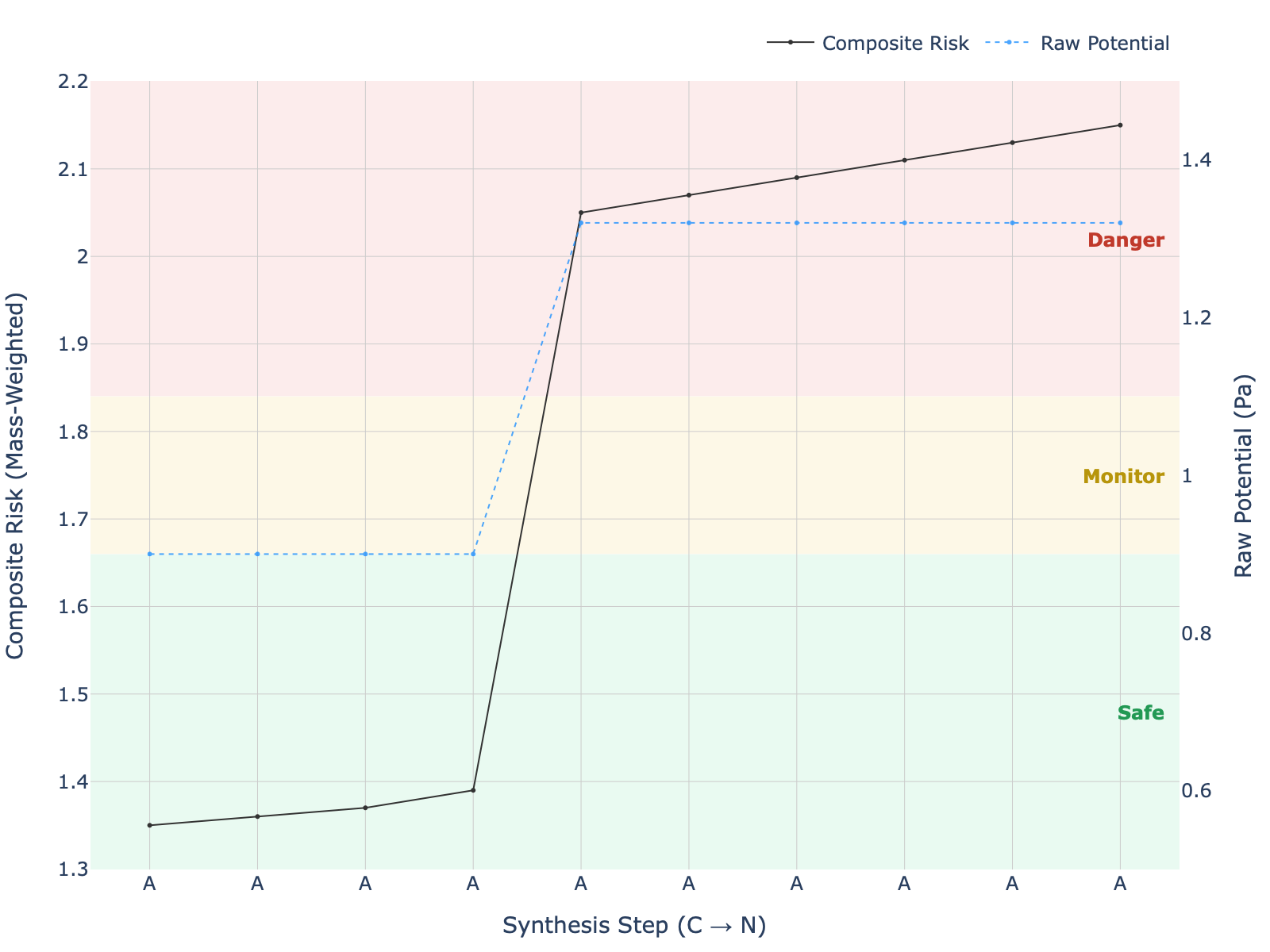
- Engine A: Alanine is assigned a modernized Pa value of 1.32, reflecting its surprisingly strong on-resin aggregation propensity.
- The Result: Because the Pa is consistently above the 1.1 threshold, the engine flags a Local Failure almost immediately after the fifth residue is coupled, accurately predicting the rapid transition from a random coil to a “sticky” aggregated state.
HIV-1 Protease (81-99): The Hydrophobic & Steric Trap
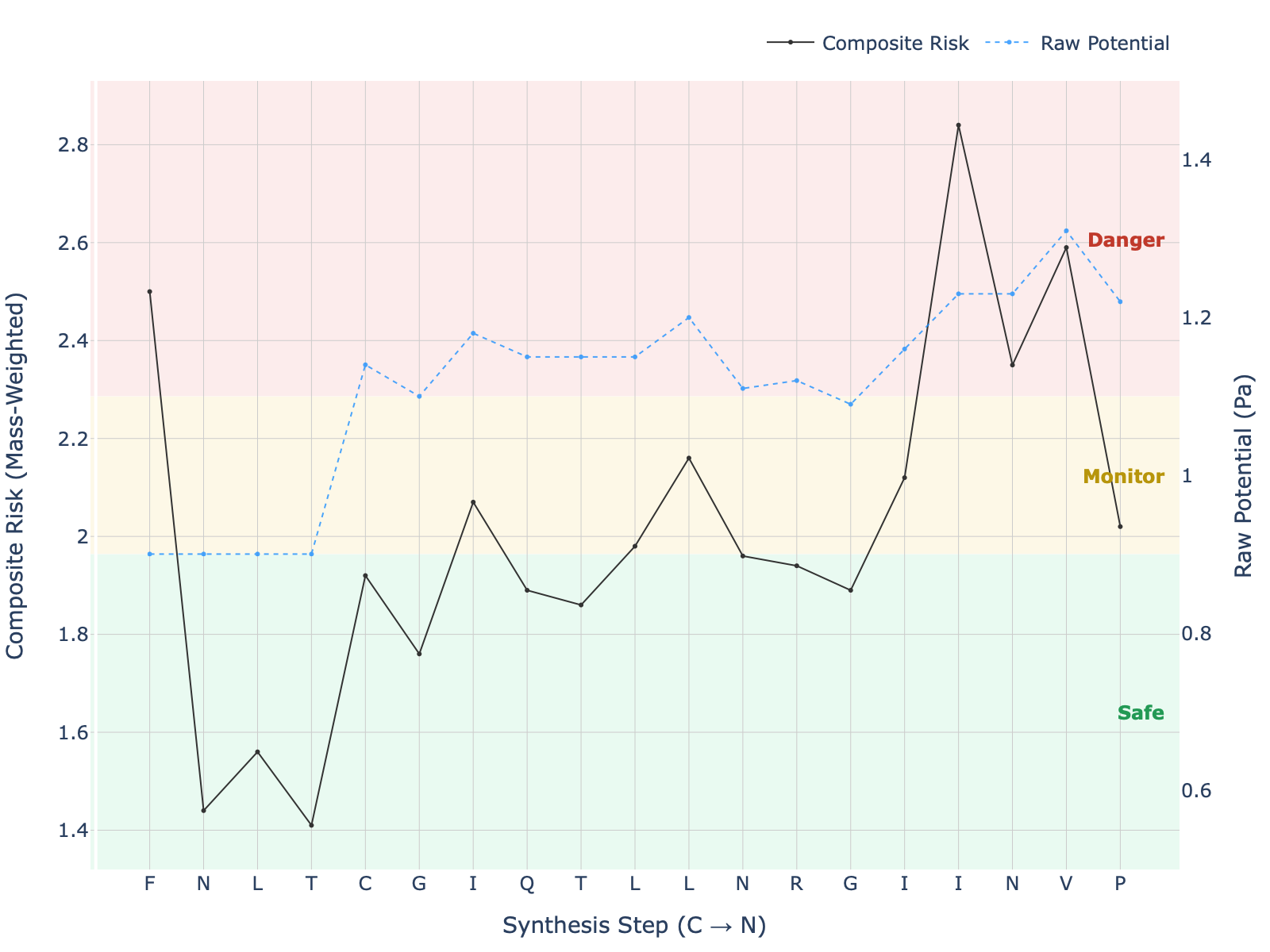
The C-terminal fragment of the HIV-1 Protease, sequence PVNIIGRNLLTQIGCTLNF is a well-known “hard-to-synthesize” benchmark due to its mix of hydrophobic clustering and steric bulk.
- Lab Reported Reality: The synthesis is notoriously difficult in the N-terminal region, specifically the
IIG(Ile-Ile-Gly) hydrophobic cluster. Researchers often report incomplete coupling and deletion sequences at the bulky isoleucine residues. - Peptalyzer™ Prediction:
- Engine A (Blue Line): The Raw Potential (Pa) climbs steadily into the “Danger” zone (≥1.1) as the synthesis reaches the N-terminal hydrophobic patch (
I-I-N-V-P). This correctly flags the thermodynamic aggregation of theIIGcluster. - Engine B (Black Line): The Composite Risk exhibits a massive spike (reaching ~2.8) specifically at the Ile-Ile coupling step.
- Mechanism: This triggers the Bulky-on-Bulky Penalty (+0.4). The engine correctly identifies that coupling a β-branched Isoleucine onto another Isoleucine is physically difficult due to steric clash, amplifying the already high aggregation risk.
- Engine A (Blue Line): The Raw Potential (Pa) climbs steadily into the “Danger” zone (≥1.1) as the synthesis reaches the N-terminal hydrophobic patch (
- Synthesis Strategy: Peptalyzer™ identifies a Compound Failure (Thermodynamic + Kinetic).
SPPS Difficulty Prediction - FAQ
Peptalyzer™ Engine A calculates the Raw Potential (Pa) to predict thermodynamic aggregation (“Will it collapse?”). Engine B calculates a Penalty Multiplier to predict physical and kinetic barriers (“Will reagents get in?”) based on mass and steric hindrance.
Peptide aggregation is a local phenomenon. A single “sticky” 5-residue nucleus can cause resin collapse regardless of total length. Peptalyzer™ uses this window to identify specific failure points rather than summing total values, which falsely flags long peptides.
The engine sets a normalization anchor at 5000 Da, representing the SPPS Diffusion Limit. Beyond this mass, the volume of the protected peptide physically restricts reagent entry, increasing the Composite Risk.
Traditional models like Chou-Fasman are based on folded proteins in water. In SPPS solvents, Peptalyzer™ correctly identifies that Poly-alanine forms insoluble β-sheets, creating a high-risk aggregation zone.
This is a critical alert where if the Raw Potential (Pa) stays ≥ 1.1 for 3 consecutive residues, Peptalyzer™ flags the sequence as “Sticky”. This indicates a stable β-sheet has likely nucleated on the resin
Peptalyzer™ applies a -0.3 Rescue Credit to account for Proline disrupting β-sheets. However, it simultaneously applies a +0.5 Kinetic Penalty for coupling onto Proline, identifying the steric hindrance of the secondary amine.
References
Krchnak, V., Flegelova, Z., & Vagner, J. (1993). Aggregation of resin-bound peptides during solid-phase peptide synthesis. Prediction of difficult sequences. International Journal of Peptide and Protein Research, 42(5), 450–454.
- Context: The foundational paper for Engine A. It establishes the original swellographic parameters and the concept of the “aggregation nucleus.”
- DOI: 10.1111/j.1399-3011.1993.tb00153.x
Chou, P. Y., & Fasman, G. D. (1978). Prediction of the secondary structure of proteins from their amino acid sequence. Advances in Enzymology and Related Areas of Molecular Biology, 47, 45–148.
- Context: Used in your Poly-Alanine case study to explain the conflict between “helical propensity” (in nature) and “beta-sheet aggregation” (on resin).
- DOI: 10.1002/9780470122921.ch2
Milton, R. C., Milton, S. C., & Adams, P. A. (1990). Prediction of difficult sequences in solid-phase peptide synthesis. Journal of the American Chemical Society, 112(16), 6039–6046.
- Context: The source for the “Rule of Five” and the conformational parameters that influence on-resin difficulty.
- DOI: 10.1021/ja00172a020
Bedford, J., Hyde, C., Johnson, T., Jun, W., Owen, D., Quibell, M., & Sheppard, R. C. (1992). Amino acid structure and difficult sequences in solid phase peptide synthesis. International Journal of Peptide and Protein Research, 40(3-4), 300–307.
- Context: Critical for Engine B; this study identifies how specific residues (Val, Ile, Ala) drive aggregation and how “Bulky-on-Bulky” pairings cause failure.
- DOI: 10.1111/j.1399-3011.1992.tb00305.x
Kent, S. B. H. (1988). Chemical synthesis of peptides and proteins. Annual Review of Biochemistry, 57, 959–968.
- Context: Defines the distinction between “random” (kinetic) and “non-random”(aggregation/thermodynamic) difficult couplings.
- DOI: 10.1146/annurev.bi.57.070188.004521