Residual palladium removal is the step that decides whether a palladium-mediated peptide route is a laboratory curiosity or a viable process. Any synthesis that uses a palladium catalyst — most often the Pd(PPh₃)₄ of an Alloc or allyl ester deprotection — leaves metal behind on the resin and in the crude, and that metal has two consequences. It interferes with the chemistry that follows, and it counts as an elemental impurity against defined regulatory limits. Neither problem is solved by a visually clean resin, and both are cheaper to design for at the start than to patch in after a route is fixed.
The metal does not announce itself. A crude peptide with the correct mass can still carry enough palladium to poison the next on-resin coupling, discolour the product, or fail an elemental-impurity specification for a parenteral drug substance. Residual palladium removal is therefore not a single wash bolted onto the end but a tiered decision about how much control the work actually needs. It runs from a solvent rinse for exploratory chemistry to validated scavenging and elemental analysis for material heading toward the clinic.
📘 What will you learn here?
Why Residual Palladium Matters
Palladium left on a peptide-resin does its damage quietly. The catalytically relevant species are thiophilic and Lewis-acidic, so they bind side chains and sit in the polymer matrix rather than washing straight out. The visible symptom of overloaded or decomposed catalyst is a resin that darkens toward palladium black, but the more common and more dangerous case is metal that leaves no colour and still contaminates. When a coupling or a cyclisation underperforms after an apparently complete deprotection, residual palladium is a more likely cause than the activation chemistry, because residual palladium and phosphine-ligand species can interfere with the coupling that follows.
For therapeutic material the issue is regulatory, not just synthetic. Palladium is an ICH Q3D Class 2B elemental impurity, and because it is deliberately introduced, its contribution to the finished drug product has to be assessed against the route-specific limit — controlled through process understanding, material specifications, testing, or a combination, rather than by one mandatory measurement. That obligation shapes the whole route: it is far easier to design metal removal into the synthesis than to rescue a batch that already exceeds its limit.
Where the Palladium Comes From
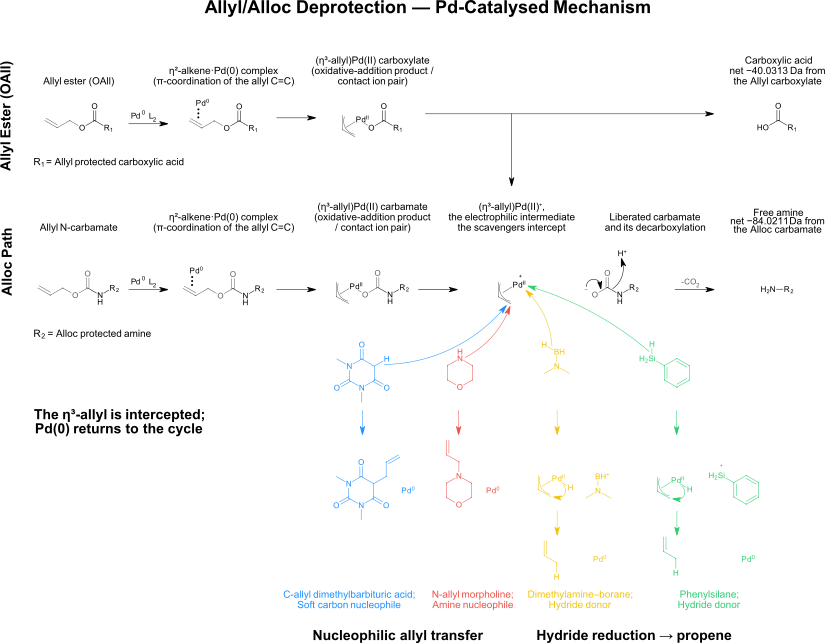
In Fmoc-SPPS the usual source is the palladium(0) or palladium(II) catalyst used to cleave Alloc and allyl esters through a π-allyl intermediate. The classical Pd(PPh₃)₄/phenylsilane systems are the most common, and they are also the ones most prone to depositing metal when the catalyst is pushed hard on a difficult or sulfur-containing sequence. The mechanism and protocol detail for that step sit in the companion guide to Alloc deprotection. For metal control, what matters is the amount of palladium introduced and how strongly it is retained — set by catalyst loading, the number of cycles, and the side chains present. Sulfur-rich sequences retain more, because Cys and Met hold the metal. Base-metal and metal-free deallylation routes have been explored to cut or remove the palladium introduced at this step — though a base metal brings its own impurity to control — while air-stable palladium systems ease the handling but carry the same metal load.
Residual Palladium Removal on Resin
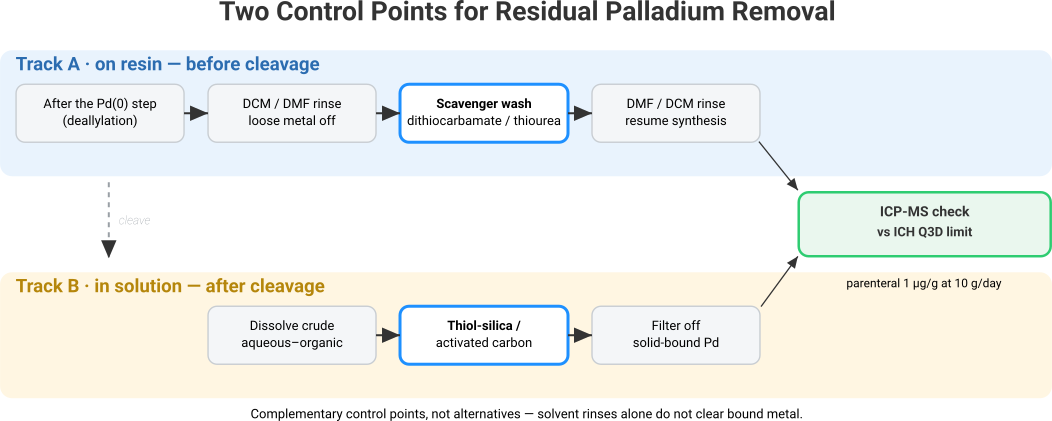
The most established on-resin control is a dedicated scavenging wash applied after the palladium step and before synthesis resumes. Sodium diethyldithiocarbamate in dimethylformamide (DMF) is the classical choice, used in the earliest automated allyl-cleavage protocols: the dithiocarbamate chelates palladium and pulls it off the resin. Thiourea works on the same soft-donor principle and is a common palladium scavenger in process chemistry, though it is less documented for on-resin peptide work than the dithiocarbamate wash — screen it rather than assume it transfers. These are soft-donor ligands matched to a soft metal, and they belong after the reaction, not in the active catalyst mixture, where they would only poison the chemistry you are trying to run.
A practical wash sequence for discovery-scale work that continues on resin is dichloromethane, then DMF, then the scavenger solution, then DMF and dichloromethane again before the next coupling. The scavenging step is the one most often skipped, because solvent alone makes the resin look clean. Skipping it is exactly how a downstream coupling fails for reasons that look like poor activation but are really retained metal.
Post-Cleavage Residual Palladium Removal
Once the peptide is cleaved and in solution, the control shifts to solution-phase capture. The crude is dissolved in an aqueous–organic mixture and passed through thiol-functionalised silica — a standard palladium scavenger in pharmaceutical process chemistry — which binds dissolved palladium onto a filterable solid. How well it transfers to a given peptide (solvent system, adsorption losses, contact time, palladium speciation) should be screened rather than assumed. Activated carbon can also take up palladium, but it may adsorb the peptide itself, so it is the more situational choice. This does not fix metal that has already interfered with an on-resin step, so it complements rather than replaces the on-resin wash. For material heading toward regulated manufacture, post-cleavage capture is combined with the on-resin scavenging and with a defined analytical check, so that the metal is controlled at more than one point in the route.
| Method | How it works | Where it fits |
|---|---|---|
| Solvent washing only | DCM/DMF rinses displace loosely held metal and scavenger residue. | Exploratory chemistry; not a substitute for scavenging when Pd matters analytically. |
| Sodium diethyldithiocarbamate wash (on resin) | Soft-donor chelation lifts Pd off the resin; applied after the Pd step. | Most established dedicated on-resin scavenging; discovery through development. |
| Thiourea wash (on resin) | Sulfur-donor complexation of Pd; same post-reaction placement. | Alternative or complement to dithiocarbamate. |
| Thiol-silica / activated carbon (post-cleavage) | Solid-supported thiol or carbon captures dissolved Pd from the crude. | Solution-phase polishing after cleavage; pairs with on-resin scavenging. |
| Process-level control + ICP-MS | Layered scavenging and purification with quantitative metal measurement. | Routes heading toward regulated peptide manufacture. |
Regulatory Limits: ICH Q3D and Palladium
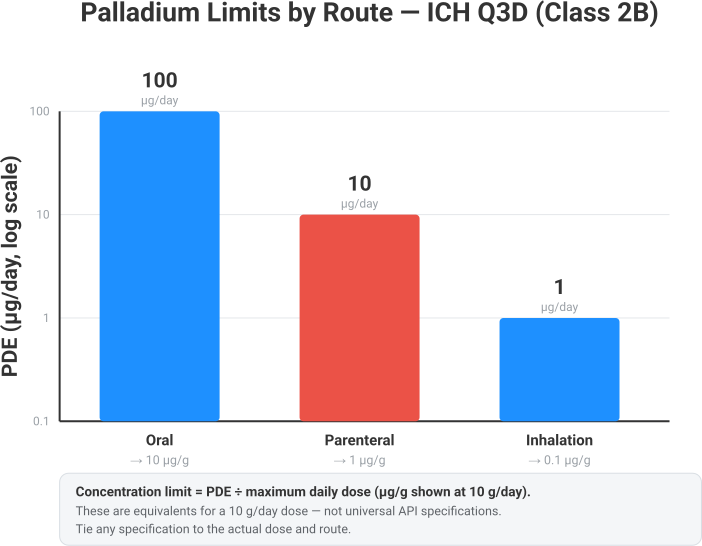
Palladium is classified under the ICH Q3D elemental-impurities guideline as a Class 2B element. That means low natural abundance in materials, but enough toxicological concern to require control when it is deliberately introduced, as it is in a catalytic deallylation. The permitted daily exposure (PDE) is route-dependent, and the parenteral limit is usually the governing one for injectable peptides.
| Route | PDE (µg/day) | Concentration at 10 g/day dose |
|---|---|---|
| Oral | 100 | 10 µg/g (10 ppm) |
| Parenteral | 10 | 1 µg/g (1 ppm) |
| Inhalation | 1.0 | 0.1 µg/g (0.1 ppm) |
The concentration limits in the third column follow from the daily-dose conversion the guideline uses. For a maximum daily dose of 10 g of drug product, the concentration equivalent is the PDE divided by that dose:
\[C_{\mathrm{limit}} = \frac{\mathrm{PDE}}{D_{\mathrm{daily}}} = \frac{10\ \mu\mathrm{g/day}}{10\ \mathrm{g/day}} = 1\ \mu\mathrm{g/g}\]These third-column values are concentration equivalents for a hypothetical 10 g daily intake, not universal peptide specifications; the applicable concentration depends on the route, the maximum daily dose, the formulation, and the ICH Q3D control option chosen. A smaller daily dose raises the allowed concentration proportionally, so any specification has to be tied to the actual dose and route rather than quoted as a fixed ppm. The values above are from ICH Q3D(R2) and should be checked against the guideline itself before they anchor a specification.
Choosing a Residual Palladium Removal Strategy
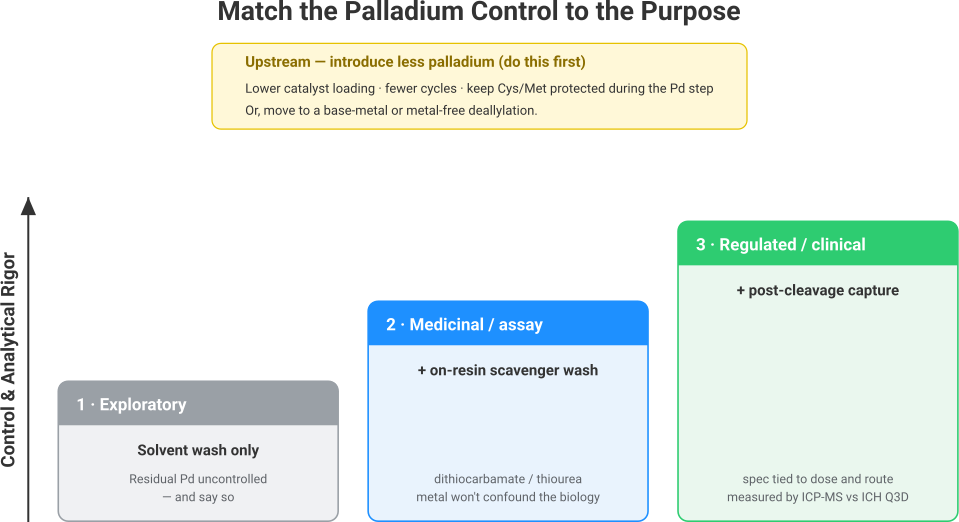
The right level of control follows the purpose of the material. For exploratory synthesis where the peptide will be characterised and discarded, solvent washing is usually enough, and the honest position is that residual palladium is uncontrolled. Material that feeds a medicinal-chemistry assay needs the on-resin dithiocarbamate or thiourea wash, so that metal does not confound the biology or the downstream chemistry. Anything progressing toward regulated manufacture should treat metal control as a process-development question from the first synthesis: layer on-resin scavenging with post-cleavage capture, tie the specification to the intended dose and route, and measure.
The design choice that matters most sits upstream of removal entirely. A route that never introduces much palladium is easier to clean than one that introduces a lot. Lowering catalyst loading, minimising cycles, keeping Cys and Met protected during the metal step, or moving to a base-metal or metal-free deallylation can do more for the final number than any wash. Removal and avoidance are two halves of the same plan.
Analytical Confirmation
The usual quantitative method is inductively coupled plasma mass spectrometry (ICP-MS), which measures palladium in the final peptide at low trace levels with a properly validated, matrix-matched procedure; ICP-OES or another validated elemental method can also serve. It supports an elemental-impurity control strategy or release test where routine testing is the chosen control — Q3D does not mandate testing, and risk assessment with process controls may be sufficient. It is a post-synthesis control, appropriate as a route moves toward regulated manufacture rather than a routine discovery check. Colour is not a measurement: a resin that has lost its darkness has not been shown to meet a limit, and a crude that looks clean can still fail. Where the number matters, it is measured, not inferred.
The Chemist’s Perspective
The trap here is the clean-looking crude. Solvent washes strip colour and loosely bound metal, so the resin and the product look finished, and the temptation is to move on. The palladium that matters is the fraction that colour never revealed — bound to a side chain, lodged in the polymer, invisible until an ICP-MS run or a failed coupling exposes it. The habit that prevents the late surprise is to place the scavenging wash immediately after the palladium step, as a fixed part of the cycle, rather than as a remedial measure invoked only when something already went wrong.
The second reality is that this is a design problem, not a cleanup problem. By the time a batch exists, the amount of palladium it can carry is largely set by how the route was run. The teams that meet their limits comfortably decided early how much metal they were willing to introduce and built removal into the sequence. They are not the ones that reached for a scavenger cartridge after the elemental-impurity result came back high.
Residual Palladium Removal — FAQ
A wash with sodium diethyldithiocarbamate in DMF applied after the palladium step is one of the most established on-resin methods; thiourea also coordinates palladium through sulfur. Place the scavenger after the reaction, never in the active catalyst mixture, and finish with DMF and dichloromethane rinses.
Palladium is a Class 2B element with a parenteral permitted daily exposure of 10 µg/day, which corresponds to about 1 µg/g (1 ppm) at a 10 g/day maximum dose. The oral limit is 100 µg/day. Confirm the current values against the Q3D guideline before setting a specification.
No. Solvent washing removes colour and loosely held metal, but palladium bound to Cys or Met or lodged in the matrix leaves no visible sign. Only ICP-MS confirms the residual level; a decolourised resin is not evidence of meeting a limit.
Dissolve the crude in an aqueous–organic mixture and pass it through thiol-functionalised silica, a palladium scavenger adapted from process chemistry, which captures dissolved palladium onto a filterable solid. This polishes the solution but does not undo metal interference that already occurred on resin, so pair it with an on-resin scavenging wash.
Partly. Lower catalyst loading, fewer cycles, and keeping Cys and Met protected reduce how much metal is introduced and retained. A metal-free route such as iodine/water removes the transition-metal residue entirely; a nickel route only swaps palladium for another element that still needs control. Only a metal-free route removes the palladium the deallylation would otherwise introduce.
References
International Council for Harmonisation. (2022). Guideline for Elemental Impurities Q3D(R2). ICH Harmonised Guideline.
- Primary regulatory source for palladium classification, route-specific permitted daily exposures, risk assessment, and the conversion of PDEs into permitted concentrations.
- URL: database.ich.org — Q3D(R2)
Kates, S. A., Daniels, S. B., & Albericio, F. (1993). Automated allyl cleavage for continuous-flow synthesis of cyclic and branched peptides. Analytical Biochemistry, 212(2), 303–310.
- Introduces the sodium diethyldithiocarbamate on-resin wash for palladium after allyl/Alloc deprotection.
- DOI: 10.1006/abio.1993.1334
Napier, P., Bakas, N., Bhat, A., & Noncovich, A. (2025). Open-Flask Protocol for the Removal of Alloc Carbamate and Allyl Ester Protecting Groups. Application to In-solution and On-resin Peptide Synthesis. The Journal of Organic Chemistry, 90(1), 197–201.
- Open-flask, air-stable palladium protocol for Alloc and allyl-ester removal in solution and on resin; more operationally robust than classical air-sensitive Pd(PPh₃)₄ conditions, and suppresses N-allylation.
- DOI: 10.1021/acs.joc.4c02115