Alloc deprotection is the palladium-catalysed removal of the allyloxycarbonyl group from an amine. It sits on a third deprotection axis that answers to neither the piperidine of the Fmoc cleavage cycle nor the trifluoroacetic acid (TFA) of the final cleavage. That independence is the whole point. The allyloxycarbonyl (Alloc) carbamate and its carboxyl counterpart, the allyl ester (OAll), survive both routine base and routine acid, then come off under near-neutral conditions through a π-allyl palladium intermediate. This makes Alloc and allyl the working tools for on-resin cyclisation, side-chain branching, and any route that needs a selective handle opened while the rest of the protection scheme stays intact.
The distinction that matters at the bench is between the two substrate classes. Alloc protects an amine — most often the ε-amine of Lys, sometimes an Nα-terminus — and its removal exposes a nucleophile for acylation, labelling, or lactam closure. The allyl ester protects a carboxylate — the side chain of Asp or Glu, or a C-terminus anchored to the resin — and its removal exposes an acid for the same cyclisation and branching chemistry from the other direction. They share a mechanism but not their downstream role, their local electronics, or their analytical signatures, and treating them as one interchangeable step is the first mistake to avoid.
Audit the sequence before you commit the route.
Run it through the Peptalyzer™, which flags the aspartimide, glutarimide, and diketopiperazine liabilities that decide whether an Asp(OAll) or Glu(OAll) will survive the synthesis, and returns the matching remedies. Peptalyzer™ flags sequence-based risk; it does not replace experimental optimisation or LC-MS confirmation.
📘 What will you learn here?
What Alloc and Allyl Groups Protect
What Alloc and Allyl Groups Protect
The Alloc carbamate is applied to an amine as Fmoc-Lys(Alloc)-OH for orthogonal side-chain unmasking, or as an Nα-Alloc amino acid where a neutral temporary protection is wanted in place of Fmoc. Nα-Alloc has a specific historical use: tandem deprotection–coupling under neutral conditions suppresses diketopiperazine formation at the vulnerable dipeptide stage, because the free amine is consumed by the next coupling rather than left to cyclise onto the penultimate residue.
The allyl ester is applied to acidic side chains as Fmoc-Asp(OAll)-OH and Fmoc-Glu(OAll)-OH, and to the C-terminal α-carboxyl in head-to-tail cyclisation strategies. Allyl ethers on Ser, Thr, or Tyr belong to the same chemical family but are far less common in mainstream Fmoc-SPPS. Their cleavage is slower and less clean, and most peptide routes reach for tert-butyl or trityl on those side chains instead. The practical library, then, is Lys(Alloc), Asp(OAll), and Glu(OAll), with allylic anchoring as the specialist case.
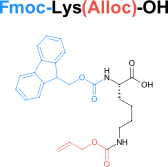
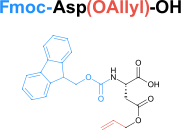
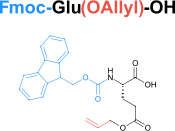
The Alloc Deprotection Mechanism
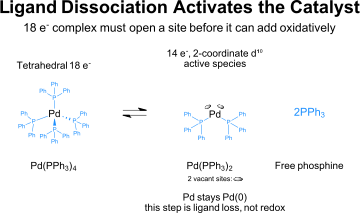
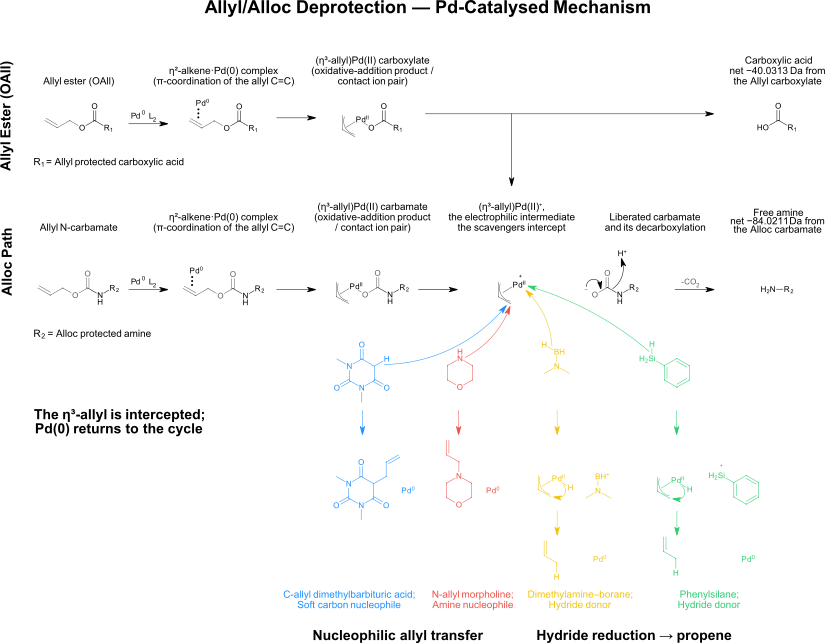
The mechanism is the palladium π-allyl manifold, established in the small-molecule allyl and carbamate literature and imported into peptide chemistry. A coordinatively unsaturated palladium(0) species — generated when a ligand dissociates from the resting catalyst — coordinates the allyl alkene, then inserts into the allylic carbon–oxygen bond. This oxidative addition expels the peptide-bound heteroatom fragment and forms a cationic η³-allyl palladium(II) complex.
That η³-allyl cation is electrophilic at both termini and short-lived, so it has to be captured. That capture is the scavenger’s job: hydride donors such as phenylsilane reduce the metal-bound allyl and commonly release propene, while carbon- and nitrogen-based scavengers take it as an allylated adduct. The scavenger is a dedicated allyl sink — without it the allyl finds the nearest nucleophile instead, usually the amine just unmasked, giving the N-allylated by-product (+40.0313 Da) while the catalyst turns over sluggishly. What differs between Alloc and allyl ester is not this core but the fate of the peptide-bound fragment that leaves.
Why Alloc Deprotection Needs Ligand Loss First
Pd(PPh₃)₄ is an 18-electron, coordinatively saturated d¹⁰ complex: four phosphines fill every site, which is why it is stable enough to weigh out. That saturation is also why it is unreactive as supplied — there is no vacant orbital for a substrate to bind. Losing one or two phosphines gives the 14-electron Pd(PPh₃)₂, a coordinatively unsaturated species with an open site and accessible frontier orbitals.
That open site is what lets the allyl alkene coordinate. Binding follows the Dewar–Chatt–Duncanson model: the filled alkene π donates into an empty palladium orbital, and a filled palladium d orbital back-donates into the alkene π*. Both halves need an accessible empty orbital on the metal, which the saturated 18-electron complex does not have. Only after ligand loss can the C=C bind η², and that π-coordination is the geometric prerequisite for oxidative addition into the allylic C–O bond.
Alloc Carbamate Cleavage and Decarboxylation
When the allyl–oxygen bond breaks on an Alloc carbamate, the fragment released is a carbamic acid equivalent, R–NH–CO–O⁻. This species is not stable. It decarboxylates, losing carbon dioxide and delivering the free amine. That extra decarboxylation step is why Alloc removal costs more mass than allyl ester removal: the peptide loses the whole allyloxycarbonyl unit, C₄H₄O₂, a monoisotopic loss of 84.0211 Da. The decarboxylation is a standard consequence of carbamate fragmentation and is inferred from the clean amine product rather than from an intermediate trapped on resin.
Allyl Ester Cleavage to the Free Acid
On an allyl ester the same oxidative addition occurs, but the fragment released is the carboxylate itself, R–CO–O⁻. There is no carbamate to collapse and no carbon dioxide to lose. The carboxylate picks up a proton to give the free acid. The peptide loses only the allyl group, C₃H₄, a monoisotopic loss of 40.0313 Da. This is the direct feed into side-chain-to-side-chain and side-chain-to-tail lactamisation, because the exposed acid is ready to be activated against a free amine unmasked in the same or a neighbouring step.
Allyl Ethers and the Scavenger’s Role
Allyl ethers react through the same palladium chemistry but more sluggishly, because the aliphatic allyl–oxygen bond is stronger and less activated than an ester or carbamate linkage. In peptide contexts their use is limited enough that they should be treated as mechanistically related rather than bench-validated in the way Alloc and allyl esters are. Across all three substrates the scavenger is not a spectator. Phenylsilane acts as a hydride source and allyl sink. Amine acceptors such as N-methylmorpholine trap the allyl fragment by a different route, and soft carbon nucleophiles such as Meldrum’s acid or dimethylbarbituric acid capture it without touching the newly freed amine. Because the trapping step regenerates the catalyst, the choice of scavenger changes the rate, the by-product profile, and whether the reaction stalls — which is why two protocols on the same palladium source can behave very differently.
Catalysts and Scavengers for Alloc Deprotection
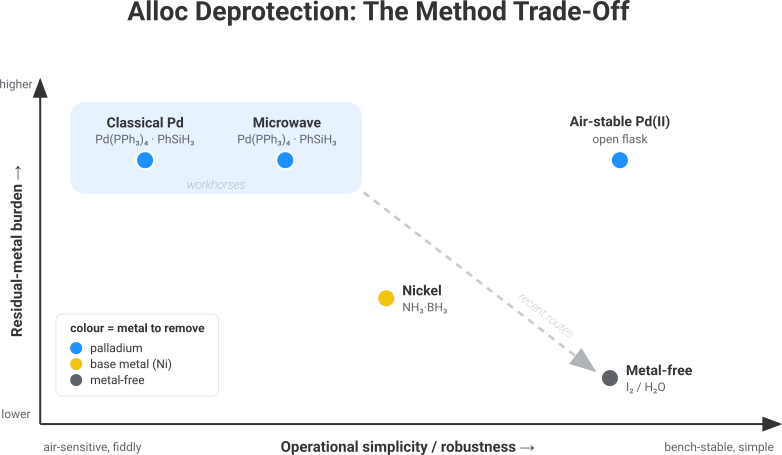
The dominant catalyst in the peptide literature remains tetrakis(triphenylphosphine)palladium(0), Pd(PPh₃)₄, paired with phenylsilane in dichloromethane for neutral on-resin work, or used in a chloroform/acetic acid/N-methylmorpholine medium for older automated and continuous-flow methods. Pd(PPh₃)₄ is active and well understood, but it oxidises quickly in air to inactive species, so classical protocols assume inert handling. The most useful recent development is a shift toward air-stable precatalysts. An open-flask protocol using bis(triphenylphosphine)palladium(II) dichloride, Pd(PPh₃)₂Cl₂, with Meldrum’s acid and triethylsilane was reported to give high yields and to suppress the N-allylated by-product that dogs the standard method. It tolerates open-vessel and automated operation.
Scavengers and Allyl Acceptors
Scavenger choice tracks the substrate. Phenylsilane is the best-supported neutral default for routine Lys(Alloc) and Asp/Glu(OAll) removal, and it dovetails into on-resin cyclisation. Its weakness is that it can promote N-allylation on some substrates, and excessive catalyst loading or prolonged reaction can increase palladium black formation. For a secondary amine, or wherever allyl back-transfer keeps appearing, amine–borane complexes are worth trying before adding more phenylsilane: dimethylamine–borane has been reported to remove Nα-Alloc cleanly where morpholine and phenylsilane underperformed. The soft carbon nucleophiles — Meldrum’s acid, dimethylbarbituric acid — are mechanistically well matched because they trap the allyl fragment without competing for the freed amine, and they are the basis of the air-stable open-flask chemistry.
| Scavenger | Role and behaviour | When to reach for it |
|---|---|---|
| Phenylsilane | Hydride donor and allyl sink; supports catalyst turnover. Can drive N-allylation on some substrates. | Neutral default for routine Lys(Alloc), Asp(OAll), Glu(OAll); pairs well with immediate cyclisation. |
| Dimethylamine–borane | Reductive amine–borane scavenger; suppresses allylamine side products. | Secondary-amine Alloc, or any substrate that repeatedly shows N-allylation. |
| Meldrum’s acid / dimethylbarbituric acid | Soft carbon nucleophile; traps the allyl fragment without reacting with the freed amine. | Air-stable open-flask systems; substrates prone to back-alkylation. |
| N-Methylmorpholine (in acidic medium) | Amine allyl acceptor of the classical automated method; less neutral, slower. | Legacy continuous-flow and automated allyl cleavage. |
Standard and Microwave Alloc Deprotection Protocols
There is no single universal procedure. There are a few evidence-backed starting regions, and the right one depends on scale, instrument, and how sulfur-rich or aggregation-prone the sequence is. The values below are starting conditions, verified against LC-MS on the real sequence, not guarantees.
Classical Room-Temperature Removal
The neutral manual standard is Pd(PPh₃)₄ with phenylsilane in dichloromethane at room temperature, run as two treatments with fresh reagent each time, under inert gas, with the resin pre-swollen in dichloromethane. A widely used manual protocol runs 0.2 equivalents palladium and roughly 20 equivalents phenylsilane, 30 minutes twice, followed by dichloromethane, dimethylformamide (DMF), and a sodium diethyldithiocarbamate wash to strip residual metal before synthesis resumes. The classical automated and continuous-flow route instead uses Pd(PPh₃)₄ in chloroform/acetic acid/N-methylmorpholine over a longer recycle, again finished with a dithiocarbamate wash. The trade is clear: the neutral silane method is milder and cyclisation-ready; the acidic amine method is homogeneous and instrument-friendly but slower and heavier on metal management.
Microwave-Assisted Alloc Deprotection
Microwave heating shortens the step from hours to minutes. A reproduced instrument protocol removes both Alloc and allyl ester with Pd(PPh₃)₄ (about 0.25 equivalents) and phenylsilane (about 15 equivalents) in dichloromethane at 40 °C, 5 minutes twice. The most defensible reading is that controlled heating improves diffusion and catalyst turnover in a swollen bead. The study demonstrates the acceleration at a modest 30–40 °C but does not distinguish conventional heating from any microwave-specific effect. Microwave methods also succeed under atmospheric handling when the step is short, but oxygen tolerance is protocol-dependent and should be confirmed on the sequence in hand rather than assumed.
Open-Flask and Air-Stable Systems
The open-flask Pd(PPh₃)₂Cl₂ / Meldrum’s acid / triethylsilane protocol is the most relevant modern change, because it removes the two operational pains of the classical method at once: the air-sensitive catalyst and the N-allylation by-product. It was demonstrated for both in-solution and on-resin Alloc and allyl ester removal, and it is compatible with automated synthesis. Head-to-head peptide comparisons against the established Pd(PPh₃)₄ methods are still limited, so it is a strong default to trial rather than a settled replacement.
Nickel and Ammonia–Borane Deallylation
The most current work is trying to leave palladium behind entirely, which matters directly for the metal-control burden discussed below. An air-stable nickel precatalyst with ammonia–borane has been reported to deallylate allyl and Alloc groups in solution and on resin. It is not a free pass: nickel swaps palladium for another element that still needs impurity control, and the method is recent rather than routine. For a sulfur-rich sequence or a process facing tight palladium limits, it is worth scouting.
Metal-Free Iodine/Water Alloc Removal
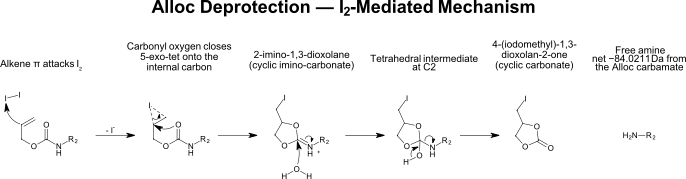
A separate route removes Alloc on resin with iodine and water in greener solvents, run one-pot with racemisation-free couplings and demonstrated on a long sequence and at ten-gram scale with TFA-free resin cleavage. It is the one option that clears the transition-metal residue entirely. Cleavage runs through a nitrogen-stabilised cyclic intermediate rather than a metal π-allyl complex — a different manifold from the palladium and nickel routes above. Because that intermediate depends on the carbamate nitrogen, the iodine route is carbamate-specific: it removes Alloc but does not cleave allyl esters, so Asp(OAll) and Glu(OAll) still require palladium. Like the nickel route, it is recent and not yet routine.
| Method | Catalyst, scavenger, solvent, conditions | Best fit / caveat |
|---|---|---|
| Neutral manual (RT) | Pd(PPh₃)₄ ~0.2 eq, phenylsilane ~20 eq, DCM, 30 min × 2, inert gas; dithiocarbamate wash after. | Mild, cyclisation-ready. Catalyst oxidises in air; verify on sulfur-rich sequences. |
| Classical automated / flow | Pd(PPh₃)₄ in CHCl₃/AcOH/N-methylmorpholine, longer recycle; dithiocarbamate wash. | Homogeneous, instrument-friendly. Less neutral, slower, heavier metal management. |
| Microwave | Pd(PPh₃)₄ ~0.25 eq, phenylsilane ~15 eq, DCM, 40 °C, 5 min × 2. | Minutes not hours. Success depends on real temperature control, not nominal power. |
| Open-flask air-stable | Pd(PPh₃)₂Cl₂, Meldrum’s acid, triethylsilane; in-solution or on-resin. | No inert handling; suppresses N-allylation. Peptide head-to-head data still limited. |
| Base-metal (nickel) | Air-stable Ni(PPh₃)₂Br₂ with ammonia–borane; solution and on resin, inert atmosphere. | Avoids palladium, but nickel is itself a controlled elemental impurity. |
| Metal-free | Iodine/water in a greener solvent, one-pot with coupling; shown at ten-gram scale, TFA-free. | Removes the transition-metal residue entirely. Recent, not yet routine. |
Orthogonality: Alloc Deprotection versus Dde and Mtt
Alloc and allyl complete an orthogonality cluster with the hydrazine-labile Dde/ivDde groups and the mild-acid-labile Mtt/Mmt groups. Each member unmasks a side chain without disturbing Fmoc or the tert-butyl protection, and each solves a different problem. Alloc and allyl give the cleanest separation from both base and mild acid, at the cost of transition-metal handling. Dde and ivDde avoid metals but bring hydrazine, which can nick Fmoc and can be sluggish to remove in aggregated regions. Mtt and Mmt are simple to monitor by colour, but they spend part of the synthesis acid budget rather than saving that selectivity for the end.
Orthogonality of side-chain deprotection
| Piperidinebase | TFA 95%strong acid | 1–2% TFAin DCM | Hydrazine2–5% | Pd(0)PhSiH₃ | |
|---|---|---|---|---|---|
| Fmoc (Nα) | ✗removed — designed trigger | ✓stable | ✓stable | ✗removed — trap | ✓stable |
| OtBu / tBu | ✓stable | ✗removed — designed trigger | ✓stable | ✓stable | ✓stable |
| Alloc / allyl | ✓stable | ✓stable | ✓stable | ~at risk / partial | ✗removed — designed trigger |
| Dde / ivDde | ~at risk / partial | ✓stable | ✓stable | ✗removed — designed trigger | ✓stable |
| Mtt / Mmt | ✓stable | ✗removed | ✗removed — designed trigger | ✓stable | ✓stable |
Where the Orthogonality Fails
The orthogonality is real but it fails in predictable ways. The most-cited trap is that hydrazine used for Dde removal can also strip or degrade Alloc and allyl unless the protocol is adjusted. The standard fix is to add allyl alcohol as a sacrificial alkene, so diimide generated in the hydrazine step reduces the additive instead of the Alloc double bond. Alloc orthogonality also fails when palladium is poisoned by sulfur, when poor swelling makes deprotection diffusion-limited, and when the metal is not washed out before the next coupling.
| Criterion | Alloc / allyl | Dde / ivDde | Mtt / Mmt |
|---|---|---|---|
| Removed by | Pd(0)-mediated allyl transfer, near-neutral | 2% hydrazine in DMF | Dilute acid (1% TFA/DCM, HFIP mixtures) |
| Typical target | Lys ε-amine; Asp/Glu side-chain acid | Mostly Lys ε-amine | Mostly Lys ε-amine; some O/S |
| Monitoring | Test-cleavage LC-MS mass shift | Indazole by-product UV at 290 nm | Trityl colour and acid release |
| Main failure mode | Residual Pd, incomplete removal, N-allylation | Migration, sluggish ivDde in aggregated regions | Cumulative acid exposure, linker sensitivity |
| Hidden incompatibility | Hydrazine steps can threaten Alloc unless allyl alcohol is added | Hydrazine can also remove Fmoc | Acid can disturb acid-labile contexts |
| Best when | Cyclisation and multi-orthogonal routes | No metal can be tolerated | Simplicity matters more than full orthogonality |
On-Resin Cyclization After Alloc Deprotection
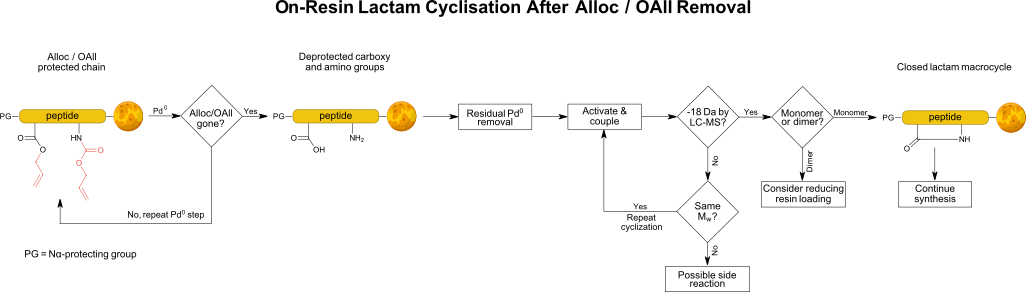
The most productive use of this chemistry is paired unmasking followed by immediate cyclisation. Build the protected linear chain, remove Alloc and/or allyl ester selectively, wash hard to clear palladium and low-molecular-weight scavenger residue, then couple on resin. Removing Lys(Alloc) and Asp(OAll) or Glu(OAll) together exposes a free ε-amine and a free side-chain acid that close to a side-chain-to-side-chain lactam.
Head-to-tail closure works differently. The chain is held to the resin through a side-chain anchor — classically an Asp or Glu side chain. The C-terminal α-carboxyl is carried as an allyl ester, so palladium frees that terminus on resin without releasing the peptide. If an allylic linker is instead the only resin attachment, cleaving it releases the protected linear peptide for solution-phase cyclisation, not an on-resin ring. The advantage in both cases is pseudo-dilution on the bead, which favours intramolecular closure over intermolecular oligomerisation — though ring size, sequence flexibility, and resin loading still decide whether that advantage is enough.
Two workflow-level traps matter more than the deprotection chemistry itself. First, a freed Glu(OAll) side chain should be functionalised promptly. An exposed internal glutamate is not a pyroglutamate precursor — pyroglutamate needs an N-terminal Glu or Gln — but on activation it can cyclise to a glutarimide that quietly removes it from the intended coupling. Second, complete deprotection does not guarantee cyclisation. If LC-MS shows the linear deprotected precursor but not the ring, the closure is a separate optimisation problem: lower the loading, extend or repeat the activation, and confirm the amine is genuinely free before blaming the coupling reagent.
Side-Chain Compatibility and Failure Modes
The palladium step and its scavengers are not inert toward the rest of the sequence. Two failure classes dominate: metals that poison the catalyst, and side chains that react once freed or once heated.
Sulfur and Selenium
Free thiols and selenols are the classic poison. Cys and Sec coordinate strongly to palladium, displace phosphine, and shut the catalyst down; the visible tell is slow, inconsistent deprotection and a resin that darkens toward palladium black. Keep Cys in a palladium-stable group such as trityl during the palladium step, keep Met-containing sequences degassed to limit sulfoxide, and scout a sulfur-rich sequence on small scale before committing. Where sulfur density is high and metal removal must be validated, a base-metal or metal-free route, or an entirely different orthogonal group, is often the better call. There is a constructive exception: palladium has been used deliberately to build a disulfide directly from Allocam-protected cysteines on resin, turning the metal's thiophilicity into the productive step rather than the failure.
Aspartimide, Glutarimide, and Over-Reduction
An Asp(OAll) residue is still an Asp, and base exposure during a long synthesis can drive aspartimide formation through the side-chain ester; the risk is sequence-dependent and highest at Asp-Gly and Asp-Ser. Glu(OAll) has the analogous glutarimide liability once freed. The subtler failure is over-reduction. When hydrazine is used elsewhere in the route, diimide generated in situ can reduce the allyl double bond to a propyl group. That adds 2.0156 Da and leaves a carbamate or ester palladium can no longer cleave. The propyl species is inert and permanent, which is exactly why the allyl alcohol additive is worth building into any route that combines Alloc with a Dde step.
Removing Palladium After Alloc Deprotection
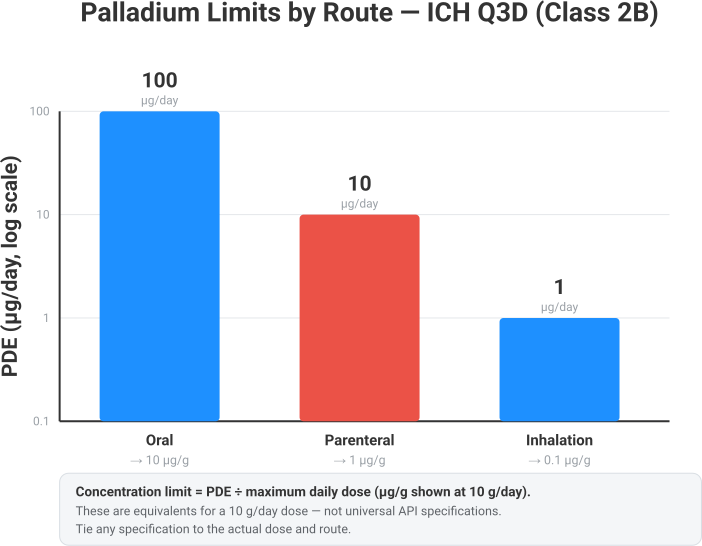
Palladium left on the peptide is not cosmetic. It can sabotage the next coupling or the cyclisation for reasons that look like poor activation but are really residual metal, and for therapeutic work it must meet elemental-impurity limits. The reviewed peptide sources support three tiers of control. The lightest is solvent washing alone for exploratory work. The intermediate is a dedicated on-resin scavenging wash — classically sodium diethyldithiocarbamate in DMF, and also thiourea. The highest is full process-level management with post-cleavage capture and elemental analysis for routes heading toward regulated manufacture. The right tier depends on whether the chemistry is exploratory, medicinal, or therapeutic, and the metal-control question is developed in full in the companion guide to residual palladium removal in peptides.
Analytical Confirmation and Mass Shifts
Test cleavage followed by LC-MS or UPLC-MS is the most defensible checkpoint, because it interrogates the real peptide rather than the appearance of a free amine on resin. On-resin colour tests — Kaiser or trinitrobenzenesulfonic acid for a primary amine exposed by Alloc removal, chloranil for a secondary amine — are useful quick reads but secondary to the mass evidence. The mass shifts are diagnostic and small enough to resolve on a good instrument.
| Transformation | Δm (monoisotopic) | Interpretation and trap |
|---|---|---|
| Alloc amine → free amine | −84.0211 Da (−C₄H₄O₂) | A residual +84 Da versus the target means unresolved Alloc. |
| Allyl ester → free acid | −40.0313 Da (−C₃H₄) | A residual +40 Da means unresolved allyl ester. |
| Deprotected precursor → lactam | −18.0106 Da (−H₂O) | Water loss is consistent with lactam closure after dual deprotection. |
| N-allylation of a freed amine | +40.0313 Da (+C₃H₄) | Same nominal shift as an unremoved allyl ester — resolve by which group was protected. |
| Allyl over-reduced to propyl | +2.0156 Da (+H₂) | Diimide from a hydrazine step reduces allyl to a Pd-inert propyl group. This is +2.0156 Da versus the protected precursor, but far heavier versus the intended product (+86.0368 Da for Alloc, +42.0470 Da for the ester). Add allyl alcohol to prevent. |
Reading Alloc Deprotection Mass Shifts
The interpretation trap is the two species that share +40 Da. An unremoved allyl ester and an N-allylated amine differ by 40.0313 Da from the target in the same direction, so the mass alone cannot tell them apart. Intact Alloc, intact allyl ester, and N-allylated by-products are usually less polar than the target and tend to elute later in acidic reversed-phase LC, though retention is sequence-dependent and cyclisation can shift it in either direction. Resolve it by which functional group was under protection and whether the amine that should be free is reactive in a follow-on test. And when the crude mass is correct but the next step misbehaves, put residual palladium among the first things to check, ahead of a hidden protecting group.
The Chemist's Perspective
The thing that looks right and is not is a clean-looking resin after a single deprotection cycle. Alloc removal on a well-behaved Lys reads as done in one treatment, so it is tempting to skip the second cycle and the metal wash. On an aggregated or sulfur-adjacent sequence that shortcut is where the run quietly fails. The deprotection is only partly complete, the unremoved fraction carries through as a +84 Da shoulder, and the on-resin coupling that follows is dragged down by palladium the wash never removed. Two short treatments with fresh reagent, a real metal-scavenging wash, and a test cleavage before the next coupling cost an hour and save a resynthesis.
The second bench reality is that the deprotection and the cyclisation are separate battles. A free amine and a free acid sitting on the same bead do not guarantee a ring — they guarantee the possibility of one. Ring geometry, resin loading, and how long the deprotected chain sits before activation all decide the outcome, and a linear precursor peak in the crude is the signal to optimise the closure, not to run the deprotection again. Treat "is it deprotected?" and "did it cyclise?" as two questions with two answers.
Alloc Deprotection — FAQ
Removing an Alloc carbamate lightens the peptide by 84.0211 Da (loss of C₄H₄O₂). If a test-cleavage LC-MS still shows a +84 Da species, the Alloc deprotection is incomplete — repeat with fresh Pd(PPh₃)₄ and phenylsilane.
An allyl ester loses only the allyl group, C₃H₄, for a change of 40.0313 Da, because there is no carbamate to decarboxylate. Alloc loses the whole allyloxycarbonyl unit at 84.0211 Da. They are separate bench events despite sharing the mechanism.
Maintain a strong allyl sink and use fresh catalyst. For secondary amines or repeat offenders, screen dimethylamine–borane or a soft carbon scavenger such as Meldrum's acid instead of adding more phenylsilane; both suppress the +40.0313 Da allylated by-product.
Yes, but hydrazine used for Dde removal can degrade Alloc and allyl. Add allyl alcohol as a sacrificial alkene so diimide reduces it rather than the Alloc double bond, which otherwise gives an inert propyl species (+2.0156 Da) that palladium cannot cleave.
Microwave methods cut room-temperature cycles of tens of minutes to about 5 minutes per treatment at 40 °C. The reported benefit is operational speed; the study shows acceleration but does not prove a purely thermal cause. Success tracks temperature control, not power.
Not reliably. Free Cys and Sec thiols and selenols, and the Met thioether, can coordinate palladium and stall removal. Keep Cys in a palladium-stable group such as trityl, degas solvents, and consider a metal-free route where sulfur density is high. Watch Met oxidation separately as +15.9949 Da.
References
Foundational allyl and Alloc chemistry
Dangles, O., Guibé, F., Balavoine, G., Lavielle, S., & Marquet, A. (1987). Selective cleavage of the allyl and (allyloxy)carbonyl groups through palladium-catalyzed hydrostannolysis with tributyltin hydride. Application to the selective protection-deprotection of amino acid derivatives and in peptide synthesis. The Journal of Organic Chemistry, 52(22), 4984–4993.
- Foundational palladium-mediated allyl and Alloc cleavage chemistry on amino-acid and peptide substrates.
- DOI: 10.1021/jo00231a027
Loffet, A., & Zhang, H. X. (1993). Allyl-based groups for side-chain protection of amino-acids. International Journal of Peptide and Protein Research, 42(4), 346–351.
- Early peptide-specific establishment of allyl and Alloc side-chain protection in both Boc and Fmoc amino-acid series.
- DOI: 10.1111/j.1399-3011.1993.tb00504.x
Peptide protocols and cyclisation
Kates, S. A., Daniels, S. B., & Albericio, F. (1993). Automated allyl cleavage for continuous-flow synthesis of cyclic and branched peptides. Analytical Biochemistry, 212(2), 303–310.
- Seminal automated allyl/Alloc deprotection protocol with the dithiocarbamate metal wash.
- DOI: 10.1006/abio.1993.1334
Thieriet, N., Alsina, J., Giralt, E., Guibé, F., & Albericio, F. (1997). Use of Alloc-amino acids in solid-phase peptide synthesis. Tandem deprotection-coupling reactions using neutral conditions. Tetrahedron Letters, 38(41), 7275–7278.
- Key Nα-Alloc paper for neutral tandem deprotection–coupling and diketopiperazine suppression.
- DOI: 10.1016/S0040-4039(97)01690-0
Gomez-Martinez, P., Dessolin, M., Guibé, F., & Albericio, F. (1999). Nα-Alloc temporary protection in solid-phase peptide synthesis. The use of amine–borane complexes as allyl group scavengers. Journal of the Chemical Society, Perkin Transactions 1, 1999(20), 2871–2874.
- Establishes amine–borane scavengers for faster Alloc removal and suppressed allyl side products.
- DOI: 10.1039/a906025a
Grieco, P., Gitu, P. M., & Hruby, V. J. (2001). Preparation of 'side-chain-to-side-chain' cyclic peptides by Allyl and Alloc strategy: potential for library synthesis. The Journal of Peptide Research, 57(3), 250–256.
- Clear peptide demonstration of Alloc/OAll pairing for on-resin cyclisation.
- DOI: 10.1111/j.1399-3011.2001.00816.x
Trzeciak, A., & Bannwarth, W. (1992). Synthesis of 'head-to-tail' cyclized peptides on solid support by Fmoc chemistry. Tetrahedron Letters, 33(32), 4557–4560.
- Side-chain resin attachment with an allyl-protected α-carboxyl for on-resin head-to-tail closure.
- DOI: 10.1016/S0040-4039(00)61311-4
Rohwedder, B., Mutti, Y., Dumy, P., & Mutter, M. (1998). Hydrazinolysis of Dde: complete orthogonality with Aloc protecting groups. Tetrahedron Letters, 39(10), 1175–1178.
- Experimental basis for the hydrazine–Alloc incompatibility and its suppression with allyl alcohol.
- DOI: 10.1016/S0040-4039(97)10810-3
Modern acceleration and greener routes
Wilson, K. R., Sedberry, S., Pescatore, R., Vinton, D., Love, B., Ballard, S., Wham, B. C., Hutchison, S. K., & Williamson, E. J. (2016). Microwave-assisted cleavage of Alloc and Allyl Ester protecting groups in solid phase peptide synthesis. Journal of Peptide Science, 22(10), 622–627.
- Primary source for microwave acceleration of Alloc and allyl ester removal in SPPS.
- DOI: 10.1002/psc.2910
Napier, P., Bakas, N., Bhat, A., & Noncovich, A. (2025). Open-Flask Protocol for the Removal of Alloc Carbamate and Allyl Ester Protecting Groups. Application to In-solution and On-resin Peptide Synthesis. The Journal of Organic Chemistry, 90(1), 197–201.
- Air-stable Pd(PPh₃)₂Cl₂ / Meldrum's acid / triethylsilane open-flask method that suppresses N-allylation.
- DOI: 10.1021/acs.joc.4c02115
Pawlas, J., & Lindgren, A. (2025). Expanding the Reach of Sustainable Solid-Phase Peptide Synthesis: One-Pot, Metal-Free Alloc Removal–Peptide Coupling. Organic Letters, 27(12), 2891–2896.
- Metal-free on-resin Alloc removal with iodine/water in greener solvents, one-pot with coupling, scaled to ten grams.
- DOI: 10.1021/acs.orglett.5c00423
Kondasinghe, T. D., Saraha, H. Y., Odeesho, S. B., & Stockdill, J. L. (2017). Direct palladium-mediated on-resin disulfide formation from Allocam protected peptides. Organic & Biomolecular Chemistry, 15(14), 2914–2918.
- Uses palladium thiophilicity constructively to build disulfides on resin without S-allylated by-products.
- DOI: 10.1039/c7ob00536a
Aguilera, M. C., Crossley, S. W. M., Sifri, R. J., Ruhl, K. E., Ruccolo, S., Qin, Y., Armstrong, B. M., & Ad, O. (2026). Nickel-catalyzed deallylation for sustainable solution and solid-phase peptide synthesis. Organic Letters, 28(9), 2965–2970.
- Air-stable Ni(PPh₃)₂Br₂ / ammonia–borane deallylation of allyl and Alloc groups in solution and on resin.
- DOI: 10.1021/acs.orglett.6c00213