Guanidinylation in peptide synthesis is the side reaction in which a free amine — usually the N-terminal α-amine of the growing chain — attacks the electrophilic carbon of a uronium, aminium, or carbenium coupling reagent instead of the intended active ester, capping the amine as a stable guanidinium and stopping elongation. It is the defining liability of the HATU, HBTU, and HCTU family, and it produces one of the more confusing peaks a chemist meets on a crude trace: a product that looks near-target but cannot elongate.
Although routinely overlooked, the reaction has been recognized since 1994, when Story and Aldrich found an HBTU-mediated cyclization failing and delivering tetramethylguanidinium-capped peptides instead of the ring. The same electrophilic carbon that makes these reagents fast lets them transfer the uronium or carbenium fragment to any exposed nucleophile — the N-terminus, and the side chains of Tyr, Lys, and Cys. This article covers the mechanism, the exact mass signatures, the conditions that promote it, and how to suppress it.
For the coupling cycle these reagents belong to, see Peptide Coupling Reactions.
Audit Your Sequence with Peptalyzer™
Peptalyzer™ flags guanidine-formation risk and other coupling liabilities before synthesis through its Sequence Auditor.
📘 What will you learn here?
The Mechanism at the Carbon Center
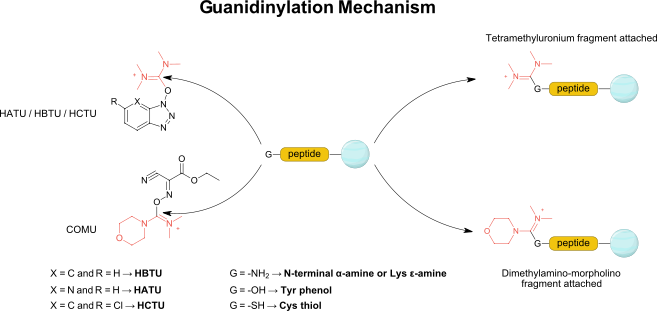
Uronium and aminium reagents such as HATU and HBTU carry an electrophilic central carbon — the same carbon that, in normal coupling, is attacked by the carboxylate to form the O-acyl(iso)uronium intermediate and then the active ester. Guanidinylation is the competing pathway: a free amine reaches that carbon first.
When the carboxylate is slow to form or is absent, the α-amino group of the resin-bound peptide adds to the central carbon and displaces the benzotriazole. The tetramethyl reagents leave a tetramethylguanidinium group on the amine; COMU, a carbenium reagent, leaves a dimethylamino-morpholino guanidinium. Either way the amine is converted to a stable, positively charged guanidine that cannot be acylated. The chain is terminated.
The distinction that matters at the bench is structural. Phosphonium reagents such as PyBOP carry a phosphorus center rather than an electrophilic carbon; they cannot form a guanidinium cap and can be used in excess without this risk. Uronium, aminium, and carbenium reagents cannot. That single difference drives most of the prevention advice below.
Which Reagent Classes Cause It
Guanidinylation follows the reagent’s structure, not its speed: a preformed electrophilic carbon is what caps the amine, and reagents without one cannot do it. This sorts the common reagents into two groups rather than a graded scale.
| Reagent class (examples) | Electrophilic carbon? | Guanidinylation |
|---|---|---|
| Uronium / aminium / carbenium (HATU, HBTU, HCTU, COMU) | Yes | Susceptible |
| Phosphonium (PyBOP, PyAOP) | No — phosphorus center | Not susceptible |
| Carbodiimide + additive (DIC/OxymaPure) | No — no preformed onium carbon | Not susceptible |
COMU is not an exception within its class: its carbenium carbon caps the amine by the same route, and the guanidinylated peptide becomes the major product in slow cyclizations.
Where It Strikes: The N-Terminus and Side Chains
The N-terminal α-amine is the primary target, and capping it is a chain-termination event rather than a recoverable impurity. This is why guanidinylation is most damaging in the settings where the amine sits exposed while activation lags: slow couplings, on-resin cyclizations, and fragment condensations.
Nucleophilic side chains are also vulnerable in solution-phase work, where protection is often incomplete. Vrettos and colleagues, building peptide-drug conjugates, found HATU installing a uronium moiety on the phenol of Tyr and a guanidinium on the ε-amine of Lys, with the Cys thiol similarly reactive. In their model peptide the Tyr modification was reproducible enough to undermine the synthesis. The practical reading is that any free phenol, primary amine, or thiol in a solution-phase coupling is a candidate for capping when uronium reagent is in excess. A sequence carrying several unprotected lysines can then show a ladder of singly and multiply capped species, each rung adding another +98 Da — a pattern worth expecting when reading the LC-MS.
Analytical Signatures of Guanidinylation in Peptide Synthesis
The value of recognizing guanidinylation is that its mass signatures are specific. A capped chain is not a random degradation product; it is a defined adduct with a predictable shift, and knowing the number turns an unexplained peak into a diagnosis. Each of these shifts is catalogued in the Peptide Mass Shift Index.
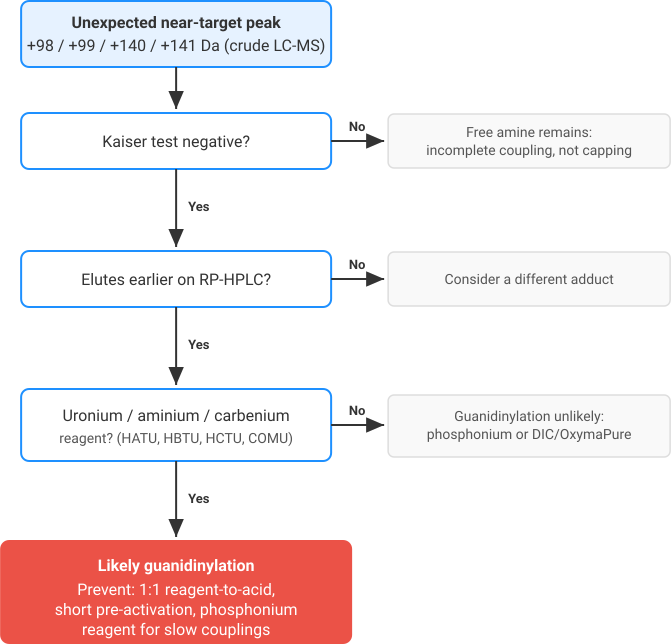
The tetramethyl reagents — HATU, HBTU, and HCTU — add +98 Da when the nucleophile is nitrogen (the N-terminus or a Lys ε-amine, giving a guanidinium) and +99 Da when it is oxygen or sulfur (a Tyr phenol or Cys thiol, giving an isouronium or thiouronium). COMU installs the same adduct with a morpholine ring in place of one dimethylamino group, so every shift is +42 Da larger — a +140 Da N-terminal cap. All of these adducts are polar and protonated under normal HPLC and MS conditions, so they carry a positive charge, elute earlier than the target on reversed-phase HPLC, and can be suppressed or masked in the ESI trace. A Kaiser test does not catch them: the capped amine is no longer free, so the resin reads negative as if the coupling had succeeded.
| Site (nucleophile) | Adduct | HATU / HBTU / HCTU | COMU |
|---|---|---|---|
| N-terminal α-amine | Guanidinium — chain termination | +98 Da | +140 Da |
| Lys ε-amine | Guanidinium — per exposed Lys | +98 Da | +140 Da |
| Tyr phenol | Isouronium (O-linked) | +99 Da | +141 Da |
| Cys thiol | Thiouronium (S-linked, per Cys) | +99 Da | +141 Da |
Ser and Thr are not on this list: their aliphatic hydroxyls are weak nucleophiles here and are tBu-protected in Fmoc-SPPS, so no free hydroxyl is present during coupling. The COMU column is the dimethylamino-morpholino analog, +42 Da above the tetramethyl figure at each site.
Conditions That Promote It
Guanidinylation competes with acylation, so anything that slows the productive path or leaves reagent unconsumed shifts the balance toward capping. Three conditions dominate.
Excess reagent is the first. When the uronium reagent outstrips the carboxylate, unreacted reagent remains in solution with the free amine. Slow activation is the second, and it is why the reaction is a recurring problem in on-resin cyclization and fragment condensation, where the intramolecular or hindered coupling is intrinsically slow and the exposed amine has time to find the reagent. Story and Aldrich’s failed lactam cyclization is the textbook case. Long pre-activation is the third: holding the reagent and acid together before adding the amine gives the active ester time to hydrolyze, after which fresh reagent meets the amine directly.
Exposed nucleophiles compound all three. A free N-terminus during a stalled coupling, or an unprotected Tyr, Lys, or Cys in a solution-phase step, gives the electrophilic carbon a target.
Prevention and Mitigation
The controls follow directly from the mechanism. Keep the reagent from meeting a free amine while activation lags, and keep no reagent in excess.
Hold the coupling reagent to a 1:1 ratio with the acid, or a slight excess of acid, so the reagent is consumed forming the active ester. Keep pre-activation short — tens of seconds, not minutes. Pre-activate the acid and reagent before exposing the resin-bound amine, so the ester is already formed when the amine arrives. Wash the resin thoroughly after each coupling so residual reagent cannot cap the next deprotected amine. In Boc synthesis, in-situ neutralization couples and neutralizes simultaneously, which suppresses capping by not leaving the amine free in the presence of reagent; Hjørringgaard and colleagues evaluated COMU under exactly these conditions. Weaker, hindered bases such as 2,4,6-collidine slow base-driven side reactions relative to excess DIPEA.
For couplings that are unavoidably slow — head-to-tail cyclizations, fragment condensations, hindered junctions — switch reagent class. A phosphonium reagent has no electrophilic carbon to cap the N-terminus and can be used in the excess those reactions need.
The Chemist’s Perspective
The practical trap is that guanidinylation hides behind a good-looking coupling. The Kaiser test reads negative because the amine is no longer free — it is capped, not coupled — so on-resin monitoring gives the all-clear while the chain is already dead. The failure only surfaces at LC-MS, as a near-target peak shifted +98, +99, or +140 Da and eluting earlier than expected.
Two habits cause most of it. The first is reflexively loading extra reagent to force a hard coupling; with a uronium reagent, the excess is what caps the terminus. The second is treating a slow cyclization like a normal coupling. A slow intramolecular reaction with an exposed amine and excess uronium reagent is the exact recipe from the 1994 lactam study — the guanidinium product, not the ring, becomes the major species. When a coupling must be driven, drive it with a phosphonium reagent, not more uronium.
Guanidinylation in Peptide Synthesis — FAQ
A tetramethylguanidinium cap: a free amine attacked the HATU carbon instead of the active ester. On the N-terminus it terminates the chain; on Tyr (+99) or Lys (+98) it is a side-chain adduct. Keep HATU at 1:1 with the acid and pre-activate only briefly.
The slow intramolecular coupling lets the free amine react with excess uronium reagent, capping it as a guanidinium — the failure Story and Aldrich reported in 1994. Switch to a phosphonium reagent, which cannot cap the terminus and tolerates the excess cyclization needs.
No. Carbodiimide plus OxymaPure has no preformed electrophilic uronium carbon, so it does not cap the N-terminus. Guanidinylation is specific to uronium, aminium, and carbenium reagents such as HATU, HBTU, and COMU.
No. The capped amine is no longer free, so the Kaiser test reads negative as if coupling succeeded. Confirm by LC-MS: look for a near-target mass shifted +98/+99 Da (or +140 Da for COMU) eluting earlier on reversed phase.
Use a 1:1 reagent-to-acid ratio, pre-activate for only 20–30 seconds, pre-form the active ester before adding the amine, and prefer a hindered base such as 2,4,6-collidine. In Boc synthesis, in-situ neutralization suppresses it.
References
Story, S. C., & Aldrich, J. V. (1994). Side-product formation during cyclization with HBTU on a solid support. International Journal of Peptide and Protein Research, 43(3), 292–296.
- The foundational report: an HBTU cyclization failed and gave tetramethylguanidinium-capped peptides via transfer of the tetramethyluronium moiety to a side-chain amine, limiting HBTU for lactam formation.
- DOI: 10.1111/j.1399-3011.1994.tb00393.x
Vrettos, E. I., Sayyad, N., Mavrogiannaki, E. M., Stylos, E., Kostagianni, A. D., Papas, S., Mavromoustakos, T., Theodorou, V., & Tzakos, A. G. (2017). Unveiling and tackling guanidinium peptide coupling reagent side reactions towards the development of peptide-drug conjugates. RSC Advances, 7(80), 50519–50526.
- Identifies uronium/guanidinium capping of Tyr (+99 Da), Lys (+98 Da), and Cys in solution-phase conjugate synthesis, with a proposed mechanism and conditions to avoid it.
- DOI: 10.1039/C7RA06655D
El-Faham, A., & Albericio, F. (2011). Peptide coupling reagents, more than a letter soup. Chemical Reviews, 111(11), 6557–6602.
- Comprehensive framework for uronium, aminium, phosphonium, and carbodiimide reagents and their side reactions, including guanidinylation and the O/N-form question.
- DOI: 10.1021/cr100048w
El-Faham, A., & Albericio, F. (2010). COMU: A third generation of uronium-type coupling reagents. Journal of Peptide Science, 16(1), 6–9.
- Lists the overactivation side reactions of uronium coupling, including guanidinylation, and the role of minimal pre-activation in avoiding them.
- DOI: 10.1002/psc.1204
Hjørringgaard, C. U., Brust, A., & Alewood, P. F. (2012). Evaluation of COMU as a coupling reagent for in situ neutralization Boc solid phase peptide synthesis. Journal of Peptide Science, 18(3), 199–207.
- Tests COMU against HBTU and HCTU under in-situ-neutralization Boc conditions on difficult sequences, the context in which guanidinylation of the free terminus is suppressed.
- DOI: 10.1002/psc.1438