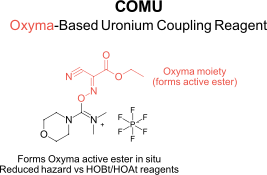
COMU peptide coupling uses a standalone Oxyma-based carbenium reagent — (1-cyano-2-ethoxy-2-oxoethylidenaminooxy)dimethylamino-morpholino-carbenium hexafluorophosphate — to activate a protected carboxylic acid and form the amide bond through an Oxyma active ester. It was introduced as a safer, more soluble alternative to benzotriazole-based uronium reagents, delivering fast activation at low base loading while avoiding the explosive-additive hazard of dry HOBt and HOAt.
COMU belongs to the same uronium/aminium family as HATU and HBTU, but it replaces the benzotriazole leaving group with the Oxyma anion and swaps one dimethylamino group of the symmetric tetramethyl reagents for a morpholine ring. That single structural change drives most of what distinguishes COMU at the bench: high solubility, activation at one equivalent of base, water-soluble by-products, and a decomposition profile that is milder — though not inert — relative to benzotriazole uronium salts.
This article covers the activation mechanism and its correct intermediate, the kinetics relative to HATU and HBTU, and the solvent-stability problem that reshaped how COMU is used on automated platforms. It then covers the guanidinylation and side-chain modifications with their mass-spectrometric signatures, the process-safety picture, and the decision logic for when COMU earns its place over cheaper alternatives.
For background on the coupling cycle and reagent classes, see Peptide Coupling Reactions.
Check Coupling Difficulty with Peptalyzer™
Use Peptalyzer™ to flag aggregation-prone regions, β-branched hotspots, and racemization-sensitive positions before committing to a reagent.
📘 What will you learn here?
Why COMU Was Designed: Oxyma on a Morpholino Carbenium
COMU was introduced in 2009 by El-Faham, Subirós-Funosas, Prohens, and Albericio as a replacement for benzotriazole-based uronium reagents. Its design converges two earlier lines of work from the same group. The first showed that Oxyma (ethyl 2-cyano-2-hydroxyiminoacetate) could stand in for HOBt and HOAt with a lower explosion risk. The second found that morpholine-containing uronium skeletons handle differently from their symmetric tetramethyl analogues.
Structurally, COMU carries an asymmetric carbenium carbon flanked by a dimethylamino group and a morpholine ring, with the Oxyma oximate bound through oxygen. The morpholine ring does two jobs. Its oxygen raises the polarity of the cation, which lifts solubility in DMF and NMP to roughly 1.5 M — against 0.43 M for HATU and 0.46 M for HBTU measured under the same conditions. Concentrated stocks reduce solvent volume and help push hindered couplings. The morpholine, liberated during activation, is also believed to contribute to proton transfer, which is why COMU activates efficiently at 1 equivalent of base where symmetric uronium reagents typically need 2.
Carbon-13 NMR indicates COMU exists predominantly in the reactive O-carbenium (uronium-like) form rather than the less reactive guanidinium N-form that older symmetric reagents can populate. This is the same O-form/N-form distinction that governs HATU and HBTU reactivity: the bottle holds the stable form, and the coupling relies on the reactive one.
The COMU Peptide Coupling Mechanism
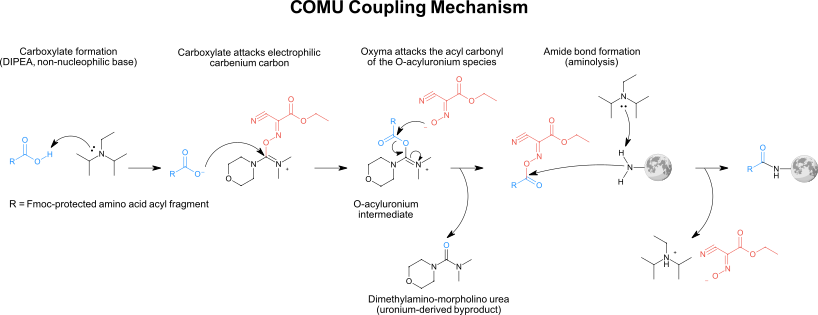
COMU activates a carboxylic acid through a uronium pathway, not the O-acylurea route of a carbodiimide. Confusing the two is a common error, and it changes which intermediate the chemist is trying to control.
A hindered tertiary base — DIPEA or 2,4,6-collidine — first deprotonates the Fmoc-amino acid to give the carboxylate. The carboxylate oxygen then attacks the electrophilic carbenium carbon of COMU. This displaces the Oxyma oximate and forms an O-acyluronium intermediate, in which the acyl group is bound through oxygen to the dimethylamino-morpholino carbon. The accepted model is that the released Oxyma anion then attacks the acyl carbonyl of this O-acyluronium species, transferring the acyl group to Oxyma. That step delivers the reactive Oxyma active ester and releases a neutral dimethylamino-morpholino urea by-product.
The Oxyma active ester is the species that acylates the amine. The α-amino group of the resin-bound peptide attacks its carbonyl, forms the peptide bond, and regenerates free Oxyma, which washes away in the following solvent cycles. The morpholine oxygen is proposed to assist proton transfer during activation, consistent with efficient coupling at one equivalent of base.
The practical consequence is that activation is near-instantaneous for ordinary residues. Extended pre-activation rarely helps and costs stereochemical integrity: it gives more time for oxazolone formation and racemization, for hydrolysis of the active ester, and for the free amine to meet unreacted reagent. El-Faham and Albericio’s 2010 protocol study reported that O→N acyl transfer was not detected for COMU, removing one loss channel that troubles some active esters. Keep pre-activation short and the mechanism works for you rather than against you.
Kinetics and Reactivity: COMU vs HATU and HBTU
Leaving-Group Acidity and What it Predicts
The reactivity of an Oxyma or benzotriazole active ester tracks with the leaving-group pKa: a more acidic leaving group gives a more electrophilic ester. Oxyma and HOBt share essentially the same pKa (both near 4.6), while HOAt is more acidic at 3.28 and 6-Cl-HOBt sits at 3.35. On pKa alone, an Oxyma ester and an OBt ester should be similar, and both less activated than an OAt ester. This is worth stating plainly because it tempers the claim that COMU is categorically faster than an HOAt reagent — the leaving-group argument does not support that.
| Additive | pKa | Reactivity note |
|---|---|---|
| Oxyma | 4.60 | COMU leaving group; similar acidity to HOBt, so ester electrophilicity is comparable to an OBt ester |
| HOBt | 4.60 | OBt ester; benchmark for a moderately activated ester |
| 6-Cl-HOBt | 3.35 | More activated than HOBt; leaving group of HCTU and PyClock |
| HOAt | 3.28 | OAt ester; more electrophilic, plus a neighboring-group effect at the 7-N; leaving group of HATU |
COMU Peptide Coupling Kinetics vs HATU and HBTU
What COMU does bring is a different reagent platform. In the 2009 timed model couplings, COMU outpaced HATU and HBTU early in the reaction for both standard and hindered substrates, and its high solubility let chemists run more concentrated, faster bimolecular couplings. For an Aib-rich pentapeptide, COMU gave cleaner conversion than HATU or HBTU under matched conditions. But the same study also found a hard limit: for a difficult N-methyl-leucine sequence, an HOAt-derived reagent outperformed COMU, and COMU’s result depended on solvent quality.
The field has not resolved the Oxyma-versus-HOAt reactivity question. Originator reports favour Oxyma-based reagents; some later industrial testing favours HOAt reagents; the honest reading is that the ranking is substrate-dependent. COMU is often competitive with or better than HATU, especially when base and solvent are optimised. But it is not a universal winner, and the evidence for Oxyma esters being intrinsically more reactive than HOAt esters is mixed.
The DMF Stability Problem in COMU Peptide Coupling
The defining operational weakness of COMU is its instability in DMF. The carbenium carbon is highly electrophilic, and it is attacked by dimethylamine liberated from the slow decomposition of DMF. On an automated synthesizer, where reagent stocks may sit in reservoirs for a day or more, this matters.
The 2009 paper reported good apparent stability of COMU in DMF, and that impression persisted for a few years. Later work corrected it. Subirós-Funosas and colleagues flagged in 2013 that COMU is stable in DMF only for a few hours. Kumar and colleagues then quantified it in 2017: after 24 hours, roughly 14% of COMU remained in DMF, against about 89% in acetonitrile and 88% in γ-valerolactone (GVL). This is one of the clearest cases in the coupling literature where the practical message of the first paper was reversed by follow-up work.
The bench rule that follows is direct. Do not rely on a day-old COMU stock in DMF. Prepare COMU solutions fresh, or dissolve COMU in acetonitrile or GVL for automated runs while keeping the Fmoc-amino acids in DMF. GVL also swells polystyrene and PEG resins well, which supports diffusion during chain elongation. Difficult targets, including the ACP(65–74) and JR decapeptides, have been assembled with COMU dissolved in acetonitrile or GVL under exactly this hybrid strategy.
| Solvent | ~1 h | 24 h |
|---|---|---|
| DMF | ~79% | ~14% |
| Acetonitrile | ~100% | ~89% |
| γ-valerolactone (GVL) | ~100% | ~88% |
Side Reactions: Guanidinylation
COMU’s electrophilic carbenium carbon can cap the N-terminal amine as a stable dimethylamino-morpholino guanidinium when activation is slow or reagent is in excess — a chain-termination event that can also modify exposed Tyr and Cys side chains in solution-phase work. The mass signature is a +140 Da shift, distinct from the +98 Da tetramethyl cap of HATU and HBTU, and the capped species is polar, elutes earlier on reversed-phase HPLC, and reads Kaiser-negative. Suppress it by holding COMU to a 1:1 ratio with the acid, keeping pre-activation to 20–30 seconds, and using a hindered base such as 2,4,6-collidine; for slow cyclizations and fragment couplings, switch to a phosphonium reagent that cannot cap the terminus. See the dedicated article on guanidinylation in peptide synthesis for the full mechanism, the mass-shift table across reagents, and prevention.
Process Safety and Thermal Behavior
Thermal Decomposition and Shock Sensitivity
COMU is described as safer than benzotriazole-based uronium reagents, and the claim is specific rather than general. The 2009 calorimetry showed that COMU decomposes without the autocatalytic, steeply initiating profile of the morpholino benzotriazole uroniums HDMA and HDMB, and with a lower total exotherm. In drop-hammer testing, COMU shows no impact or shock sensitivity, whereas HATU can detonate under mechanical impact. That is the substance of the safety advantage: more predictable decomposition and no shock sensitivity.
The numbers make the point precisely. Open-crucible DSC in the 2009 work placed COMU’s decomposition onset near 160 °C. A later Pfizer survey of 45 coupling reagents, reading left-limit DSC onsets, put COMU lower — an onset near 127 °C with a total exothermic energy around 736 J/g. That gap is a method effect: an unsealed pan lets the sample volatilize and endothermically absorb heat, which pushes the apparent onset higher.
Onset Temperature and the Crucible Effect
So COMU’s onset is not high; on onset temperature alone it sits among the lower-onset reagents in that survey. What sets it apart is the rest of the profile. Its total decomposition energy is well below HATU (around 1131 J/g) and HBTU (around 1032 J/g), and its Yoshida screen flagged it as neither shock-sensitive nor explosive. HATU, HBTU, and the morpholino benzotriazole uronium HDMA each flagged as one or both. The correct reading is that COMU is milder and more predictable than benzotriazole uroniums, not thermally inert. On scale it remains an energetic reagent that requires a formal thermal-hazard assessment, temperature control, and storage discipline.
Peptide coupling reagents are energetic materials. COMU is milder than benzotriazole uronium salts, but it still decomposes exothermically and requires process-safety review before scale-up. Do not grind, heat, or subject bulk quantities to impact without a documented thermal-hazard assessment. Store cold and dry.
Avoiding the DIC/Oxyma HCN Pathway
One further safety point favors COMU as a standalone reagent. The widely used DIC/OxymaPure system can release hydrogen cyanide when free carbodiimide reacts with free Oxyma, a hazard that worsens at elevated temperature and long activation. Because COMU already carries the Oxyma group bound to its carbenium, there is no free carbodiimide plus free Oxyma reaction, and this HCN pathway does not operate. That does not make COMU benign to handle: an occupational-hazard survey found most peptide couplers, COMU included, act as skin sensitizers, so gloves, eye protection, and ventilation remain necessary.
When to Choose COMU: Selection Logic
COMU is a problem-solving reagent more than a default. Its cost sits above carbodiimide systems, and for routine automated SPPS on DMF stock solutions its instability is a real drawback. Reach for it when coupling difficulty or epimerization risk justifies the switch.
The strongest cases are racemization-prone residues such as phenylglycine, α,α-dialkyl and Aib-rich segments, fragment couplings, and microwave-assisted SPPS, particularly where low-base conditions help stereochemical control. In racemization-sensitive coupling, COMU paired with a weaker, hindered base — 2,4,6-collidine or 2,4,6-trimethylpyridine — consistently outperforms COMU with excess DIPEA. For microwave work, NMP is preferred over DMF to avoid formylation of the amine.
Know when to switch away from COMU. For sluggish couplings where reagent excess is unavoidable, a phosphonium reagent avoids the guanidinylation risk. For long automated campaigns on DMF stocks, DIC/OxymaPure remains the economical workhorse despite its own HCN caveat. And where an HOAt reagent has historically solved a specific hard sequence, the substrate-dependent reactivity ranking means COMU is not guaranteed to match it.
| Situation | Reagent | Reason |
|---|---|---|
| Racemization-sensitive residue (Phg, His, Cys) | COMU + collidine/TMP | Low-base activation with tighter stereochemical control than excess DIPEA |
| Aib-rich or microwave SPPS | COMU in NMP | Fast activation, high solubility; NMP avoids formylation under microwave |
| Slow coupling needing reagent excess (cyclization, fragment) | PyOxim / PyBOP | No electrophilic carbon, so no N-terminal guanidinylation |
| Long automated DMF-stock campaign | DIC/OxymaPure | Economical and stable in DMF; manage HCN risk separately |
| Automated run where COMU is required | COMU in ACN or GVL | Stable stock solution; keep amino acids in DMF |
Practical COMU Peptide Coupling Protocols
The following conditions reflect the published procedures and the stability data above.
For solution-phase coupling, use 1 equivalent of Fmoc-amino acid, 1 equivalent of amine, 1 equivalent of COMU, and 2 equivalents of base in DMF. Add COMU at 0 °C, hold at 0 °C for about 1 hour, then warm to room temperature. Keeping COMU to a 1:1 ratio with the acid suppresses guanidinylation.
For SPPS, use 3 equivalents of Fmoc-amino acid, 3 equivalents of COMU, and 6 equivalents of base. Pre-activate for 20–60 seconds only, then couple for 10–30 minutes at room temperature; extend to 1 hour or use a double coupling for hindered residues. Choose the base for the job: 2,4,6-collidine or 2,4,6-trimethylpyridine where racemization is the concern, DIPEA where speed dominates and the position is not sensitive. Untreated DIPEA of poor quality degrades stereochemical outcomes, so base quality is not a trivial variable.
On solvent, prepare COMU fresh in DMF for same-session manual work. For automated or multi-hour runs, dissolve COMU in acetonitrile or GVL and hold the amino acids in DMF. For microwave SPPS, use NMP rather than DMF. Store solid COMU cold and dry at 2–8 °C under an inert, anhydrous atmosphere.
How Peptalyzer™ Flags Sequences That Need Stronger Activation
The decision to move from a carbodiimide default to a standalone reagent like COMU is usually driven by sequence difficulty — aggregation and steric compression that stall coupling regardless of how much reagent is added. Peptalyzer™ estimates this before synthesis through its SPPS Difficulty Profile.
The SPPS Difficulty Profile combines a Raw Aggregation Potential, computed as a local β-sheet propensity across a sliding residue window, with a Composite Risk that carries mass-weighted burden, a hydropathy proxy, aromatic burden, bulky-on-bulky steric penalties, and Proline-style rescue logic. Consecutive bulky hydrophobic residues — runs of Val, Ile, Thr, Trp, Phe, or Tyr — drive the profile into its high-risk zone, where standard carbodiimide activation is most likely to fail and a stronger, standalone reagent is worth considering. The empirical constants in this model — the diffusion threshold, hydrophobicity scaling, and rescue window — are modelled parameters chosen to reproduce known difficult sequences, not universally derived physical constants.
The SPPS Difficulty Profile is a statistical estimate derived from amino acid sequence and composition. It predicts aggregation and coupling difficulty based on residue propensities and modelled steric and hydropathy terms, not from direct measurement of this peptide. Values should be interpreted as probability signals, not chemical guarantees. Experimental validation is required for any synthesis or reagent-selection decision.
The Chemist’s Perspective
Two COMU habits cause most of the avoidable trouble, and both look reasonable at the bench.
The first is trusting a stock solution. A COMU-in-DMF bottle made yesterday looks unchanged, but roughly seven-eighths of the reagent is gone after 24 hours. Couplings early in an automated run pass; later ones truncate, and the pattern reads like instrument failure or a hard sequence when the real cause is a dead reagent. Make COMU fresh, or move the stock to acetonitrile or GVL and keep the amino acids in DMF. A visibly darkened solution is already suspect.
The second is reflexively adding excess base. Loading 6 or more equivalents of DIPEA feels like insurance for a difficult coupling, but excess strong base accelerates the side reactions COMU is already prone to. It speeds oxazolone formation at sensitive centers, and by keeping the amine free and reactive while activation lags, it invites guanidinylation. The +140 Da cap that follows is not a low-yield coupling — it is a terminated chain. For Phg, His, Cys, and fragment junctions, a weaker hindered base and a 1:1 acid-to-COMU ratio protect more than extra base ever adds.
COMU Peptide Coupling — FAQ
COMU degrades in DMF — about 14% remains at 24 hours, versus 88–89% in acetonitrile or GVL, so late cycles draw on degraded stock. Prepare COMU fresh, or use an acetonitrile or GVL stock while keeping amino acids in DMF.
COMU activates at 1 equivalent of base because it releases morpholine. Use 2 equivalents in solution and up to 6 in SPPS where speed matters; for Phg, His, or Cys, switch to a weaker hindered base such as 2,4,6-collidine and avoid excess DIPEA.
N-terminal guanidinylation: the free amine attacks the COMU carbenium and forms a guanidinium cap that terminates the chain. At +140 Da it is distinct from the +98 Da tetramethyl cap of HATU and HBTU. Keep a 1:1 acid-to-COMU ratio and pre-activate only 20–30 seconds.
In one narrow sense: COMU releases less decomposition energy (about 736 J/g versus 1131 J/g for HATU) and flags as neither shock-sensitive nor explosive, where HATU flags both. But it is not inert — onset near 127 °C — and it is a skin sensitizer needing standard PPE.
No. COMU carries the Oxyma group and generates the Oxyma active ester directly, so no separate additive is needed — which also avoids the explosive-additive handling that anhydrous HOBt and HOAt require.
Choose COMU for racemization-sensitive residues, Aib-rich or fragment couplings, and microwave SPPS, especially at low base. DIC/OxymaPure stays the economical choice for routine automated SPPS on DMF stocks, though it carries the hydrogen-cyanide caveat COMU avoids.
References
Primary COMU Papers
El-Faham, A., Subirós-Funosas, R., Prohens, R., & Albericio, F. (2009). COMU: A safer and more effective replacement for benzotriazole-based uronium coupling reagents. Chemistry – A European Journal, 15(37), 9404–9416.
- The introduction of COMU; reports the structure, DMF solubility, timed and difficult model couplings, racemization data, and the differential scanning calorimetry that grounds the safety comparison.
- DOI: 10.1002/chem.200900615
El-Faham, A., & Albericio, F. (2010). COMU: A third generation of uronium-type coupling reagents. Journal of Peptide Science, 16(1), 6–9.
- Protocol-oriented account of COMU use in solution and solid phase; establishes minimal pre-activation, the water-soluble by-products, and that O→N acyl transfer was not detected.
- DOI: 10.1002/psc.1204
Subirós-Funosas, R., Nieto-Rodriguez, L., Jensen, K. J., & Albericio, F. (2013). COMU: scope and limitations of the latest innovation in peptide acyl transfer reagents. Journal of Peptide Science, 19(7), 408–414.
- Best-conditions study that first corrected the early impression of COMU’s DMF stability and defined where the reagent performs well.
- DOI: 10.1002/psc.2517
Kumar, A., Jad, Y. E., de la Torre, B. G., El-Faham, A., & Albericio, F. (2017). Re-evaluating the stability of COMU in different solvents. Journal of Peptide Science, 23(10), 763–768.
- Quantifies COMU stock-solution stability across solvents (about 14% in DMF versus 88–89% in GVL and acetonitrile at 24 hours) and demonstrates decapeptide synthesis using the hybrid solvent strategy.
- DOI: 10.1002/psc.3024
Oxyma and Mechanism
Subirós-Funosas, R., Prohens, R., Barbas, R., El-Faham, A., & Albericio, F. (2009). Oxyma: An efficient additive for peptide synthesis to replace the benzotriazole-based HOBt and HOAt with a lower risk of explosion. Chemistry – A European Journal, 15(37), 9394–9403.
- Establishes the Oxyma leaving group that COMU is built around, including its pKa and its lower explosion risk relative to benzotriazole additives.
- DOI: 10.1002/chem.200900614
El-Faham, A., & Albericio, F. (2011). Peptide coupling reagents, more than a letter soup. Chemical Reviews, 111(11), 6557–6602.
- Comprehensive framework for coupling reagents that places COMU among uronium, phosphonium, and carbodiimide systems and their side reactions.
- DOI: 10.1021/cr100048w
Process Safety and Toxicology
Sperry, J. B., Minteer, C. J., Tao, J., Johnson, R., Duzguner, R., Hawksworth, M., Oke, S., Richardson, P. F., Barnhart, R., Bill, D. R., Giusto, R. A., & Weaver, J. D. (2018). Thermal stability assessment of peptide coupling reagents commonly used in pharmaceutical manufacturing. Organic Process Research & Development, 22(9), 1262–1275.
- Sealed-crucible DSC and accelerating rate calorimetry across 45 coupling reagents; the basis for treating COMU as an energetic material requiring process-safety review.
- DOI: 10.1021/acs.oprd.8b00193
Graham, J. C., Trejo-Martin, A., Chilton, M. L., Kostal, J., Bercu, J., Beutner, G. L., Bruen, U. S., Dolan, D. G., Gomez, S., Hillegass, J., Nicolette, J., & Schmitz, M. (2022). An evaluation of the occupational health hazards of peptide couplers. Chemical Research in Toxicology, 35(6), 1011–1022.
- Occupational survey reporting that most tested peptide couplers, COMU included, are skin sensitizers, framing the handling caveat.
- DOI: 10.1021/acs.chemrestox.2c00031