What Is Diketopiperazine (DKP) Formation?
Diketopiperazine formation is one of the most well-known deletion side reactions in solid-phase peptide synthesis (SPPS). It most often results in the loss of the C-terminal amino acid during the Fmoc deprotection step but can also occur further down the peptide sequence, even in the solid or solution state of purified peptides. As a classic example, DKP-related degradation has been observed in storage of Substance P, demonstrating that this side reaction is not limited to the synthesis phase.
Predict Diketopiperazine Formation Risk with Peptalyzer™
Use Peptalyzer™ to map sequence-specific hotspots and identify diketopiperazine-prone regions before starting your synthesis.
📘 What will you learn here?
Mechanism of DKP Formation
Diketopiperazine Formation Under Basic Conditions
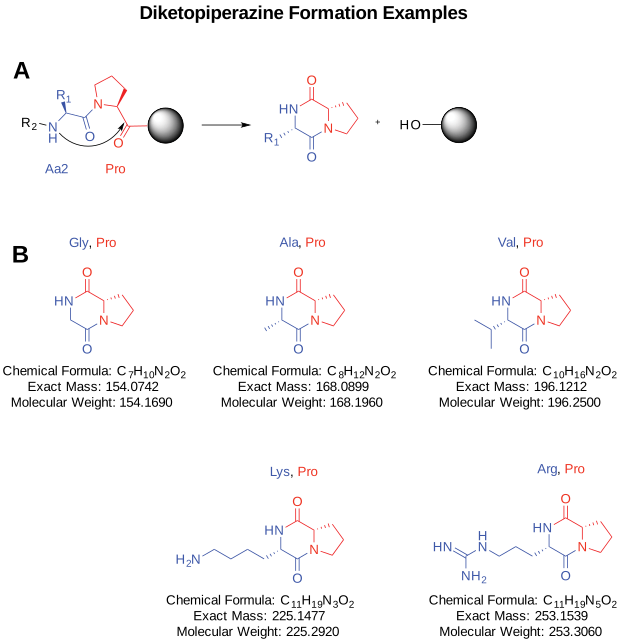
The classic mechanism involves the removal of the Fmoc group from amino acid 2 (Aa2), liberating a nucleophilic amine. This amine then attacks the ester bond between amino acid 1 (Aa1) and the resin or peptide chain. This intramolecular aminolysis leads to the formation of a six-membered DKP ring, truncating the growing chain.

Diketopiperazine Formation Under Acidic Conditions
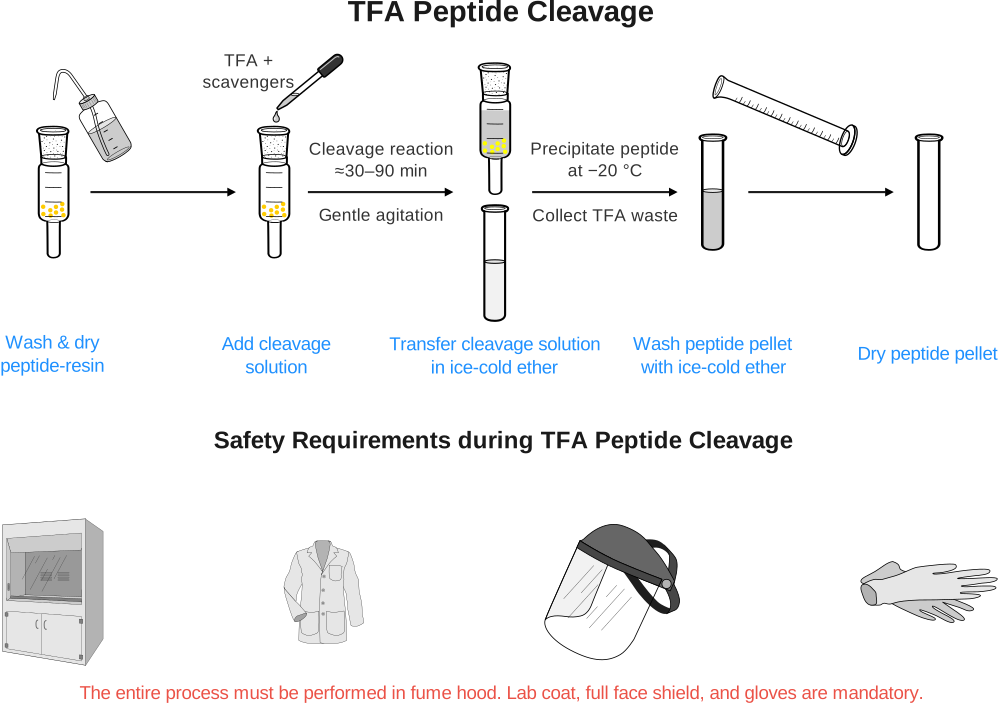
Less commonly, DKP formation can also occur during acidic cleavage, especially with carboxyl-catalyzed pathways on certain resin linkers.

Kinetics and Thermodynamics
Diketopiperazine formation is not a random occurrence; it is a chemically “driven” process. The reaction’s speed (kinetics) and its inherent likelihood (thermodynamics) are favored by the unique structural geometry of the dipeptide unit. Diketopiperazine formation is thermodynamically favorable, due to:
- Formation of a low-strain, stable six-membered ring: In organic chemistry, six-membered rings are exceptionally stable because they allow for nearly ideal bond angles, minimizing “ring strain”. The distance between the nucleophilic N-terminal amine and the carbonyl carbon of the first amino acid is perfectly suited to snap into this “sweet spot” of stability.
- Intramolecular cyclization (entropy-favored): Unlike a standard coupling reaction where two separate molecules must find each other in a large volume of solvent, DKP is an “internal” job. Because the reactive parts are already linked together on the same chain, the effective local concentration is extremely high, and the reaction does not require the loss of translational entropy associated with bringing two separate molecules together.
- No need for external catalysts in many cases: While basic conditions (like piperidine) accelerate the process by deprotonating the amine, the reaction can often proceed via an “autocatalytic” or uncatalyzed pathway. This is especially true in acidic conditions or during storage, where the proximity of the reactive groups allows the reaction to occur spontaneously without the need for an added reagent.
Temperature, solvent, and time are critical. High temperatures and long reaction or cleavage times increase the likelihood of DKP formation, particularly in polar aprotic solvents like DMF or NMP.
Factors That Promote DKP Formation
The propensity for a peptide to undergo diketopiperazine cyclization is determined by both its primary sequence and the environment in which it is synthesized. Understanding these variables is critical for identifying “Danger” zones in your synthesis plan before ever reaching the bench. Structural and chemical features promote this side reaction:
- C-terminal Proline or Glycine: Any dipeptide at the C-terminus containing Proline or Glycine is a prime candidate for cyclization. Proline is high-risk because its cyclic structure naturally promotes the cis-peptide bond configuration required for the six-membered DKP ring to close. Glycine is a risk because its lack of a side chain (R=H) removes the steric hindrance that would otherwise block the nucleophilic attack of the free amine on the resin ester linkage.
- N-methylated residues or backbone rigidification: N-methylation significantly lowers the energy barrier for cis-trans isomerization. Since DKP formation requires the peptide bond to adopt a “kinked” cis conformation, these residues dramatically accelerate cyclization compared to standard secondary amides.
- Alternating D- and L-amino acids: Sequences with alternating stereocenters (D,L or L,D) position their side chains in a way that minimizes steric clashing during ring closure. This spatial arrangement creates an entropy-favored environment for the six-membered DKP ring to form.
- Prolonged exposure to base or acid: DKP is an intramolecular aminolysis that competes with the desired coupling reaction. The longer the free N-terminal amine is exposed to basic deprotection conditions or acidic cleavage environments, the higher the probability of it attacking the resin-linker ester bond.
- Polar solvents or resin types that facilitate amine access: Polar aprotic solvents like DMF or NMP stabilize the transition state of the cyclization. “Amine access” refers to the lack of steric protection; standard ester linkers (like Wang resin) leave the carbonyl carbon vulnerable, whereas bulky resins like 2-CTC physically block the amine’s path.
Peptalyzer™ proactively scans for C-terminal Proline and Glycine motifs, identifying high-risk sequences where premature resin cleavage is likely. By predicting the specific DKP truncation shift, the tool allows you to select the appropriate 2-CTC resin or modified deprotection protocol before starting your synthesis .
Practical Impact on Solid Phase Peptide Synthesis
Diketopiperazine formation is not merely a theoretical side reaction; it results in significant material loss and analytical challenges:
- Truncated peptides: This is the hallmark of a DKP event. Because the first two amino acids are cleaved off as a cyclic dipeptide, the remaining sequence continues growing from the resin, resulting in a major impurity missing the mass of the initial dipeptide (typically -130 to -210 Da).
- Lower final yields: Since a portion of the starting material is physically detached from the solid support and washed away during filtration, the total amount of target peptide recovered is significantly reduced.
- Difficult purification due to closely related impurities: Truncated fragments often share similar hydrophobicity with the full-length peptide, leading to overlapping peaks on RP-HPLC. This makes achieving high purity levels a significant challenge during downstream processing.
- Potential degradation during long-term storage: DKP formation is not limited to the synthesis phase; it can occur spontaneously in purified peptides stored as solids or in solution. This leads to a loss of biological activity and the gradual appearance of degradation products over time.
Prevention Strategies
Adjust Fmoc Deprotection Conditions to Prevent Diketopiperazine Formation
Since DKP formation is a base-catalyzed competition reaction that occurs immediately after the N-terminal amine is liberated, modifying the deprotection environment is the first line of defense.
- Reduce piperidine exposure time: Minimizing the duration the free amine is exposed to basic conditions is critical. By using a “fast” deprotection protocol—shorter cycles or continuous flow—you reduce the time available for the intramolecular attack on the resin-linker ester bond to occur.
- Add methanol to the deprotection solution to reduce nucleophilicity: Incorporating a small percentage of a protic solvent like methanol (MeOH) can suppress cyclization. The methanol helps solvate the free amine through hydrogen bonding, effectively “masking” its nucleophilicity and making it less likely to attack the carbonyl carbon of the first amino acid.
- Avoid heating during deprotection when possible: While microwave-assisted SPPS uses heat to speed up coupling, high temperatures significantly accelerate the kinetics of DKP formation. For high-risk sequences (like C-terminal Pro/Gly), performing the Fmoc removal at room temperature is essential to keep the rate of cyclization low.
Use Sterically Hindered Resins (The Gold Standard)
The most effective way to prevent DKP formation for C-terminal Proline or Glycine sequences is to use 2-Chlorotrityl Chloride (2-CTC) resin or Trityl linkers.
- Mechanism: The bulky trityl group creates significant steric hindrance around the ester linkage, physically blocking the nucleophilic attack of the amine on the carbonyl carbon.
- Bench Utility: Unlike Wang resin, which is highly prone to DKP loss, 2-CTC allows for the safe synthesis of C-terminal Pro/Gly peptides without requiring complex backbone protection.
Use Alternative N-Protecting Groups to Prevent Diketopiperazine Formation
Replacing the standard Fmoc group with orthogonal protecting groups at the second amino acid (Aa2) is a highly effective strategy to suppress DKP. These groups prevent the formation of a free N-terminal amine under the basic conditions that typically trigger cyclization.
- Trt-Aa-OH (triphenylmethyl group): The Trityl group is extremely bulky and provides immense steric hindrance . It is typically removed under very mild acidic conditions (e.g., 1% TFA), which does not promote the base-catalyzed aminolysis required for DKP formation.
- pNZ-Aa-OH (p-nitrobenzyloxycarbonyl): The pNZ group is orthogonal to both Fmoc and Boc chemistry. It can be removed using neutral reduction conditions (e.g., SnCl2), completely bypassing the basic environment of piperidine deprotection.
- Alloc-Aa-OH (allyloxycarbonyl): The Alloc group is removed via palladium-catalyzed allyl transfer in the presence of a scavenger. Because this deprotection is nearly pH-neutral, the risk of DKP cyclization is virtually eliminated.
TBAF as a Fmoc Removal Agent
Tetrabutylammonium fluoride (TBAF) serves as a “non-classical” alternative for Fmoc removal. While piperidine is a nucleophilic base that can promote DKP, TBAF operates through a different mechanism—fluoride-mediated E1cb elimination—which can be performed under conditions that are less prone to promoting intramolecular attack.
Why it is not widely used: Despite its effectiveness in DKP suppression, TBAF is highly moisture-sensitive. It can also be aggressively reactive toward certain side-chain protecting groups and resin linkers, leading to unpredictable secondary side reactions. Additionally, the lack of widespread commercial adoption and the difficulty of ensuring completely anhydrous conditions on the resin make it a niche tool rather than a standard laboratory reagent.
Why it is used: It is specifically explored when standard secondary amines (like piperidine or DBU) cause unacceptable levels of DKP truncation or other base-catalyzed side reactions.
Advanced Techniques: Backbone Modification
When sequence-specific risks (like Pro/Gly-rich regions) cannot be mitigated by resin or base selection alone, modifying the backbone itself provides a “surgical” solution to block cyclization.
- Pseudo-proline dipeptides introduce conformational kinks that prevent DKP cyclization: These dipeptides (typically containing Serine or Threonine) form a temporary oxazolidine ring that forces the peptide backbone into a specific geometry. This “kink” physically prevents the N-terminal amine from reaching the resin-linker ester bond, effectively pausing the risk of DKP formation during the most vulnerable early cycles.
- Backbone amide protection (BAP) temporarily masks the free amine and prevents nucleophilic attack: By attaching a bulky protecting group (such as Hmb or Dmb) directly to the amide nitrogen, the nucleophilicity of the backbone is shielded. This prevents the nitrogen from attacking the C-terminal ester, making it a powerful tool for the synthesis of extremely difficult sequences or complex macrocycles.
Synthetic Utility of Diketopiperazine Formation
While usually viewed as a “deletion” side reaction, DKP formation is actually a valuable tool in medicinal chemistry for creating stable, bioactive scaffolds.
Heterocycles in medicinal chemistry: The DKP core provides a three-dimensional platform for displaying side-chain functional groups in precise orientations. This utility is widely exploited in library generation and the creation of natural product mimics to discover new drug candidates.duct mimics.
Cyclic dipeptides: The DKP ring is a common structural motif in many natural products and drugs. Because of their rigid, five-membered structure and resistance to proteases, they serve as excellent scaffolds for drug delivery and design.+1
Peptide macrocycles: Deliberate cyclization via DKP pathways can be used to constrain a peptide into a specific bioactive shape. This increases the peptide’s binding affinity and metabolic stability, which is essential for therapeutic applications.
How to Detect DKP Formation During Solid Phase Peptide Synthesis (SPPS)
- Real-Time Monitoring by LC-MS:
- Truncated peptides show a mass shift of ~130–210 Da depending on the sequence.
- Match with DKP-specific mass shift (see table below).
- On-Resin Color Test Failure
- Kaiser or ninhydrin test gives false negatives if the free amine is lost.
- Low Coupling Efficiency
- Fewer reactive sites → poor substitution → yield drop
- Resin Cleavage and RP-HPLC
- DKP side products elute earlier and can be matched by LC-MS.
- Storage Degradation
- DKPs can form post-synthetically, especially at high temperature or acidic pH.
| Detection Method | Observed Sign | Interpretation |
|---|---|---|
| LC-MS | Mass shift of 130–210 Da | DKP truncation likely |
| Kaiser/Ninhydrin test | False negative after deprotection | No free amine → DKP may have formed |
| HPLC (test cleavage) | Early eluting minor peak | Truncated DKP product |
| Coupling efficiency | Low resin substitution | Free amine missing → DKP event occurred |
| Storage test | Degradation over time | Solid or liquid-phase DKP degradation |
Mass Shifts from DKP Formation
General Rule form Mass Shift in Diketopiperazine Formation
Mass shift = – (Aa1 + Aa2 – H₂O)
Example: Gly–Pro
57.0215 + 97.0528 − 18.0106 = 136.0637 Da loss
| Aa1–Aa2 | Monoisotopic Mass Shift [Da] | Average Mass Shift [Da] |
|---|---|---|
| Gly–Pro | −136.0637 | −136.1250 |
| Ala–Pro | −150.0793 | −150.1761 |
| Val–Gly | −158.1050 | −158.2081 |
| Leu–Pro | −210.1421 | −210.2765 |
Diketopiperazine Formation in Peptide Synthesis – FAQs
A deletion side reaction where a free amine attacks the previous ester linkage, forming a stable six-membered ring and truncating the peptide.
Because Fmoc removal exposes a reactive amine on Aa2, which can attack the adjacent ester bond under basic conditions.
No. Once the cyclic DKP forms, it is irreversible under standard SPPS conditions. Prevention is critical.
TBAF is a niche alternative. While effective, it poses moisture sensitivity and compatibility issues, and is not widely adopted.
Use pseudo-proline dipeptides, alternative protecting groups, and minimize base exposure time during Fmoc removal.
These residues offer the easiest path for cyclization. Proline enforces the cis-geometry required for the amine to attack the resin bond. Glycine’s lack of bulk leaves the carbonyl carbon fully exposed. Peptalyzer™ flags these C-terminal “Danger” zones to prevent truncation.
Yes. While DKP is primarily a base-catalyzed risk during Fmoc deprotection, it can also occur during acidic cleavage if the peptide sequence contains C-terminal Proline or Glycine . Carboxyl-catalyzed pathways on certain resin linkers can trigger cyclization as the peptide is being released into the TFA cocktail.
Indirectly, yes. If a coupling reaction is slow (due to steric hindrance at Aa3), the N-terminal amine of the Aa1-Aa2 dipeptide remains “unprotected” and exposed for a longer duration. Using high-efficiency reagents like Oxyma/DIC or HATU ensures the third amino acid is added rapidly, “capping” the amine before DKP cyclization can occur.
References
Mechanistic Overviews & Reviews
Yang, Y. (2015). Peptide Fragmentation/Deletion Side Reactions. In Side Reactions in Peptide Synthesis, pp. 1–31, Academic Press.
- Comprehensive overview of peptide side reactions, including DKP formation pathways, resin and sequence dependency, and mitigation strategies.
- DOI: 10.1016/B978-0-12-801009-9.00001-X
Borthwick, A. D. (2012). 2,5-Diketopiperazines: Synthesis, Reactions, Medicinal Chemistry, and Bioactive Natural Products. Chemical Reviews, 112(7), 3641–3716.
- Definitive mechanistic and medicinal review of DKP structures, synthetic routes, and their relevance in drug discovery.
- DOI: 10.1021/cr200398y
Synthetic Conditions Affecting DKP Formation
Pedroso, E., et al. (1986). Diketopiperazine formation in solid phase peptide synthesis using p-alkoxybenzyl ester resins and Fmoc-amino acids. Tetrahedron Letters, 27(6), 743–746.
- Demonstrates elevated DKP formation with p-alkoxybenzyl ester linkers, particularly under basic deprotection conditions.
- DOI: 10.1016/S0040-4039(00)84089-7
Giralt, E., et al. (1981). Diketopiperazine formation in acetamido- and nitrobenzamido-bridged polymeric supports. Tetrahedron Letters, 22(18), 3779–3782.
- Early evidence that polymer architecture can influence DKP cyclization, especially during early-stage SPPS.
- DOI: 10.1016/S0040-4039(01)82019-0
Rothe, M., & Mazánek, J. (1972). Side‐Reactions Arising on Formation of Cyclodipeptides in Solid‐Phase Peptide Synthesis. Angewandte Chemie International Edition, 11(4), 293.
- One of the first reports describing DKP as a cyclodipeptide side product in SPPS.
- DOI: 10.1002/anie.197202931
Capasso, S., & Mazzarella, L. (1999). Solvent effects on diketopiperazine formation from N-terminal peptide residues. Journal of the Chemical Society, Perkin Transactions 2, (2), 329–332.
- Demonstrates how solvent polarity influences DKP kinetics and thermodynamics in solution-phase synthesis.
- DOI: 10.1039/A805323E
Strategies to Suppress DKP Formation
Alsina, J., et al. (1996). Use of N-tritylamino acids and PyAOP1 for the suppression of diketopiperazine formation in Fmoc/tBu solid-phase peptide synthesis using alkoxybenzyl ester anchoring linkages. Tetrahedron Letters, 37(24), 4195–4198.
- Highlights that steric hindrance (e.g., Trt) and optimized coupling reagents can reduce DKP formation during Fmoc SPPS.
- DOI: 10.1016/0040-4039(96)00793-9
Isidro-Llobet, A., et al. (2005). p-Nitrobenzyloxycarbonyl (pNZ) as a temporary Na-protecting group in orthogonal solid-phase peptide synthesis – Avoiding diketopiperazine and aspartimide formation. European Journal of Organic Chemistry, 2005(14), 3031–3039.
- Shows that pNZ provides orthogonality and minimizes DKP and aspartimide formation in sensitive peptide sequences.
- DOI: 10.1002/ejoc.200500167