T3P peptide coupling uses propylphosphonic anhydride — the cyclic trimeric anhydride of propylphosphonic acid — to activate a carboxylic acid and form the amide bond through a mixed carboxylic–phosphonic anhydride rather than a benzotriazole or uronium active species. T3P is the common name for that cyclic trimer, sold as a stable solution of roughly 50% by weight in a range of solvents. Wissmann and Kleiner introduced it as a mild condensation reagent in 1980, and it has since become a workhorse for low-epimerization amide bond formation in solution and in process-scale manufacturing.
Its move into solid-phase peptide synthesis (SPPS) and liquid-phase peptide synthesis (LPPS) is recent, and the evidence there is thinner than the reagent’s reputation suggests. The draw is a specific one: fast coupling, low racemization with the right base, and phosphorus byproducts that are often easier to purge by aqueous workup than those of many conventional coupling reagents. Easy aqueous removal is a process advantage, not by itself a lower life-cycle footprint.
Before committing a difficult sequence to an on-resin T3P screen, Peptalyzer™ can identify aggregation-prone regions and sterically demanding junctions through its SPPS Difficulty Profile, flagging positions that may justify closer monitoring or comparative coupling trials. It does not determine which reagent, temperature, or number of equivalents will be optimal, and it does not replace experimental conversion testing by LC-MS or an on-resin assay.
Check Coupling Difficulty with Peptalyzer™
Use Peptalyzer™ to map aggregation-prone regions and sterically demanding junctions with the SPPS Difficulty Profile before choosing a coupling strategy.
📘 What will you learn here?
How T3P Activates a Carboxylic Acid
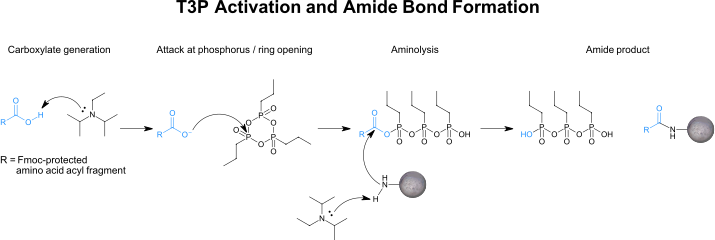
T3P peptide coupling is generally understood to proceed through a T3P-derived mixed carboxylic–phosphonic anhydride — an acyl group bound through oxygen to a phosphorus centre, not an acyl phosphonate with a direct carbon–phosphorus bond, and not a phosphate. Getting that identity right matters, because it explains both the reactivity and the phosphorus byproduct that follows.

Carboxylate Attack and Ring Opening
A non-nucleophilic base — DIPEA, N-methylmorpholine, 2,4,6-collidine, or pyridine — first deprotonates the carboxylic acid to give the carboxylate. The carboxylate oxygen is the nucleophile. It attacks an electrophilic phosphorus(V) centre of the cyclic trimer, not the carbonyl carbon, because the electrophilic site in T3P is the phosphorus of the phosphonic anhydride ring. That attack is expected to pass through a pentacoordinate phosphorus state and cleave one P–O bond of the six-membered ring, so the ring opens and the acyl group ends up as a mixed carboxylic–propylphosphonic anhydride. Whether the reactive species is best drawn as the minimal monomeric mixed anhydride or as the full ring-opened trimeric adduct is an accepted model, not a universally isolated intermediate. The minimal monomeric drawing is therefore a convenient mechanistic representation rather than evidence that one discrete activated species dominates in solution.
Aminolysis and the Phosphonate Leaving Group
The incoming amine attacks the carbonyl carbon of the mixed anhydride — again, not phosphorus. That gives a tetrahedral intermediate at the carbonyl, which collapses to the amide as the phosphonate fragment leaves. The reason T3P couples quickly is that once the mixed anhydride forms, its carbonyl is far more electrophilic than the parent acid, and the phosphonate is a much better leaving group than hydroxide. The base has a second job through all of this: keeping the amine in its reactive free-base form. The phosphonate departs as propylphosphonic acid and related phosphorus species. Many of these have good aqueous solubility and can be removed by aqueous washing, though some condensed pyrophosphonate byproducts persist under certain pH and crystallization conditions.
Reaction Context: Solvents, Bases, and the On-Resin Penalty
That solution formulation is part of its practical appeal and a real handling advantage over solid benzotriazole-derived reagents. The solvent and base choice then set both the rate and the stereochemical outcome.
Solvent and Base Selection
T3P couples across a wide solvent range. In the solution-phase peptide study by Mattellone and co-workers, high conversion was reached in DMF, DCM, anisole, ethyl acetate, and several other solvents, with a few bio-derived candidates limited mainly by building-block solubility rather than by the chemistry. In the reported solvent comparison, added or retained water generally reduced yield, while DCM behaved differently under the tested conditions — a reminder that T3P is moisture-sensitive and hydrolyses to inactive phosphonic acid. The base is the lever for racemization. Stronger tertiary amine bases such as DIPEA generally promote rapid activation and coupling but may raise the stereochemical risk at configurationally labile centres. Pyridine is directly supported by the Dunetz process study; other less basic or hindered bases, including 2,4,6-collidine, may also be screened when epimerization is a concern, though their performance is substrate-dependent.
On-Resin T3P Peptide Coupling With an OxymaPure Co-Activator
On resin, the picture changes. In the 2021 study by Al Musaimi and co-workers, the strongest on-resin results used OxymaPure as a co-activator together with elevated temperature and reagent excess; T3P alone was less reliable across the tested models. OxymaPure is expected to intercept the T3P-activated acyl species and generate a more conventional Oxyma active ester in situ. Better accessibility within the swollen resin is a plausible reason for the improvement, but the study did not separate the contributions of active-ester formation, reaction kinetics, resin swelling, and diffusion. Either way, the on-resin result is a working proof of concept on short model peptides, not a validated routine — a point the Chemist’s Perspective returns to.
How T3P Peptide Coupling Suppresses Epimerization
The strongest quantitative case for T3P is low epimerization, and it comes mostly from solution-phase and process work rather than from broad modern SPPS panels.
How Epimerization Happens
Epimerization proceeds by base-mediated abstraction of the α-proton from the activated acyl species, or through an oxazolone intermediate. Phenylglycine is especially sensitive because its benzylic α-centre eases stereochemical erosion; cysteine and other configurationally labile residues can also racemize, but the degree depends strongly on side-chain protection, base, activation time, and temperature.
What the T3P Peptide Coupling Data Show
Two numbers anchor the claim. In the process amidation of an epimerization-prone acid, Dunetz and co-workers found that T3P paired with pyridine at 0 °C provided sufficiently low epimerization, a practical aqueous workup, and scalability for the selected process; their kilogram process delivered product with 1.0–1.5% epimer starting from 0.3–0.6% epimer in the acid feed. These process data show the value of T3P with pyridine for a particular epimerization-prone intermediate; they are not a universal racemization value for amino-acid couplings.
In peptide-relevant work, Mattellone and co-workers measured about 0.5% of the racemized dipeptide when coupling N-Boc-L-phenylglycine with leucine methyl ester under standard T3P/DIPEA conditions — a single amino-acid stereocentre, and a directly useful figure. Combining the acid, amine, and base before adding T3P shortens the lifetime of the activated acid before aminolysis and may reduce the opportunity for epimerization; extended pre-activation of the acid is worth avoiding. The effect is protocol-dependent.
That case has a real boundary. There is no published head-to-head study that couples the same peptide panel under modern, optimised T3P, HATU, and DIC/OxymaPure conditions and compares racemization quantitatively. And Wang and co-workers showed that under strongly basic conditions, some T3P-derived mixed anhydrides can eliminate to a ketene, a pathway that scrambles stereochemistry for that substrate class. That is a demonstrated warning for acidic substrates under aggressive base, not evidence that every T3P coupling racemizes by ketene formation.
Monitoring T3P Peptide Coupling by LC-MS
The reliable readout of a T3P coupling is the disappearance of the starting acid and the appearance of the amide product, not the search for one universal activated-intermediate ion. A minimal monomeric mixed-anhydride model would add a calculated +106.0184 Da relative to the free acid, derived as one propylphosphonic acid unit minus water:
\[\Delta m = m(\mathrm{C_3H_9O_3P})-m(\mathrm{H_2O}) = 124.0289-18.0106 = 106.0184\ \mathrm{Da}\]Treat that value as arithmetic, not a routine impurity marker. The T3P-derived activated species may be oligomeric, may form several adducts, and can hydrolyse during sampling or LC-MS analysis, so an absent +106 Da ion does not prove absent activation. The free phosphorus byproducts are small molecules rather than peptide-bound shifts: propylphosphonic acid has a calculated neutral monoisotopic mass of 124.0289 Da. A condensed dipropylpyrophosphonic-acid diacid would compute to 230.0473 Da, but the exact structure and solid form of the persistent process byproduct should be taken from the primary characterization by Davidson and co-workers rather than assigned here.
³¹P NMR can track changes in T3P-derived phosphorus speciation, including reagent consumption and the formation of hydrolysed or condensed species. Assigning a discrete mixed-anhydride signal requires comparison with primary experimental data and should not be inferred from chemical shift alone.
When to Use T3P Peptide Coupling, and When to Switch
T3P is a rational first choice for a narrow, well-defined set of problems, and not the most evidence-supported default for routine Fmoc-SPPS. The table separates the cases; the reasoning is that T3P’s advantages — low epimerization with a weak base and water-soluble byproducts — pay off in solution and process chemistry, while its on-resin penalty and steric bulk cost it against dedicated SPPS reagents.
| Synthetic problem | Reasonable choice | Why |
|---|---|---|
| Epimerization-prone solution or LPPS amidation | T3P with pyridine, low temperature | Low racemization; phosphorus byproducts purge in aqueous workup. |
| Head-to-tail macrocyclization or hindered segment coupling | T3P supported by an early model study | Sterically hindered head-to-tail cyclization was shown in a model study; broad validation across ring sizes and sequences is not established. |
| Routine Fmoc-SPPS of a standard sequence | DIC/OxymaPure | Better validated on resin; the strongest T3P on-resin results used an OxymaPure co-activator and forcing conditions. |
| Hindered or N-methylated junction | HATU, COMU, or a phosphonium reagent | More extensively established for difficult resin-bound and N-methylated couplings, often with faster acyl transfer under standard SPPS conditions. |
Choosing Between T3P and the Alternatives
For the routine on-resin case the alternative is well characterised: DIC/OxymaPure remains the economical benchmark, with its own hydrogen cyanide caveat. For hindered and N-methyl-rich closures, uronium reagents such as HATU or a phosphonium reagent like PyBOP usually have the reactivity edge. One point favours T3P outside pure coupling rate: unlike aminium and uronium reagents, it has no electrophilic uronium carbon, so it is not expected to form the guanidinium caps of the guanidinylation side reaction that can terminate chains when activation is slow. That non-capping behaviour, together with rapid activation and phosphorus byproducts that wash out, is part of why T3P can suit the dilute, slow workups of head-to-tail macrocyclization — though the direct evidence there remains a model study.
Failure Modes and Substrate Traps
Several failure modes are specific enough to plan around. Each is a reagent-level quirk rather than a general coupling problem, which is why they sit here rather than in a standalone side-reaction article.
In one solution-phase substrate screen, N-Boc-Cys-OH gave a mixture containing oxidised cysteine derivatives, and N-Boc-Lys-OH cyclized through its unprotected side-chain amine instead of coupling intermolecularly. These are substrate-specific observations, not evidence that suitably protected Cys or Lys building blocks are incompatible with T3P; they point to using appropriate side-chain protection under comparable conditions. Strongly basic conditions on an unusually acidic substrate open the ketene pathway noted above. Its analytical signature is easy to miss: the epimerized product has the same exact mass as the target amide, so it must be resolved chromatographically or by a stereochemically selective method, not by mass alone.
The phosphorus byproducts have a downstream tail. Under alkaline workup, T3P can degrade to a persistent condensed phosphorus byproduct that is stable to high pH and can co-crystallize as an impurity; Davidson and co-workers isolated it and showed that low-pH treatment degrades it toward more water-soluble species. Where a later step uses a transition-metal catalyst, confirm the phosphorus purge analytically rather than assume it — the same discipline applied to residual palladium removal before a metal-catalysed step. The cited byproduct study did not establish a catalyst-poisoning threshold.
Practical T3P Peptide Coupling Protocols
The conditions below are literature-reported starting points, grouped by synthetic format. Treat them as anchors to optimise from, not as settled recipes for an untested sequence.
| Context | Conditions | Outcome and notes |
|---|---|---|
| Solution-phase model coupling | Acid 1.0 : amine 1.0 : DIPEA 4.0 : T3P 1.5 equiv, dry DCM or EtOAc, 0.125 M, room temperature, under nitrogen. Add T3P last. | Starting acid consumed after about 10 min under the model conditions. |
| Iterative SolPPS (Leu-enkephalin) | Same chemistry, reusing the DCM solution across steps without isolating intermediates; the authors raised T3P to a 2:4 T3P/DIPEA ratio so it also consumes residual water. | About 62% overall yield over seven steps and 95% final purity by HPLC, the peptide isolated by solvent evaporation rather than chromatography. |
| Low-epimerization process amidation | T3P with pyridine as base and co-solvent, 0 °C, ethyl acetate. | 1.0–1.5% epimer in product; byproducts removed by acidic aqueous wash. |
| On-resin SPPS (model pentapeptide) | AA : DIPEA : T3P : OxymaPure = 5 : 10 : 5 : 5, 2-MeTHF-formulated T3P, 60 °C, PEG-based resin. | Practical conversion at 60 °C; proof of concept on a short sequence. |
The Chemist’s Perspective
The green reputation of T3P is partly earned and partly ahead of the evidence, and it helps to keep the two apart. What is demonstrated is concrete: many T3P-derived phosphorus species transfer readily to aqueous washes, though persistent condensed byproducts have also been reported; carrying a single reaction solution through several steps without intermediate evaporation cuts solvent volume; and a recent tag-assisted LPPS report gives an approximately 2.7-fold lower process mass intensity than its comparison process, though such a ratio depends on where the process boundary is drawn. Those are genuine process advantages.
What is not demonstrated is the broader slogan that T3P is categorically greener or safer than every uronium, phosphonium, and carbodiimide reagent. There is no matched comparison of process mass intensity, E-factor, and epimerization across those platforms on the same peptide sequences and scale. The most defensible safety contrast is not that T3P is proven benign but that repeated exposure to some uronium reagents has caused occupational anaphylaxis — a documented hazard of the alternatives, not a clean bill of health for T3P. Comparable occupational-sensitization data for T3P are not established by that comparison.
The trap is the SPPS scope. It is easy to read “green coupling reagent for SPPS” and assume a drop-in replacement for DIC/OxymaPure on a real target. The on-resin proof is a short model peptide, run at 60 °C with a large excess of co-activator and base, because T3P alone does not couple cleanly on resin. For a long, aggregation-prone chain, that is an open question, not a solved one. T3P is a strong solution-phase and process reagent with a specific low-epimerization niche; on resin it is still early, and worth screening rather than trusting.
T3P Peptide Coupling — FAQ
The strongest published SPPS results used T3P with an OxymaPure co-activator, reagent excess, and elevated temperature — around 5:10:5:5 acid/DIPEA/T3P/OxymaPure at 60 °C — on short model peptides. Evidence for T3P alone as a broadly reliable routine Fmoc-SPPS reagent is limited; DIC/OxymaPure remains much more established for standard resin-bound synthesis.
The activated acid is modelled as a mixed carboxylic–propylphosphonic anhydride, a calculated shift of +106.02 Da, and the phosphorus byproduct propylphosphonic acid has a calculated mass of 124.03 Da. These are calculated compositions, not validated LC-MS markers, and the intermediate can hydrolyse during analysis.
Pyridine is a weaker base and suppresses α-proton abstraction. Dunetz reported 1.0–1.5% epimer with T3P and pyridine at 0 °C on an epimerization-prone acid, against higher levels with stronger bases.
Not through the characteristic uronium pathway. T3P has no electrophilic uronium carbon, so the familiar +98 or +140 Da guanidinium caps are not expected. This does not rule out other substrate-specific termination products.
In one solution-phase screen, unprotected N-Boc-Cys-OH gave oxidised cysteine derivatives and N-Boc-Lys-OH cyclized through its ε-amine. These are substrate-specific; suitable side-chain protection is the fix, not avoiding Cys or Lys.
References
Mechanism and Origin
Wissmann, H., & Kleiner, H.-J. (1980). New peptide synthesis. Angewandte Chemie International Edition in English, 19(2), 133–134.
- Introduces propylphosphonic anhydride as a mild condensation reagent for amide and peptide bond formation.
- DOI: 10.1002/anie.198001331
Klose, J., Bienert, M., Mollenkopf, C., Wehle, D., Zhang, C., Carpino, L. A., & Henklein, P. (1999). 2-Propanephosphonic acid anhydride (T3P)-mediated segment coupling and head-to-tail cyclization of sterically hindered peptides. Chemical Communications, 1847–1848.
- Reports model segment coupling and head-to-tail cyclization involving sterically hindered residues, not only simple linear amidation.
- DOI: 10.1039/A905021C
Dunetz, J. R., Xiang, Y., Baldwin, A., & Ringling, J. (2011). General and scalable amide bond formation with epimerization-prone substrates using T3P and pyridine. Organic Letters, 13(19), 5048–5051.
- Develops a scalable T3P/pyridine procedure for selected epimerization-prone amidations.
- DOI: 10.1021/ol201875q
Wang, Z., Barrows, R. D., Emge, T. J., & Knapp, S. (2017). Stereochemical aspects of T3P amidations. Organic Process Research & Development, 21(3), 399–407.
- Shows that base-driven elimination of a T3P-derived mixed anhydride to a ketene can scramble stereochemistry for certain substrate classes.
- DOI: 10.1021/acs.oprd.7b00046
SPPS and Green Methods
Al Musaimi, O., Wisdom, R., Talbiersky, P., de la Torre, B. G., & Albericio, F. (2021). Propylphosphonic anhydride (T3P) as coupling reagent for solid-phase peptide synthesis. ChemistrySelect, 6(11), 2649–2657.
- Evaluates T3P in SPPS and reports improved performance under conditions using OxymaPure, with green-solvent screening.
- DOI: 10.1002/slct.202100123
Mattellone, A., Corbisiero, D., Ferrazzano, L., Cantelmi, P., Martelli, G., Palladino, C., Tolomelli, A., & Cabri, W. (2023). Speeding up sustainable solution-phase peptide synthesis using T3P as green coupling reagent: methods and challenges. Green Chemistry, 25(7), 2563–2571.
- Reports process-mass-intensity calculations for the proposed continuous solution-phase workflow with T3P.
- DOI: 10.1039/D3GC00431G
Mattellone, A., Corbisiero, D., Cantelmi, P., Martelli, G., Palladino, C., Tolomelli, A., Cabri, W., & Ferrazzano, L. (2023). Fast solution-phase and liquid-phase peptide syntheses (SolPSS and LPPS) mediated by biomimetic cyclic propylphosphonic anhydride (T3P). Molecules, 28(20), 7183.
- Open-access study reporting solvent screens, the 0.5% phenylglycine racemization figure, and iterative Leu-enkephalin syntheses.
- DOI: 10.3390/molecules28207183
Kushwaha, P., Mantel, M., Talbiersky, P., Li, Y., Sharma, A., de la Torre, B. G., & Albericio, F. (2026). Cyclover-assisted liquid-phase peptide synthesis using T3P as a green coupling reagent. Organic Letters, 28(9), 3046–3051.
- Recent LPPS advance in 2-methyltetrahydrofuran reporting an approximately 2.7-fold reduction in process mass intensity.
- DOI: 10.1021/acs.orglett.6c00353
Byproducts and Safety
Davidson, A., Foley, D. A., Frericks-Schmidt, H., Ruggeri, S. G., Herman, M., Lacasse, S., Liu, Y., McInturff, E., Morris, R., Mugheirbi, N. A., Samas, B., Sarkar, A., Singer, R., Witkos, F. E., & Yu, S. (2021). pH-dependent degradation of T3P-related byproducts. Organic Process Research & Development, 25(3), 621–626.
- Isolates and characterizes a persistent T3P-derived degradation byproduct and evaluates washing and low-pH degradation strategies.
- DOI: 10.1021/acs.oprd.0c00431
McKnelly, K. J., Sokol, W., & Nowick, J. S. (2020). Anaphylaxis induced by peptide coupling agents: lessons learned from repeated exposure to HATU, HBTU, and HCTU. The Journal of Organic Chemistry, 85(3), 1764–1768.
- Documents occupational sensitization to uronium coupling reagents; a primary-source safety contrast for coupling-reagent selection. Comparable data for T3P are not established by this comparison.
- DOI: 10.1021/acs.joc.9b03280