When regulators review a peptide, they assess more than biological activity. They expect a coherent CMC in peptide discovery package — identity, purity, impurities, stability, manufacturing controls, and specifications — as outlined in global frameworks such as ICH Q6A and EMA/FDA guidelines.
FDA organizes peptide CMC expectations around four practical areas: how it’s characterized, controlled, specified, and stabilized. Even in early discovery, your data should begin to feed into these same areas — regulators expect information to deepen as development progresses. This doesn’t mean every university experiment must follow regulatory frameworks. Instead, CMC awareness in academia helps researchers prioritize, interpret, and communicate results so that discoveries remain open for translation.
CMC in Peptide Discovery: Why Awareness Matters
Identity & Purity
LC-MS and HPLC are routine tools in every peptide lab. In discovery, these results are often treated as “confirmation.” In development, they become specifications. The difference is not the technique, but the framing. A mass spectrum and purity profile aren’t just evidence that the peptide exists — they become the regulatory definition of what the drug is. Ignoring that connection early often leads to mismatched expectations later (e.g. “95% purity” in a paper vs. what regulators would require for batch release). Even a simple LC-MS purity check can be framed as part of CMC in peptide discovery and a proto-specification. Ask yourself: Would this data be enough to demonstrate identity and purity if carried forward into a regulatory submission? If not, what would be missing?
In the FDA’s four-pillar model, these results fall under characterization and later support specification. These are the two pillars that define how your peptide will be controlled once it leaves the bench. Thinking in that structure now prevents data gaps later during process validation.
Impurities
Byproducts like deletion sequences, aspartimide, or oxidized forms are not just synthetic noise — they are classified as process- or degradation-related impurities under ICH Q6A and EMA’s peptide draft guideline. If you don’t track them, someone else will — under pressure, at scale, and with regulatory deadlines looming. For example, aspartimide formation or diketopiperazine cyclization, if only noted informally in a thesis, often resurface during scale-up and force costly re-characterization under GMP conditions. FDA encourages using complementary analytical methods (for example, pairing LC-MS and HPLC) to confirm impurity profiles. Reporting and qualification limits are set case-by-case, following ICH principles on impurity control.
Stability
Discovery labs often test peptides after freeze–thaw or storage. Industry calls this stress testing (ICH Q1A). The difference is intent: instead of simply reporting “it degraded,” you can frame it as evidence for degradation pathways. For instance, oxidation of methionine or deamidation of asparagine may look like minor changes in discovery data but can later invalidate release specifications if not characterized early. This transforms informal notes into the starting point of a stability narrative — the kind regulators expect to see when specifications are justified.
The point
Early CMC thinking does not ask you to run extra experiments — it asks you to recognize that the data you already generate can either die in a thesis or live on as the foundation of a regulatory story. Framing results with a CMC lens doesn’t limit discovery nor constrain creativity; it ensures that promising science has the option to move forward.
While scale-up and manufacturability challenges (e.g. resin loading, cleavage chemistry, purification efficiency) come later, recognizing purity, stability, and impurities early ensures your peptide is even worth manufacturing.
The Potency vs. Developability Trade-off
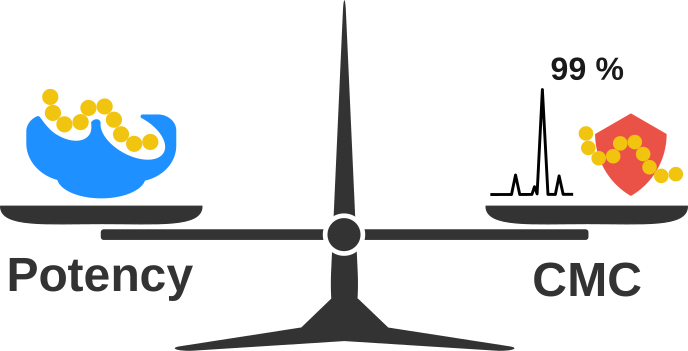
It’s tempting to chase only biological potency. Potency is the starting point — without convincing biological activity, there is no drug candidate. But potency alone is not enough. A highly active peptide that degrades rapidly, aggregates, or carries uncontrolled impurities raises doubts about whether they can survive translation.
Potency without stability = a scientific curiosity, but not a viable candidate unless formulation or delivery can realistically compensate.
A peptide with strong activity but rapid degradation is not automatically excluded from development — its success may depend on formulation or delivery strategies. In some cases, chemical modifications such as PEGylation, lipidation, stapling, or the use of non-natural amino acids can also improve stability or pharmacokinetics. Yet even these strategies are more persuasive when they build on solid CMC data. Until then, investors and regulators will hesitate.
Potency with a CMC-aware profile = not just promising, but a viable candidate.
Moderate activity, combined with data showing stability, reproducibility, and controlled impurities, often makes a stronger case than “super-potent but unstable.” It signals that the science is not only interesting, but also actionable.
The takeaway: potency is primary, but developability is the multiplier. Even in discovery, noting stability issues or impurity trends doesn’t undermine activity — it frames them as challenges that can be addressed through formulation, process optimization, or chemical modification. What matters is balance: biological promise paired with enough CMC awareness to suggest a viable path forward.
Whether you are publishing, applying for funding, or pitching to investors, the same principle applies: your data should be interpretable as the beginning of a specification.
What do you need to know?
👩🔬 PhD/Postdocs:
When you run LC-MS or HPLC, don’t just report numbers — ask whether the data could support identity, purity, or stability in a regulatory sense. Add a note in your logbook: “Specification-like meaning” — even one line per experiment helps you think like a developer.
🎓 PIs/Grant Writers:
Signal translational awareness by framing data in regulatory language. Instead of “95% pure by HPLC,” write: “95% purity — approaching acceptance criteria used in peptide specifications.” A single line like this shows reviewers that your lab connects discovery to development.
🚀 Biotech Founders
Investors look for a CMC narrative from day one. Without it, even the most potent peptide will fail due diligence. A lead candidate that combines biological activity with early stability and impurity data — framed like a proto-specification — sends the signal that your project is not just promising, but fundable.
Potency is Primary, Developability the Multiplier
Potency remains the foundation of peptide drug discovery — without convincing biological activity, there is no candidate. But activity alone cannot carry a project to translation, because regulators and investors expect a coherent CMC story: identity, purity, impurities, and stability.
This principle aligns with regulatory thinking. ICH Q6A establishes specifications around identity, assay, impurities, and degradation products. The EMA’s 2024 draft peptide guideline adapts these pillars to peptides, emphasizing impurity control and stability. The FDA’s peptide guidance similarly underscores that robust analytical characterization is essential for advancing peptide candidates.
It is worth noting that ICH Q6A and ICH Q1A were originally developed for small molecules, but their principles on specifications and stability are often applied to synthetic peptides, supplemented by peptide-specific guidance such as EMA’s 2024 draft guideline. More broadly, ICH Q8 and ICH Q11 highlight that drug design and manufacturing strategies must be integrated early — reinforcing why CMC awareness belongs in discovery, not just later development.
The message for discovery researchers is clear: potency is primary, but developability is the multiplier. Noting degradation trends, framing purity data in specification-like terms, and recording impurity observations does not undermine creativity — it preserves optionality. It keeps promising peptides open for formulation strategies, process optimization, or delivery solutions that can later overcome inherent instability.
In short: CMC in peptide discovery is not a burden, but a bridge — ensuring that today’s academic results remain tomorrow’s therapeutic possibilities.