Arg-sulfonyl side reactions arise because, among all amino-acid side chains, arginine demands one of the strongest protection strategies in solid-phase peptide synthesis. Its guanidinium group is both basic and nucleophilic, easily protonated yet reactive toward activated carbonyl or sulfonyl species. For decades, chemists have relied on sulfonyl protecting groups—Mtr, Pmc, Pbf, and MIS—to render arginine inert during coupling and deprotection cycles.
All four belong to the same conceptual family: an aryl-sulfonyl moiety linked through a sulfonamide bond to arginine’s δ-nitrogen. This bond is robust toward bases but cleaves in trifluoroacetic acid (TFA), producing the free guanidinium. However, the process is not as clean as early textbooks implied. During acidolysis, each Arg-sulfonyl protection releases a highly electrophilic sulfonyl fragment, commonly represented operationally as Ar–SO₂⁺—a highly electrophilic species capable of attacking nucleophilic residues within the same peptide. Whether such a reaction occurs depends largely on how long that cation survives before being trapped by scavengers.
This article compares the side-reaction profiles of the four major Arg-sulfonyl protecting groups—Mtr, Pmc, Pbf, and MIS—and explains why Pbf and MIS dominate modern Fmoc-SPPS while Mtr and Pmc persist mainly in legacy processes.
Predict Arg-Trp Conflicts with Peptalyzer™
Use Peptalyzer™ to map proximity-based hotspots and identify high-risk Arg-Trp sequences prone to sulfonyl transfer and aryl-alkylation before starting your synthesis.
📘 What will you learn here?
Mechanistic Origin of Arg-Sulfonyl Side Reactions
Arginine deprotection is details described in Arg Pbf Deprotection in Fmoc-SPPS: Mechanism, Optimization & Side Reaction Control article. It occurs in multiple steps as briefly outlined below.
Protonation and Bond Polarization
When TFA contacts the Arg-protected resin, the sulfonamide nitrogen is protonated, producing Ar–SO₂–NH₂⁺–Arg. This weakens the S–N bond because the nitrogen no longer donates electron density to sulfur. The bond becomes polarized Sδ⁺–Nδ⁺, pre-disposing it to heterolytic cleavage.
Heterolytic Cleavage and Electrophile Formation
The electron pair on the S–N bond shifts toward nitrogen, breaking the linkage and releasing a highly electrophilic sulfonyl fragment (operationally denoted as Ar–SO₂⁺).This transient cation initiates sulfonyl-derived chemistry that ultimately gives rise to the observed side reactions. Its lifetime and reactivity are dictated by the substituents on the aromatic ring.
| Protecting Group | Key Structural Feature | Relative Persistence of Sulfonyl-Derived Electrophiles | Main Side Reactions | Relative Frequency / Risk |
|---|---|---|---|---|
| Mtr | p-OMe donor + 3 methyls (electron-rich aromatic) | ≈ seconds | Trp sulfonation (+80 /+160 Da); Arg(SO₃H); Ser/Thr O-sulfonation | 🔴 High |
| Pmc | Chroman ring (sp³ O donor) | ≈ hundreds ms | Same profile as Mtr but less pronounced | 🟠 Medium |
| Pbf | Benzofuran ring (sp² O donor) | ≈ tens ms | Minor Trp/Ser/Thr sulfonation; rare Arg(SO₃H) | 🟢 Low |
| MIS | 2,4-Dimethoxyphenyl + sulfonamide N (strong +M effect) | ≈ milliseconds or less | Trace Arg(SO₃H); practically artifact-free | 🟢 Minimal |
Even though MIS deprotects far faster than Pbf, Pbf remains the standard because its by-products are easier to handle, it fits seamlessly into existing TFA cleavage protocols, and it is universally available and validated across industrial peptide synthesis.
Competing Fates
- Productive route: Ar–SO₂⁺ is trapped by scavengers (thioanisole, EDT) → inert thioether adducts.
- Uncontrolled route: The cation encounters peptide nucleophiles → sulfonation or alkylation.
Thus, all Arg-sulfonyl protecting groups share the same mechanistic vulnerability, but differ in the persistence of the reactive intermediate.
Comparative Severity of Sulfonation and Alkylation
The likelihood of sulfonation depends on how long the transient aryl-sulfonyl cation (Ar–SO₂⁺) survives after cleavage begins. Substituents that donate electron density into the aromatic ring stabilize the cation and extend its lifetime; heteroatom conjugation (O or N) further delocalizes charge. Consequently, the lifetime decreases in the order Mtr > Pmc > Pbf > MIS, mirroring the observed reduction in sulfonation severity.

Short-lived cations, as in Pbf and MIS, are quenched before reacting with nearby residues, whereas more persistent electrophilic sulfonyl fragments (Mtr, Pmc) create wider windows for side reactions. These differences in cation lifetime directly explain the residue-specific outcomes discussed below. Note that for various reasons described in a separate article, Pbf still remains the industry standard compared to MIS group.
The highly electrophilic fragments released by Pbf and Pmc groups trigger two distinct types of side reactions across various amino acid side chains: aryl-alkylation and sulfonation.
Proposed Origin of +80 Da Arg-Sulfonyl Side Reactions During TFA Cleavage
The formation of +80 Da sulfonated side products during global TFA cleavage of Arg(Pbf)- or Arg(Pmc)-containing peptides is well documented experimentally, but not mechanistically resolved at the level of elementary steps. This section summarizes what is established, clarifies the common conceptual pitfalls, and presents a chemically plausible, explicitly proposed pathway consistent with the literature and with broader sulfonyl chemistry. Importantly, this remains a proposal, not a proven mechanism.
Experimental Evidence for Arg-Sulfonyl Side Reactions
Multiple independent studies report sulfonated peptide side products with mass increases of +80 Da (and multiples thereof) formed during peptide side-chain global deprotection when Arg(Pbf), Arg(Pmc), or Arg(Mtr) are present. These include:
- Trp aryl-alkylation (indole C-2 substitution by aryl-sulfonyl fragments),
- Ser/Thr sulfonation (O-sulfate formation),
- Tyr sulfonation, and
- Arg(SO₃H) formed via irregular cleavage pathways.
These observations are reproducible, sequence-dependent, and strongly influenced by the nature of the Arg protecting group and the scavenger system. Crucially, the +80 Da signature corresponds to incorporation of an SO₃ unit, i.e. a sulfur(VI) sulfate/sulfonate functionality.
What is not established in the literature is the exact identity and lifecycle of the sulfonating electrophile(s) responsible for transferring this SO₃ unit to the peptide.
A Chemically Plausible, Literature-Consistent Proposal
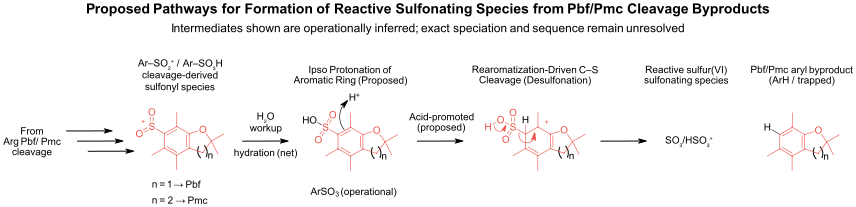
Based on the peptide literature and on established sulfonyl chemistry analogies, the following conceptual pathway is proposed:
Cleavage-derived sulfonyl fragment pool
Acidolysis of Arg(Pbf)/Arg(Pmc) generates reactive sulfonyl-containing fragments, commonly described as formal ArSO₂⁺ / sulfonic acid–type species. The exact speciation is unresolved, but their electrophilic character is evident from downstream reactivity.
Net hydration to sulfonic acid derivatives
During rehydration/workup, these fragments undergo net conversion to sulfonic acid–type species (Ar–SO₃H). This step accounts for net oxygen incorporation without requiring a single, well-defined elementary water attack in neat TFA.
Proposed ipso protonation and C–S bond cleavage (analogy-based)
By analogy with broader aromatic sulfonyl chemistry, protonation at the ipso carbon can weaken the Ar–S bond. Rearomatization-driven C–S cleavage would then release:
- An aryl fragment (ArH or trapped Ar–Nu), and
- A small, highly reactive sulfur(VI) sulfonating unit capable of downstream sulfonation, conveniently denoted as SO₃ / HSO₃⁺ (shorthand, not a discrete free ion).
Downstream sulfonation of peptide residues
These sulfur(VI) electrophiles can later react with nucleophilic peptide side chains (Trp, Ser, Thr, Tyr), yielding stable sulfate/sulfonate adducts corresponding to the observed +80 Da mass shift.
Key Conceptual Pitfalls (And How to Avoid Them)
During analysis, several intuitive but misleading assumptions tend to arise. These are worth addressing explicitly.
1. Is the reactive species a sulfonyl cation or an anion?
The term sulfonyl cation is often used operationally to describe a highly electrophilic sulfonyl fragment released during cleavage. In reality, under strongly acidic conditions (TFA), rapid protonation, ion pairing, and solvent interactions make it unrealistic to assign a single, persistent charge state. It is more accurate to think in terms of a reactive sulfonyl fragment pool that can exist in multiple protonated or solvated forms.
2. Where does the third oxygen come from in +80 Da products?
This is a critical point. Direct attachment of an –SO₂– fragment cannot yield a +80 Da product. Formation of a sulfate/sulfonate (–SO₃H) requires net oxygen incorporation. The most plausible source is water during rehydration/workup, not a clean nucleophilic substitution occurring in neat TFA. This distinction resolves many apparent contradictions.
3. Isn’t water fully protonated in TFA and therefore non-nucleophilic?
In strongly acidic media, water is indeed heavily protonated and poorly nucleophilic. However:
- Protonation is an equilibrium, not an absolute state.
- Many transformations attributed to “hydrolysis” occur during dilution, rehydration, or workup, when water activity increases substantially. Thus, invoking net hydration rather than a single SN-type water attack is both chemically sound and consistent with practice.
4. Why do dry conditions promote sulfonation if water is needed later?
These effects act at different stages:
- Low water during cleavage favors survival and diffusion of reactive sulfonyl fragments by reducing rapid quenching.
- Subsequent rehydration/workup converts transient intermediates into the thermodynamically stable sulfate/sulfonate forms that are detected analytically.
There is no contradiction once timing is separated.
5. Why does sequence proximity matter?
Experimental observations show that sulfonation is enhanced when susceptible residues (e.g., Trp) are close to Arg(Pmc/Pbf). The pronounced dependence of sulfonation on the proximity between Arg(Pbf/Pmc) and susceptible residues strongly suggests that the sulfonating species is generated locally upon Arg cleavage and intercepted before diffusion into bulk solution, consistent with a short-lived, proximity-driven sulfur(VI) electrophile rather than a freely diffusing sulfonating reagent.
Scope and Limitations of This Proposal
This pathway explains:
- The +80 Da mass increment,
- The dependence on Arg protecting group structure,
- The influence of scavengers and hydration,
- The strong sequence-proximity effects.
However, no study to date directly observes each intermediate or confirms the exact order of events. The identity of the true sulfonating species (free SO₃, protonated variants, mixed anhydrides, or tightly associated ion pairs) remains unresolved.
Accordingly, the mechanism should be viewed as a working model that rationalizes existing data and aligns peptide chemistry observations with well-established sulfonyl chemistry principles, rather than as a definitive arrow-pushing sequence.
What SO₃ / HSO₃⁺ Can Do Next: Ser/Thr/Tyr O-Sulfonation and Arg(+80) Formation
Once reactive sulfur(VI) species are generated during Arg(Pbf) or Arg(Pmc) side-chain cleavage, their chemical reactivity can lead to a consistent and experimentally well-documented consequence is the formation of +80 Da sulfonated side products, most prominently on Ser, Thr, Tyr, and in certain cases Arg itself. The mechanistic origin of these species has been discussed in the peptide chemistry literature but remains only partially resolved. The pathway described below represents a chemically reasonable and literature-consistent proposal, rather than a definitively proven mechanism.
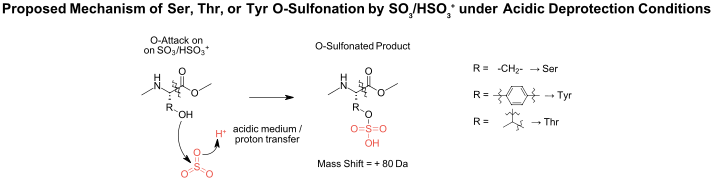
O-Sulfonation of Ser, Thr, and Tyr by SO₃ / HSO₃⁺
A mass increase of +80 Da corresponds to installation of an SO₃ unit, yielding a sulfate monoester (R–O–SO₃H or its ion-paired form). In the context of peptide global deprotection, this modification is most plausibly explained by direct O-sulfonation mediated by highly electrophilic sulfur(VI) species, commonly denoted as SO₃ or protonated SO₃ (HSO₃⁺).
Sulfur(VI) sulfonating species derived from sulfonyl cleavage are exceptionally electrophilic. Unlike classical acylations, it does not require strongly nucleophilic partners. Even weak nucleophiles such as alcohol oxygens can react, provided the electrophile is sufficiently activated and survives long enough in the reaction medium. This condition is met transiently during TFA-mediated deprotection, particularly when sulfonyl protecting groups are cleaved in close proximity to susceptible residues.
In the proposed mechanism, the hydroxyl oxygen of Ser, Thr, or Tyr donates a lone pair to the sulfur center of SO₃ (or HSO₃⁺), forming a tetrahedral sulfur(VI) intermediate. Subsequent proton transfers to the surrounding acidic medium yield the corresponding O-sulfate monoester. Importantly, no external water molecule is required as a nucleophile in this step. All three oxygens present in the +80 Da adduct originate from the SO₃ electrophile itself, while the alcohol oxygen becomes the fourth ligand on sulfur.
This point resolves a common conceptual pitfall: although TFA is a strongly acidic medium in which water is extensively protonated, water does not need to act as a nucleophile for O-sulfonation to occur. The reaction is driven by the intrinsic electrophilicity of SO₃, not by the availability of neutral H₂O.
For Tyr, two sulfonation modes are in principle possible: aromatic ring sulfonation (via SEAr) or O-sulfonation at the phenolic oxygen. In the context of +80 Da side products observed during peptide deprotection, phenolic O-sulfonation provides the most parsimonious explanation, especially when no regioisomeric ring sulfonation pattern is detected.
Arg(+80) Formation: A Distinct Origin
Yang and co-workers explicitly report Arg(+80) species, best interpreted as sulfonyl-retaining cleavage products rather than post-cleavage sulfation side products with a +80 Da mass shift. However, this modification should not be interpreted as a straightforward intermolecular sulfation of the regenerated guanidino group by free SO₃. Instead, Arg(+80) formation is best rationalized as the result of irregular or alternative cleavage pathways of sulfonyl-based protecting groups, in which a sulfonyl fragment remains attached to the Arg side chain rather than being cleanly expelled.
This distinction is critical. While Ser, Thr, and Tyr +80 Da products arise from downstream reactions of reactive sulfur(VI) species, Arg(+80) reflects a protecting-group-dependent fragmentation outcome. This explains why Arg sulfonation correlates strongly with protecting group structure (Pbf vs Pmc) and cleavage conditions, rather than with general nucleophilicity.
Tryptophan Indole Aryl-Alkylation by Ar–SO₂⁺ (SEAr Pathway)
Tryptophan’s indole ring is the most π-rich environment in peptides, and its C-2 position is especially susceptible to electrophilic substitution. When a highly electrophilic sulfonyl fragment is generated in close proximity to a Trp residue—whether as a short-lived aryl-sulfonyl cation, a tight ion pair, or derived transiently from mixed anhydrides such as CF₃COOSO₂Ar—it can be intercepted by the indole π-system. Therefore, in figure below Ar–SO₂⁺ is used here as a formal representation of the highly electrophilic sulfonyl fragment generated during Arg(Pbf/Pmc) cleavage.
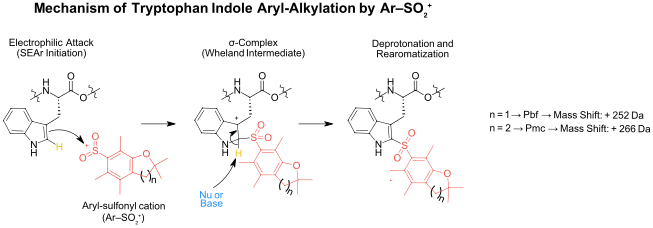
The reaction proceeds through a classical electrophilic aromatic substitution (SEAr) sequence, initiated by the highly electrophilic aryl-sulfonyl cation (Ar–SO₂⁺) released from Arg-sulfonyl protecting groups during TFA cleavage:
electrophilic attack → σ-complex formation → deprotonation → restoration of aromaticity.
In peptide systems, the outcome of this reaction is highly sequence-dependent. Aryl-alkylation of tryptophan is strongly favored when Trp is in close spatial proximity to an Arg residue bearing a sulfonyl protecting group (Pbf, Pmc, or Mtr). This reflects the extremely short lifetime and high local reactivity of the aryl-sulfonyl electrophile generated during TFA cleavage, which is therefore preferentially captured intramolecularly rather than by bulk scavengers. As a result, Trp residues located near Arg(Pbf/Pmc) are selectively modified to form stable aryl-sulfonyl adducts, typically observed as characteristic mass shifts of +252 Da (Pbf) or +266 Da (Pmc) in LC–MS analyses.
Electrophilic attack (C-2 substitution)
The indole ring of tryptophan, being the most π-rich moiety in peptides, behaves as a highly activated aromatic system toward electrophilic substitution. Its C-2 position, adjacent to the indole nitrogen, is particularly susceptible to electrophilic sulfonylation. Interaction of the indole π-system with the highly electrophilic aryl-sulfonyl fragment (formally represented as Ar–SO₂⁺) leads to formation of a new C–S bond through a classical electrophilic aromatic substitution pathway, generating a positively charged σ-complex (Wheland intermediate). This step is accompanied by temporary loss of aromaticity in the five-membered indole ring.
σ-Complex stabilization
In the resulting σ-complex, the positive charge is delocalized over the indole framework, with major resonance contributors involving N-1 and C-3. This charge delocalization stabilizes the intermediate under strongly acidic TFA conditions, where rapid protonation–deprotonation equilibria further modulate the electronic structure of the indole ring. Despite the highly acidic medium, the σ-complex remains sufficiently activated that loss of the C-2 proton is thermodynamically favored, driven by the strong gain in aromatic stabilization upon rearomatization. As a result, deprotonation can proceed even in the presence of only weak bases, such as trifluoroacetate or sulfur-based scavengers present in the cleavage mixture.
Deprotonation and rearomatization
Aromaticity is restored through deprotonation at C-2, driven by the strong thermodynamic gain associated with rearomatization. In the highly acidic TFA medium, this proton transfer is most plausibly mediated by any available weak base or scavenger present in the cleavage mixture—such as thioanisole, anisole, or EDT—which can transiently accept the proton. Trifluoroacetate anion (CF₃CO₂⁻), when present, may also contribute to this step, although its effective concentration is often limited in neat TFA. The result is regeneration of the indole π-system and formation of the neutral C-sulfonated indole adduct (Trp–C₂–SO₂–Ar).
Competing scavenger quench
If an efficient sulfur-based scavenger (e.g., thioanisole or EDT) is present, it reacts more rapidly with Ar–SO₂⁺ to form an inert thioether, thereby diverting the electrophile away from Trp and preventing aryl-alkylation.
🧪 Experimental Tip: Protect Trp as Nin-Boc or Nin-For. Maintain 3–5 % H₂O and include both thioanisole (2–5 %) and EDT (1–3 %). Perform cleavage ≤ 25 °C for ≤ 90 min.
Controlling Arg-Sulfonyl Side Reactions During TFA Cleavage
The extent of Arg-sulfonyl side reactions depends strongly on the cleavage environment—particularly hydration, scavenger composition, and exposure time. Dry or overheated conditions delay quenching of sulfonyl cleavage intermediates, thereby increasing the effective lifetime of downstream sulfur(VI) sulfonating species (e.g., SO₃ / HSO₃⁺) that can modify Trp, Ser/Thr, or Arg. Conversely, a hydrated, sulfur-rich cocktail quenches the cation almost instantly, preventing detectable sulfonation. In brief:
- Hydration (3–5 %) accelerates quenching of electrophilic sulfonyl-derived fragments before sulfur(VI) evolution, limiting formation and persistence of reactive sulfur(VI) sulfonating species.
- Balanced scavengers (thioanisole ± EDT/DTT) intercept reactive fragments.
- Short, cooled cleavages (≤ 90 min at ≤ 25 °C) maintain scavenger efficiency.
- Phenol or anisole (1–2 %) reduces mixed-anhydride O-sulfonation in Ser/Thr-rich sequences.
These parameters are described in full, with optimized TFA cocktails and timing guidance, in Arg Pbf deprotection protocol. That article details each Arg protecting group’s recommended cleavage composition, exposure limits, and scavenger balance, serving as the central reference for experimental setup and optimization.
Protecting Group Dependence of Arg-Sulfonyl Side Reactions
The extent of sulfonation and related artifacts depends on how long the aryl-sulfonyl cation persists during TFA cleavage. More stable cations (Mtr, Pmc) sustain reactivity long enough to modify Trp, Ser/Thr, or even Arg itself, while short-lived systems (Pbf, MIS) are quenched before such reactions occur.
| Reaction Type | 🔴 Mtr | 🟠 Pmc | 🟢 Pbf | 🟢 MIS |
|---|---|---|---|---|
| Tryptophan aryl-alkylation (+252/+266 Da) | High – evident even with scavengers (Trp aryl-alkylation risk) | Medium – visible under prolonged cleavage | Low – rare (<1 %) | Minimal – almost undetectable |
| Serine / Threonine O-sulfonation | Prominent in dry or extended cleavages | Noticeable at long exposure | Very low – only under harsh conditions | Minimal – practically absent |
| Arg(+80) formation via irregular or incomplete sulfonamide cleavage (Arg-SO₃H) | After >2 h TFA – several % | Minor (<1 %) | Trace | None detected |
These chemical events leave characteristic analytical signatures that can be identified by LC–MS or HPLC.
Analytical Identification and Diagnostic Patterns
LC–MS Signatures of Arg-Sulfonyl Side Reactions
| Observation | Interpretation |
|---|---|
| Mass shift of +80 Da | Mono-sulfonated Ser, Thr, Tyr or Arg(SO₃H) |
| Mass shift of +160 Da | Di-sulfonation |
| +64 Da neutral SO₂ loss in MS/MS | Confirms SO₂ presence |
| +80 Da peak disappears after re-cleavage or thiol treatment | Confirms sulfonyl adduct was transient |
RP-HPLC Behavior of Arg-Sulfonyl Side Reactions
- Sulfonated species often show altered retention on C₁₈ columns, typically eluting earlier due to increased polarity, although ion-pairing and aromatic context can modulate this behavior.
- Color changes (orange/brown hues) often correlate with oxidized Trp or sulfonated species.
Summary and Outlook
Sulfonyl protecting groups have defined peptide synthesis for over four decades. Their success lies in balancing base stability with acid-triggered lability. Yet, their unavoidable consequence—the brief existence of the sulfonyl cation—continues to produce trace artifacts in sensitive sequences.
Pbf largely mitigated the problem, and MIS reduced it to near-background levels, and emerging non-sulfonyl alternatives (NO₂, Alloc, bis-Boc) now bypass it altogether. As synthesis shifts toward greener and thiol-free cleavage systems, these classical protecting groups will gradually yield to next-generation chemistries.
The practical lesson is simple: Hydration, scavenger balance, and time discipline neutralize the sulfonyl footprint—no matter which protecting group is used.
Arg-Sulfonyl Side Reactions in Peptide Cleavage – FAQ
During TFA cleavage, Arg-sulfonyl protecting groups generate highly electrophilic sulfonyl-derived fragments. If these species are not rapidly quenched by scavengers or hydration, they can react with nucleophilic residues such as Trp, Ser, Thr, or even Arg itself, leading to sulfonyl-derived side products.
Risk follows the persistence of electrophilic sulfonyl fragments: Mtr > Pmc > Pbf > MIS. Mtr and Pmc form long-lived cations that readily sulfonate residues, while Pbf minimizes and MIS nearly eliminates such artifacts.
Tryptophan is highly sensitive to modification, but it rarely undergoes simple +80 Da O-sulfonation. Because its indole ring is highly π-rich, it instead undergoes electrophilic aromatic substitution (SEAr) at the C-2 position. This aryl-alkylation results in characteristic +252 Da (Pbf) or +266 Da (Pmc) mass shifts.
Maintain 3–5 % H₂O to rapidly quench sulfonyl-derived electrophiles. Use thioanisole + EDT (2–5 %), keep temperature ≤ 25 °C; limit time ≤ 90 min; add 1–2 % phenol / anisole for Ser/Thr-rich peptides.
In many cases, re-cleavage under hydrated, thiol-rich TFA conditions reduces or eliminates sulfonyl-derived adducts, indicating that at least part of the modification arises from reversible sulfonyl chemistry. Complete reversal is not guaranteed for all products.
LC–MS: +80 Da / +160 Da shifts; MS/MS: loss of 64 Da (SO₂); HPLC: altered retention behavior, often later elution depending on residue and modification.
Pbf generates less persistent electrophilic sulfonyl fragments during acidolysis, which are more rapidly quenched under standard cleavage conditions. As a result, Pbf generally affords cleaner global deprotection than Mtr or Pmc while remaining compatible with common scavenger systems.
References
Primary Experimental Evidence for Arg-Sulfonyl Side Reactions
Beck-Sickinger, A. G., Schnorrenberg, G., Metzger, J., & Jung, G. (1991). Sulfonation of arginine residues as side reaction in Fmoc-peptide synthesis. Int. J. Pept. Protein Res., 38(1), 25–31.
- Experimental study identifying peptides with sulfonated arginine residues arising from unexpected cleavage of Mtr or Pmc protecting groups during TFA cleavage.
- DOI: 10.1111/j.1399-3011.1991.tb01405.x
Stierandová, M., Lebl, M., & Kovářová, Z. (1994). Sequence-dependent modification of tryptophan by the Pmc protecting group of arginine during TFA deprotection. International Journal of Peptide and Protein Research, 43(1), 31–38.
- Experimental study demonstrating sequence-dependent Trp modification during Arg(Pmc) deprotection, providing early evidence for proximity-driven Trp aryl-alkylation pathways.
- DOI: 10.1111/j.1399-3011.1994.tb00373.x
Fields, C. G., & Fields, G. B. (1993). Minimization of tryptophan alkylation following Fmoc solid-phase peptide synthesis. Tetrahedron Letters, 34(42), 6661–6664.
- Foundational paper describing Trp alkylation side reactions during Fmoc-SPPS and strategies to suppress electrophilic modification during TFA cleavage, directly relevant to +252/+266 Da Trp adducts.
- DOI: 10.1016/S0040-4039(00)61669-6
Yang, Y. (2016). Peptide Global Deprotection / Scavenger-Induced Side Reactions. In Side Reactions in Peptide Synthesis, pp. 43–75. Academic Press.
- Detailed discussion of Arg-sulfonyl transfer and hydroxyl sulfonation.
- DOI: 10.1016/B978-0-12-801009-9.00003-3
Arginine Protecting Groups: Structure, Acidolysis, and Side-Reaction Propensity
Carpino, L. A., Shroff, H., Triolo, S. A., Mansour, E.-S. M. E., Wenschuh, H., & Albericio, F. (1993). The 2,2,4,6,7-pentamethyldihydrobenzofuran-5-sulfonyl group (Pbf) as arginine side-chain protectant. Tetrahedron Letters, 34(49), 7829–7832.
- Original Pbf introduction; rationale for improved deprotection.
- DOI: 10.1016/S0040-4039(00)61487-9
Ramage, R., Green, J., & Blake, A. J. (1991). An acid labile arginine derivative for peptide synthesis: NG-2,2,5,7,8-pentamethylchroman-6-sulphonyl-L-arginin Tetrahedron, 47(32), 6353–6370.
- Primary literature introducing the Pmc protecting group for arginine, including its acidolysis behavior and implications for side reactions during TFA cleavage.
- DOI: 10.1016/S0040-4020(01)86564-9
Isidro-Llobet, A., Álvarez, M., & Albericio, F. (2009). Amino acid protecting groups. Chem. Rev., 109(6), 2455–2504.
- Comprehensive review of amino acid protecting groups and mechanistic comparisons including Arg(Pbf, Pmc, Mtr), their acidolysis mechanisms, stability, and documented side reactions during peptide cleavage and global deprotection.
- DOI: 10.1021/cr800323s
Isidro-Llobet, A., Latassa, D., Giraud, M., & Albericio, F. (2009). 1,2-Dimethylindole-3-sulfonyl (MIS), the most acid labile sulfonyl protecting group for the side chain of arginine. Organic & Biomolecular Chemistry, 7, 2565–2569.
- Introduction and evaluation of the p-methoxybenzenesulfonyl (MIS) protecting group for arginine, with discussion of acid lability and compatibility with Fmoc-SPPS.
- DOI: 10.1039/B904836G
Mechanistic Context and Chemical Analogy
King, D. S., Fields, C. G., & Fields, G. B. (1990). A cleavage method which minimizes side reactions following trifluoroacetic acid deprotection. Int. J. Pept. Protein Res., 36(3), 255–266.
- Defined optimal scavenger systems for acidolytic deprotection.
- DOI: 10.1111/j.1399-3011.1990.tb00976.x
Ramsden, C. A. (2007). Product Class 9: Arenesulfonic Acids and Derivatives. Science of Synthesis
- Authoritative organic chemistry treatment of aryl sulfonic acids, sulfonyl activation, ipso substitution processes, and desulfonation logic, used here as mechanistic analogies rather than peptide-specific evidence.
- DOI: 10.1055/sos-SD-031-00615