In modern Fmoc solid-phase peptide synthesis (SPPS), HATU peptide coupling provides a robust strategy for the rapid activation of carboxylic acids and efficient bond formation under mild basic conditions. Reagents such as HATU and HBTU belong to the uronium/aminium salt family and support both solid-phase and solution-phase workflows. Their adoption reflects a practical requirement for faster kinetics, cleaner conversion, and reduced exposure of activated residues to epimerization-prone conditions.
Historically, peptide coupling relied on carbodiimide systems that combined DIC or DCC with additives like HOBt. While still useful, these systems pass through reactive intermediates that can trigger side reactions if aminolysis stalls. HATU and HBTU improved on this by packaging activation chemistry and leaving-group delivery into a single reagent, which enhances both operational simplicity and coupling efficiency.
This article examines how these reagents function, why HATU outperforms HBTU in difficult sequences, and where they fail in bench practice. We also detail how Peptalyzer™ anticipates the need for stronger activation chemistry. By flagging steric traps, aggregation risks, and racemization-prone motifs before synthesis starts, the Peptalyzer™ Synthesis Planning Suite provides a data-driven foundation for reagent selection.
Predict Coupling Difficulty with Peptalyzer™
Use Peptalyzer™ to identify steric traps, aggregation-prone regions, and racemization-sensitive motifs before starting your synthesis.
📘 What will you learn here?
Structural Dichotomy: Uronium vs. Aminium Salts
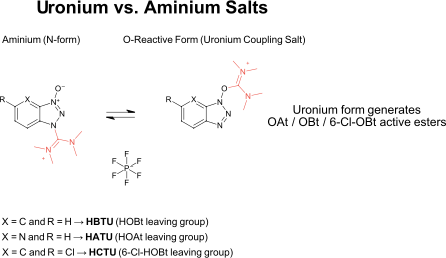
A critical gap in many descriptions of HATU peptide coupling concerns the actual chemical structure of the reagents involved. For years, HATU and HBTU were marketed as uronium salts because that terminology aligned with their synthetic origin and reactivity model. However, structural investigations revealed this description is incomplete. X-ray crystallography and NMR studies demonstrate that commercial HATU and HBTU exist predominantly as guanidinium/aminium isomers, rather than the originally assumed uronium structures.
The N-form as the Stable Commercial Structure
In the stable N-form, the tetramethylguanidinium unit bonds through nitrogen to the benzotriazole or azabenzotriazole system. This structure makes “aminium/guanidinium salt” a more accurate descriptor than “uronium salt.” This reassignment is not a semantic detail; it explains why these reagents remain shelf-stable as commercial solids while still serving as competent precursors for rapid activation during coupling.
The O-form as the More Reactive Configuration
Carpino and co-workers demonstrated that true uronium O-isomers can be prepared under controlled conditions and that these isomers are more reactive than the N-isomers. They noted that the O-form readily isomerizes to the N-form in the presence of a tertiary base, while the reverse process rarely occurs under practical conditions. In short, while the commercial reagent is the N-form, activation chemistry relies on accessing a more reactive, uronium-like state during the coupling event.
Why This Matters at the Bench
For the practicing chemist, the takeaway is simple: the bottle contains the stable form, but the reaction requires the reactive form. This dichotomy explains why the choice of base, order of addition, and reagent lifetime in solution strongly dictate performance. Mechanistically, viewing HATU or HBTU as fixed structural objects is too simplistic; the reagent functions as a dynamic reactive platform rather than a static electrophile.
Structural Exception: COMU
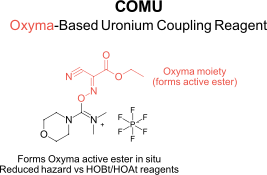
COMU, an Oxyma-based “third-generation” reagent, provides an instructive comparison. Unlike HATU, COMU is commonly isolated as an O-uronium reagent, combining high efficiency with a superior safety profile. This comparison highlights the position of the HATU/HBTU family as a historical transition between classical benzotriazole chemistry and modern oxime-based activation systems.
Counterion Effects
Chemists most commonly encounter HATU and HBTU as hexafluorophosphate (PF6–) salts, though some variants use tetrafluoroborate (BF4–). In routine synthesis, the counterion rarely affects coupling rates or stereochemical outcomes. Its influence is largely limited to reagent formulation, crystallinity, and solubility (e.g., DMF or NMP). As a result, certain reagent variants may display improved dissolution or storage stability depending on the counterion employed. While noteworthy for handling, the counterion is not a primary determinant of coupling performance.
Active Ester Chemistry: The True Reactive Intermediate
In HATU peptide coupling (and other related reagents), the reagent itself does not react directly with the incoming amine. Instead, it functions as a high-energy activation system that generates a reactive active ester in situ. This intermediate is the species that ultimately undergoes aminolysis to form the peptide bond. Understanding the transition from the uronium/aminium salt to the active ester is essential for controlling coupling kinetics, optimizing reagent performance, and minimizing epimerization of activated amino acids.
The Pathway to Activation
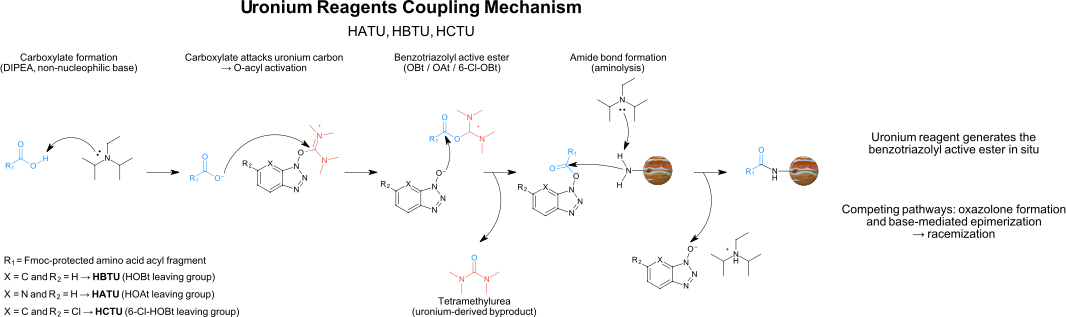
Activation begins when a tertiary base—typically DIPEA or 2,4,6-collidine—deprotonates the N-protected amino acid. This step generates a carboxylate anion, which acts as the nucleophile that initiates the activation sequence. The carboxylate attacks the electrophilic carbon center of the uronium/aminium reagent, initiating a cascade of transformations that ultimately produces the active ester responsible for peptide bond formation.
Formation of the O-Acyluronium Intermediate
The nucleophilic attack of the carboxylate on the coupling reagent forms a highly electrophilic O-acyluronium intermediate. This species remains associated with the benzotriazole-derived leaving group (OBt or OAt) and represents the first activated form of the amino acid generated during the coupling reaction. Although highly reactive, the O-acyluronium intermediate is transient and rarely accumulates under typical coupling conditions.
Active Ester Formation
The liberated HOAt or HOBt anion rapidly intercepts the O-acyluronium intermediate. This intramolecular capture converts the intermediate into a benzotriazole-based active ester:
- OAt ester when HATU is used
- OBt ester when HBTU is used
During this step, tetramethylurea (TMU) is released as the stoichiometric by-product of the activation reaction. The resulting active ester is less reactive than the acyluronium intermediate but significantly more stable, allowing it to persist long enough to react efficiently with the peptide amine.
Aminolysis
In the final step, the incoming peptide amine attacks the carbonyl carbon of the active ester. This nucleophilic substitution produces the amide bond, completing the peptide coupling event and regenerating the benzotriazole-derived leaving group. Because the active ester remains sufficiently reactive toward amines, this aminolysis step typically proceeds rapidly under standard SPPS conditions.
Relative Leaving Group Ability and Reactivity
The efficiency of HATU peptide coupling depends largely on the identity of the active ester generated during the activation step.
HOAt vs. HOBt
HATU produces OAt esters, derived from 7-azabenzotriazole (HOAt), while HBTU produces OBt esters, derived from benzotriazole (HOBt).
OAt esters generally display higher reactivity toward amines. The additional nitrogen atom present in the azabenzotriazole ring increases the electron-withdrawing character of the leaving group and contributes to the neighboring-group effect that accelerates aminolysis. This model explains why HATU peptide coupling often shows faster aminolysis kinetics. A detailed mechanistic discussion of this HOAt neighboring-group effect is provided in our dedicated article on HOAt activation chemistry.
This electronic effect facilitates faster aminolysis, which explains why HATU often outperforms HBTU in sterically demanding couplings.
Another reagent in this family is HCTU, which generates chlorobenzotriazole (ClBt) active esters. These intermediates typically show reactivity between OBt and OAt systems. Although HCTU is less commonly used than HATU or HBTU, it can provide improved coupling efficiency in certain sterically hindered sequences while maintaining compatibility with standard SPPS conditions.
HOAt as an Additive
In some workflows, HOAt is added deliberately when using HBTU. In this case, the OBt intermediate can be intercepted by HOAt to generate the corresponding OAt active ester in situ. This strategy allows chemists to achieve HATU-like activation strength while maintaining the operational simplicity of HBTU-based protocols.
Oxyma-Based Esters
More recent coupling reagents, such as COMU, generate Oxyma-derived active esters rather than benzotriazole esters. These intermediates combine high coupling efficiency with improved suppression of certain side reactions and have therefore become increasingly common in modern peptide synthesis workflows, particularly in process chemistry and large-scale peptide production.
Oxyma is also widely used outside uronium systems. In many modern protocols, DIC/OxymaPure activation replaces classical HOBt- or HOAt-based chemistry to improve safety and process robustness. A detailed discussion of this activation strategy is provided in our guide on DIC–OxymaPure peptide coupling.
HCTU and Chlorobenzotriazole Activation
HCTU generates a chlorobenzotriazole (ClBt) active ester rather than the OBt or OAt esters produced by HBTU and HATU. The chlorine substituent on the benzotriazole ring increases the electron-withdrawing character of the leaving group, which slightly increases the electrophilicity of the activated carbonyl. As a result, ClBt esters typically show reactivity intermediate between OBt and OAt systems. This places HCTU mechanistically between HBTU and HATU in terms of activation strength.
Lifetime of the Active Ester and Racemization
A key advantage of uronium-mediated activation lies in the rapid conversion of the highly reactive O-acyluronium species into a trapped active ester. Because the transient acyluronium intermediate is quickly intercepted by the benzotriazole or Oxyma nucleophile, the activated carboxyl group spends less time exposed to strongly basic conditions. This kinetic effect reduces the probability of oxazolone formation, the primary mechanistic pathway responsible for racemization (epimerization) of activated amino acids during peptide coupling. Although active esters remain susceptible to epimerization if aminolysis becomes slow, rapid trapping and efficient amine attack generally minimize this competing pathway.
Definition & Mechanism: The 7-Aza Effect
The key feature of HATU peptide coupling that distinguishes it from HBTU-mediated activation is the 7-azabenzotriazole leaving group (HOAt). Chemists often attribute the higher performance of HATU to anchimeric assistance, commonly known in peptide chemistry as the 7-aza effect (or neighboring effect). This mechanistic model is widely used to explain why HATU often shows faster aminolysis kinetics and higher coupling efficiency, especially for sterically hindered amino acids or aggregation-prone peptide sequences.

Anchimeric Assistance and the 7-Aza Nitrogen
The HOAt heterocycle contains an additional nitrogen atom at the 7-position of the triazolopyridine ring. This nitrogen creates a pyridine-like electronic environment that is absent in the benzotriazole system used in HBTU. The position of this nitrogen allows it to interact with the incoming nucleophilic amine during the aminolysis step of the coupling reaction. In the OAt active ester intermediate, the 7-nitrogen can form a transient hydrogen bond with the approaching peptide amine. The interaction is short-lived but can influence both the geometry and energetics of the aminolysis transition state. This interaction provides several mechanistic advantages:
- Transition-State Stabilization: The hydrogen bond between the amine nucleophile and the 7-nitrogen stabilizes the developing transition state during nucleophilic attack on the activated carbonyl.
- Nucleophile Orientation: The heterocyclic nitrogen can help orient the incoming amine toward the electrophilic carbonyl carbon. This orientation promotes a more productive trajectory for nucleophilic attack.
- Enhanced Electrophilicity of the Active Ester: The additional ring nitrogen increases the electron-withdrawing character of the azabenzotriazole leaving group. This electronic effect increases the electrophilicity of the activated carbonyl center.
Together, these effects accelerate the aminolysis of OAt active esters compared with the OBt esters produced during HBTU-mediated coupling.
The Activation Sequence
HATU-mediated coupling follows the general activation pathway typical of uronium-based peptide coupling reagents. Under basic conditions, a tertiary base such as DIPEA or 2,4,6-collidine first deprotonates the N-protected amino acid. This step generates a carboxylate anion.
The carboxylate then attacks the electrophilic carbon center of the uronium reagent. This nucleophilic attack forms a reactive O-acyluronium intermediate. The OAt leaving group rapidly intercepts this intermediate. This step produces the corresponding OAt active ester and releases tetramethylurea (TMU) as the stoichiometric by-product.
Kinetic Consequences for Racemization
A major practical advantage of HATU peptide coupling is the rapid conversion of the transient O-acyluronium intermediate into a trapped OAt active ester, followed by fast aminolysis. Because these steps occur quickly, the activated amino acid spends less time in highly reactive states that promote oxazolone formation. Oxazolone formation represents the primary pathway that leads to racemization during peptide bond formation.
This kinetic advantage becomes particularly important for amino acids with relatively acidic α-protons and for residues that readily form oxazolone intermediates during activation.
Fast aminolysis allows productive peptide bond formation to outcompete competing pathways, including epimerization and hydrolysis. As a result, the OAt active ester system significantly improves the efficiency and reliability of HATU-mediated peptide coupling reactions.
The Chemist’s Perspective: The Guanidylation Trap
One of the most frustrating failure modes in HATU peptide coupling is the irreversible guanidylation of the peptide N-terminus. In this side reaction, the free amine of the growing peptide chain reacts directly with the coupling reagent instead of the activated amino acid. This reaction produces a tetramethylguanidinium-capped peptide, which permanently blocks further chain elongation. The modification effectively creates a dead sequence on the resin. As a result, overall yield drops and truncated impurities accumulate.
These impurities often persist through purification and complicate downstream analysis. Guanidylation usually appears when the activation step becomes slow. This situation commonly occurs during couplings of sterically hindered residues such as valine or isoleucine, or when excess uronium reagent remains in solution during aggregation-prone peptide syntheses. Under these conditions, the uronium reagent remains in solution long enough for the peptide amine to act as a competing nucleophile.
From an analytical perspective, this modification often appears in LC–MS as an approximate +98.08 Da mass shift, corresponding to incorporation of a tetramethylguanidinium fragment. A detailed mechanistic analysis, diagnostic mass signatures, and prevention strategies will be presented in our dedicated guide.
Safety and Regulatory Context
The purpose of this section is not to act as EHS guidance. It is only to flag that these reagents are not benign bench powders and should not be treated casually.
Classical benzotriazole additives such as HOBt and HOAt are well known in peptide chemistry for their energetic hazard profile in dry form, and that concern helped drive the field toward safer oxime-based systems such as Oxyma-derived reagents and COMU. Modern reviews of coupling-reagent selection explicitly frame COMU and related reagents as part of that shift.
Separately, uronium coupling reagents are associated with occupational sensitization risk. Recent literature and case-based reports describe HBTU, HATU, and related reagents as immune sensitizers capable of causing respiratory or dermal allergic reactions after repeated exposure. The point for this article is awareness, not procedural instruction: labs should treat these reagents as substances whose hazard profile must be checked against current SDS documents and institutional safety procedures.
From a pharmaceutical process perspective, reagent-derived impurities and degradation products also matter in CMC because residual process chemicals and related impurities must remain within acceptable impurity-control frameworks during development and manufacturing. That is another reason these reagents are not merely “coupling tools”; they also create a downstream analytical and regulatory burden.
Practical Considerations for Uronium Coupling Reagents
Although uronium reagents simplify peptide activation, their performance still depends strongly on solvent choice, base selection, and activation strategy. Small procedural differences can determine whether coupling proceeds efficiently or leads to slow conversion, racemization, or side reactions. The following considerations apply broadly to the most common reagents in this class: HATU, HBTU, HCTU, and COMU.
Handling and Solubility Limits
Uronium coupling reagents show similar solubility behavior in common peptide synthesis solvents. Most dissolve readily in polar aprotic solvents, particularly DMF and NMP, which remain the standard media for both manual and automated SPPS.
| Solvent | Practical Behavior | Comment |
|---|---|---|
| DMF | Fully soluble | Standard solvent for uronium-mediated coupling |
| NMP | Fully soluble | Often used in automated peptide synthesizers |
| DCM | Poor solubility | Reactions may begin as heterogeneous suspensions |
| DMF/DCM mixtures | Variable solubility | May require careful mixing |
Poor solubility can create misleading results. If the reagent initially forms a slurry instead of a clear solution, activation efficiency may drop because the effective concentration of the reagent in solution is lower than expected. For consistent activation chemistry, most protocols therefore rely on anhydrous DMF or NMP when working with uronium reagents.
The traditional solvents for uronium-mediated peptide coupling are DMF and NMP because they dissolve both the reagents and the growing peptide-resin efficiently. However, regulatory pressure on these reprotoxic solvents has motivated the exploration of alternative media such as Cyrene, γ-valerolactone (GVL), and N-butylpyrrolidinone (NBP). While promising, these alternatives often require careful optimization of base stability, resin swelling, and reagent solubility.
Base Selection
The choice of base strongly influences both activation efficiency and stereochemical stability during uronium-mediated coupling.
| Base | Typical Role | Strengths | Limitation |
|---|---|---|---|
| DIPEA | Standard SPPS base | Fast and reliable activation | May increase racemization risk in sensitive couplings |
| 2,4,6-Collidine (TMP) | Lower-basicity alternative | Reduced α-proton abstraction | Slightly slower activation in routine couplings |
DIPEA remains the most common base for routine SPPS workflows because it provides rapid activation and efficient aminolysis. However, in fragment couplings or racemization-sensitive steps, many chemists prefer collidine. Its lower basicity and steric bulk reduce the likelihood of α-proton abstraction, which helps suppress epimerization during activation.
The Pre-Activation Rule
A widely used strategy for uronium-mediated coupling is brief pre-activation of the amino acid before contact with the resin-bound amine. In this approach, the N-protected amino acid, the coupling reagent, and the base are mixed for a short period—typically 1–2 minutes—before the solution is added to the peptide resin. This short pre-activation step increases the concentration of the reactive active ester at the moment it encounters the nucleophilic peptide amine.
However, excessive pre-activation can become counterproductive. If the activated mixture is allowed to stand too long, the active ester may begin to hydrolyze or participate in side reactions. As a result, most optimized protocols use short activation times followed by immediate exposure to the peptide-resin.
Note that in solid-phase peptide synthesis, excess amino acid and coupling reagent are commonly used to drive the reaction toward completion. However, in solution-phase fragment coupling, large excesses of uronium reagents can increase the risk of guanidylation or other side reactions. In such cases, careful control of reagent stoichiometry becomes important.
Choosing the Right Reagent: HATU vs HBTU vs HCTU vs COMU
Selecting the appropriate coupling reagent depends primarily on activation strength, steric demand of the sequence, and process considerations. The practical differences between uronium reagents largely arise from the reactivity of the active ester generated during amino-acid activation. More reactive esters typically accelerate aminolysis and improve coupling efficiency in sterically demanding sequences.
| Reagent | Leaving Group | Relative Reactivity | Racemization Tendency | Typical Bench Use |
|---|---|---|---|---|
| HATU | HOAt (OAt) | High | Very Low | Preferred for sterically hindered or difficult couplings |
| HBTU | HOBt (OBt) | Moderate | Low | Standard reagent for routine SPPS |
| HCTU | 6-Cl-HOBt (6-Cl-OBt) | Moderate–High | Very Low | Intermediate reactivity for moderately hindered sequences |
| COMU | Oxyma | High | Very Low | Safer alternative with high efficiency in SPPS and solution-phase |
Nevertheless, in solid-phase synthesis, coupling efficiency is not determined solely by reagent strength. Resin swelling, peptide aggregation, and steric crowding within the resin matrix can significantly slow aminolysis even when highly reactive coupling systems such as HATU are used.
| Situation | Preferred Reagent | Rationale |
|---|---|---|
| Routine linear SPPS | HBTU | Reliable OBt ester formation |
| Sterically hindered coupling | HATU | Faster aminolysis via OAt ester |
| Intermediate activation strength needed | HCTU | ClBt ester reactivity between OBt and OAt |
| Safety-conscious workflows | COMU or DIC/Oxyma | Avoids classical HOAt/HOBt systems |
| Racemization-sensitive fragment coupling | HATU or COMU with controlled base | Efficient activation with controlled stereochemistry |
- HBTU remains sufficient for many routine peptide syntheses.
- HATU is often preferred when coupling becomes slow due to steric congestion or aggregation effects.
- HCTU occupies an intermediate position within the uronium reagent family and generates chlorobenzotriazole (ClBt) active esters, which show reactivity between OBt and OAt systems.
- COMU represents a newer generation of coupling reagents based on Oxyma-derived activation chemistry, which often combines efficient coupling with improved safety profiles.
These recommendations should be viewed as guidelines rather than strict rules, because optimal reagent choice ultimately depends on the specific peptide sequence and synthesis conditions.
Microwave-Assisted SPPS: Compatibility and Practical Limits
Microwave-assisted solid-phase peptide synthesis (MW-SPPS) accelerates peptide coupling by rapidly heating the reaction mixture, typically to 50–90 °C. The increased temperature significantly shortens coupling times and often improves crude purity by accelerating aminolysis of activated intermediates. Uronium-type reagents such as HATU, HBTU, HCTU, and COMU are all compatible with microwave-assisted workflows and are widely used in both manual and automated synthesizers.
However, microwave heating does not fundamentally change the underlying coupling chemistry. The same active ester intermediates are formed (OBt, OAt, ClBt, or Oxyma esters), and the same competing pathways—such as racemization, hydrolysis, or slow aminolysis in sterically hindered couplings—still govern reaction outcomes. Microwave irradiation primarily accelerates these processes.
Reagent Behavior Under Microwave Conditions
Among uronium-type reagents, HATU remains a powerful option for difficult couplings because the OAt active ester reacts rapidly even at short reaction times. HBTU generally performs well for routine microwave couplings but offers little advantage when the temperature already accelerates the reaction. HCTU occupies an intermediate position in activation strength through formation of chlorobenzotriazole (ClBt) esters.
COMU, which generates an Oxyma-derived active ester, has received particular attention in microwave-assisted synthesis and is often favored in modern automated workflows because it combines efficient activation with a more favorable safety profile than benzotriazole-based reagents.
Temperature-Sensitive Residues
Elevated temperatures can increase the risk of epimerization, particularly for residues with relatively acidic α-protons such as Cys, His, and Asp. In practice, many microwave protocols reduce coupling temperature or switch to milder bases (for example 2,4,6-collidine) for these residues. Difficult sequences may therefore use a mixed strategy, combining microwave-accelerated steps with conventional couplings where stereochemical stability is critical.
Practical Constraints
Despite the kinetic advantages of microwave heating, several practical constraints remain:
- Sequence aggregation can still slow aminolysis even at elevated temperature.
- Reagent stability becomes important in automated synthesizers where activated solutions may sit in reservoirs for extended periods.
- Solvent choice and resin swelling remain critical for efficient reagent delivery to the growing peptide chain.
As a result, microwave heating should be viewed primarily as a kinetic accelerator rather than a fundamentally different coupling chemistry. Careful reagent selection and temperature control remain essential for reliable peptide synthesis.
HATU and HBTU Peptide Coupling — FAQ
HATU solutions in DMF slowly degrade through hydrolysis and reagent decomposition. In practice, solutions are usually prepared fresh for synthesis runs, especially in automated systems where reproducibility is important.
Yes. Bio-based solvents such as Cyrene or γ-valerolactone (GVL) have been explored as alternatives to DMF. However, base stability and resin swelling must be verified because some bases can open the lactone ring of GVL.
In most peptide syntheses the counterion has little influence on reaction rates or racemization. Differences mainly affect physical properties such as solubility, crystallinity, and reagent handling.
HATU generates an OAt active ester derived from HOAt. The additional ring nitrogen enables the so-called 7-aza effect, which accelerates aminolysis and improves coupling efficiency for sterically hindered or aggregation-prone sequences.
HATU itself does not prevent racemization completely. Epimerization mainly arises from oxazolone formation or base-mediated α-proton abstraction. Faster aminolysis with OAt esters often reduces, but does not eliminate, this risk.
This side reaction occurs when the peptide amine reacts directly with the uronium reagent instead of the activated amino acid. The resulting tetramethylguanidinium modification caps the peptide and stops chain elongation.
Yes. HATU can be used in microwave-assisted peptide synthesis, although temperature control remains important for residues prone to epimerization such as Cys, His, and Asp.
References
El-Faham, A., & Albericio, F. (2011). Peptide Coupling Reagents, More than a Letter Soup. Chemical Reviews, 111(11), 6557–6602.
- Relevance: The definitive modern review on coupling reagents. This paper provides the comprehensive mechanistic breakdown of active ester formation, racemization pathways (oxazolone vs. direct enolization), and the side reactions triggered by uronium salts, including the guanidylation trap.
- DOI: 10.1021/cr100048w
Abdelmoty, I., Albericio, F., Carpino, L. A., Foxman, B. M., & Kates, S. A. (1994). Structural studies of reagents for peptide bond formation: Crystal and molecular structures of HBTU and HATU. Letters in Peptide Science, 1(2), 57–67.
- Relevance: The critical X-ray crystallography and NMR study that conclusively proved commercial HATU and HBTU exist as N-guanidinium (aminium) salts rather than the originally assumed O-uronium structures.
- DOI: 10.1007/BF00126274
Carpino, L. A. (1993). 1-Hydroxy-7-azabenzotriazole. An efficient peptide coupling additive. Journal of the American Chemical Society, 115(10), 4397–4398.
- Relevance: The foundational paper introducing the HOAt moiety and the synthesis of HATU. It outlines the experimental evidence for the “7-aza effect” (anchimeric assistance) that dramatically accelerates coupling kinetics for sterically hindered residues.
- DOI: 10.1021/ja00063a082
El-Faham, A., Subirós-Funosas, R., Prohens, R., & Albericio, F. (2009). COMU: A safer and more effective replacement for benzotriazole-based uronium coupling reagents. Chemistry – A European Journal, 15(37), 9404–9416.
- Relevance: Essential reading for the safety and regulatory context. This paper discusses the explosive hazards associated with HOBt/HOAt and introduces Oxyma-based reagents (like COMU) as stable, highly reactive $O$-uronium alternatives.
- DOI: 10.1002/chem.200900615
Kumar, A., et al. (2017). Green Solid-Phase Peptide Synthesis 4. γ-Valerolactone and N-Formylmorpholine as Green Solvents for Solid Phase Peptide Synthesis. ACS Sustainable Chemistry & Engineering, 58(30), 2986-2988.
- Relevance: Provides the empirical data supporting the use of bio-based green solvents (like GVL) as direct replacements for DMF in demanding Fmoc-SPPS couplings, noting the necessary bench adjustments.
- DOI: 10.1016/j.tetlet.2017.06.058
Pedersen, S. L., Tofteng, A. P., Malik, L., & Jensen, K. J. (2012). Microwave Heating in Solid-Phase Peptide Synthesis. Chemical Society Reviews, 41(5), 1826–1844.
- Comprehensive review of microwave-assisted SPPS, including reaction kinetics and compatibility with common coupling reagents like HATU and HBTU.
- DOI: 10.1039/C1CS15214A
Bacsa, B., & Kappe, C. O. (2007). Rapid solid-phase synthesis of a calmodulin-binding peptide using controlled microwave irradiation. Nature Protocols, 2(9), 2222–2227.
- Practical protocol describing microwave-assisted Fmoc-SPPS, demonstrating the compatibility of coupling reagents under controlled microwave synthesis workflows.
- DOI: 10.1038/nprot.2007.300