Histidine racemization remains one of the most technically challenging side reactions in Fmoc solid-phase peptide synthesis (SPPS). Unlike cysteine, where direct base-mediated α-deprotonation dominates, histidine displays a more complex behavior driven by the electronic properties of its imidazole side chain during carboxyl activation.
When Fmoc-His(PG)-OH is converted into an activated ester (e.g., OBt-, OAt-, or uronium intermediates), the carbonyl becomes strongly electron-withdrawing. This increases the acidity of the α-proton and enables partial enolization under basic coupling conditions. In practice, epimerization often appears as a chromatographic doublet with identical mass spectra but distinct retention times, reflecting L- and D-His residues.
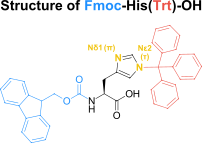
The defining feature of histidine is the proximity of its heteroaromatic ring to the reaction center. The imidazole contains two nonequivalent nitrogens, Nδ1 (π) and Nε2 (τ), whose protection pattern influences the stability and reactivity of the activated species. Although oxazolone formation is not unique to histidine, the side-chain electronics can modulate the lifetime and reactivity of activation intermediates, making histidine particularly sensitive under standard coupling conditions.
Histidine racemization occurs during a brief but critical window: the lifetime of the activated ester in polar aprotic solvent under basic conditions. Even low single-digit percentages of D-His formation at this stage can alter secondary structure, receptor affinity, or chromatographic purity. A peptide predicted to be stable in silico may therefore be synthetically compromised. Control of histidine racemization requires understanding activation chemistry, base strength, protecting-group effects, and reaction time—not biological stability metrics.
Predict Histidine Racemization Risk with Peptalyzer™
Use Peptalyzer™ to scan peptide sequences for histidine residues in sterically congested environments and identify regions with elevated racemization susceptibility before synthesis.
📘 What will you learn here?
Definition & Mechanism: The Nδ1 / Nε2 Protection Dilemma
Histidine vulnerability arises during activation, not from the free amino acid itself. Upon formation of an activated ester, the α-proton becomes significantly more acidic. Under tertiary amine base (e.g., DIPEA), partial enolization can occur before nucleophilic capture by the incoming amine.
Protection pattern matters. In the commonly used His(Trt) derivative, Nε2 is protected while Nδ1 remains free. The unprotected nitrogen retains a lone pair capable of hydrogen bonding or transient intramolecular interaction. While definitive proof of direct intramolecular α-deprotonation remains limited, numerous experimental observations show that racemization levels depend strongly on the imidazole protection pattern. This indicates that side-chain electronics influence the energy landscape of the activated intermediate.
Histidine therefore occupies an intermediate mechanistic position: it can racemize via direct α-deprotonation, via oxazolone formation, or through pathways influenced by imidazole-assisted stabilization of reactive intermediates.
Activated Intermediate Lifetime: The Real Racemization Window
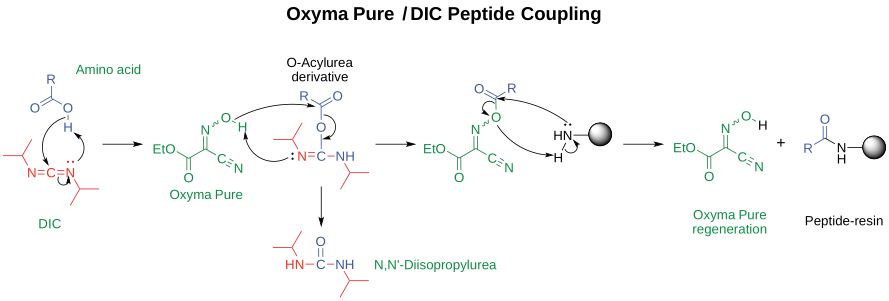
Histidine racemization does not occur during the entire coupling step but within a narrow mechanistic window: the lifetime of the activated amino acid intermediate in solution. During activation (e.g., HATU/DIPEA or DIC/Oxyma), the amino acid is converted into a highly electrophilic species such as:
- an OAt ester
- an OBt ester
- an Oxyma ester
Before nucleophilic capture by the resin-bound amine, this intermediate can undergo competing processes:
- Direct α-deprotonation → enolate → racemization
- Intramolecular cyclization → oxazolone
- Productive amide bond formation
Thus, the kinetic lifetime of the activated species, rather than histidine itself, determines racemization probability.

Mechanistic Regimes of Histidine Racemization
Histidine epimerization during Fmoc-SPPS proceeds through two dominant mechanistic regimes: direct base-mediated α-deprotonation (Path A) and activation-dependent oxazolone formation (Path B). These pathways are not mutually exclusive; rather, their relative contribution depends on activation chemistry, base strength, temperature, and protecting-group pattern.
A critical determinant in both regimes is the lifetime of the activated ester. The longer the activated intermediate persists without nucleophilic capture by the resin-bound amine, the greater the probability of α-deprotonation and configurational scrambling. Conceptually, racemization increases when:
- Activated ester concentration is high,
- Base concentration or basicity is high,
- Nucleophilic attack by the growing peptide chain is slow (steric hindrance, aggregation, poor solvation).
Thus, epimerization is governed less by inherent histidine instability and more by kinetic competition between productive amide bond formation and enolization of the activated intermediate. Crucially, both mechanisms operate while histidine exists as an activated amino acid derivative in solution. Once the residue is incorporated into the peptide backbone as an amide, oxazolone formation and α-deprotonation pathways are effectively eliminated under standard Fmoc-SPPS conditions.
Path A: Direct α-Proton Abstraction (External Base-Mediated)
Mechanistic Evidence: Level A – Experimentally proven mechanism
In Path A, racemization follows the classical base-catalyzed mechanism observed for many activated amino acids. Upon formation of an activated ester, the electron-withdrawing carbonyl increases α-proton acidity. A tertiary amine base such as DIPEA can abstract this proton, generating a planar enolate intermediate.
Because the enolate is achiral, reprotonation can occur from either face of the α-carbon, yielding a mixture of L- and D-histidine. The extent of epimerization therefore correlates strongly with base strength, base concentration, temperature, and duration of activated ester exposure. This pathway becomes dominant under conditions of strong base, elevated temperature, or prolonged preactivation.
Path B: Oxazolone-Mediated Epimerization
Mechanistic Evidence: Level B – Widely accepted mechanistic model
Path B involves intramolecular cyclization of the activated amino acid to form a 5(4H)-oxazolone intermediate. This cyclization occurs through nucleophilic attack of the backbone amide carbonyl oxygen on the activated carboxyl group and does not require deprotonation of the Fmoc-protected amine. Oxazolone formation is promoted under basic activation conditions and can occur even when external base concentration is modest.
Once formed, the oxazolone possesses an α-proton that is more acidic than in the open-chain ester. Deprotonation of this cyclic intermediate generates a conjugatively stabilized enolate. Subsequent ring opening can then occur with loss of stereochemical integrity. Oxazolone formation is a general feature of activated amino acids; however, in histidine the imidazole side chain can influence this pathway by modulating the stability and geometry of the activated intermediate. Because oxazolone formation is intramolecular and activation-driven, Path B can remain significant even when external base concentration is modest.
Importantly, oxazolone formation alone does not produce racemization and the oxazolone intermediate itself remains configurationally defined at the α-carbon. Configurational scrambling occurs only after base-mediated α-proton abstraction from the oxazolone, which generates a planar enolate capable of reprotonation from either face of the α-carbon.
Because oxazolone formation and α-deprotonation occur while the amino acid remains in its activated form, racemization takes place before incorporation into the peptide chain and becomes effectively irreversible once the residue is coupled.
In histidine, the imidazole side chain further modulates the accessibility of this pathway. Electronic interactions between the heteroaromatic ring and the activated backbone can alter the stability and conformation of the oxazolone precursor, making histidine more sensitive to activation conditions than many aliphatic residues.
Protecting Group Selection: Electronic Control Over Racemization
Protecting-group selection is the most powerful structural lever available to control histidine racemization. The choice determines which imidazole nitrogen remains electronically available during activation.
The industry standard, Fmoc-His(Trt)-OH, carries a trityl group at the Nε2 (τ) position. This leaves Nδ1 (π) unprotected. While Trt offers practical advantages—low cost, straightforward TFA cleavage, broad availability—it does not suppress potential electronic participation of the imidazole ring during activation. Under mild, room-temperature conditions, Trt protection is often sufficient. However, as activation time, temperature, or base strength increase, racemization levels can rise.
For thermally demanding or aggregation-prone sequences, electronic shielding of the Nδ1 (π) position becomes mechanistically advantageous.
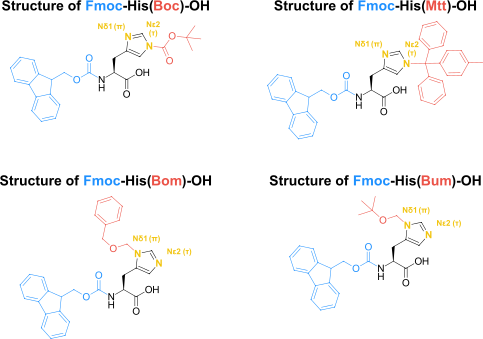
| Protecting Group | CAS Number | Protected Position | Relative Resistance | Cleavage Conditions | High-Temp Stability (≈75°C) |
|---|---|---|---|---|---|
| Trityl (Trt) | 109425-51-6 | Nε2 (τ) | Moderate | TFA | Increased epimerization risk |
| Boc / Mtt | 81379-52-4 / 133367-34-7 | Nε2 (τ) | Moderate–High | TFA / Mild acid | Condition-dependent |
| Bom (Benzyloxymethyl) | 84891-19-0 | Nδ1 (π) | High | Hydrogenolysis | Improved stability |
| Bum (t-Butoxymethyl) | 90653-46-6 | Nδ1 (π) | High | TFA | Improved stability |
Thermal Considerations: Microwave-Assisted SPPS
Modern microwave-assisted SPPS frequently operates between 70–90 °C to accelerate difficult couplings. Elevated temperature increases both the rate of productive amide formation and the rate of competing epimerization. With His(Trt), increased thermal energy shortens the time required for oxazolone formation and α-deprotonation. Importantly, temperature does not create a new mechanism; it amplifies existing kinetic competition.
Nδ1 (π) Protection: Mechanistic Rationale
Protecting groups such as Bom or Bum are installed at the Nδ1 (π) position. This alters the electronic profile of the imidazole ring and reduces its ability to stabilize or participate in activation-derived intermediates. Experimental observations consistently show lower D-His formation when Nδ1 is protected under identical activation conditions. However, such derivatives introduce practical trade-offs: increased cost, limited commercial availability, and (in the case of Bom) a requirement for hydrogenolysis.
In addition to electronic effects, the imidazole ring introduces subtle conformational constraints near the α-carbon. Formation of the oxazolone intermediate requires a specific backbone geometry that allows intramolecular attack of the amide carbonyl oxygen on the activated carboxyl group. The rigid heteroaromatic side chain of histidine slightly restricts this alignment compared with smaller aliphatic residues. As a result, histidine generally exhibits intermediate racemization propensity—higher than most nonpolar residues but typically lower than highly activated residues such as cysteine.
The Chemist’s Perspective: Kinetic Risk at the Bench
In textbooks, reaction variables appear discrete and controllable. At the bench, histidine coupling is governed by kinetic competition. Productive amide bond formation must outpace all pathways leading to α-deprotonation and oxazolone-mediated epimerization.
Histidine racemization is rarely catastrophic in a single step. Instead, it accumulates. Each activation cycle, each elevated-temperature coupling, and each delay in nucleophilic capture contributes incrementally to D-His formation. The synthesis of histidine-containing peptides is therefore a race between coupling and configurational loss.
⚠️ The Chemist’s Trap: Pre-Activation Delay
One of the most common and preventable causes of histidine racemization is prolonged pre-activation in automated synthesizers.
In many protocols, the amino acid is premixed with base (e.g., DIPEA or collidine) and an activating reagent (e.g., HATU or HBTU) before delivery to the resin. During this interval, the activated ester exists in solution under basic conditions but without a competing nucleophile.
Under these circumstances, oxazolone formation and α-deprotonation can occur before the coupling step begins. By the time the reagent reaches the resin-bound amine, a fraction of the activated histidine may already be epimerized.
Bench Rule: For histidine couplings, use in situ activation whenever possible, or minimize pre-activation time to the shortest interval supported by your synthesizer configuration.
Why “Wait-Times” Matter Mechanistically
During productive coupling, the resin-bound N-terminal amine rapidly intercepts the activated ester. This nucleophilic capture shortens the lifetime of the reactive intermediate and limits exposure to racemization pathways. During pre-activation, no such nucleophile is present. Because epimerization at this stage occurs before attachment to the growing peptide chain, any D-His formed becomes permanently incorporated. Subsequent washing or recoupling cannot correct this structural defect.
Practical Workflow: Proven Strategies for Preventing Histidine Racemization
Effective suppression of histidine racemization requires simultaneous control of three variables: the basicity of the reaction medium, the reactivity/lifetime of the activated intermediate, and the thermal energy applied during coupling chemistry.
The Racemization Triangle
Histidine racemization during SPPS is governed by three interacting parameters. Epimerization increases when all three factors align.
| Factor | Mechanistic Role | Practical Implication |
|---|---|---|
| Base strength and concentration | Controls α-proton abstraction | Weaker bases (e.g., collidine) reduce racemization |
| Activation chemistry | Affects oxazolone formation | DIC/Oxyma generally lower racemization |
| Activated intermediate lifetime | Determines exposure window | Minimize pre-activation time |
| Temperature | Accelerates all pathways | High temperature increases racemization risk |
High-Risk Histidine Racemization Scenario
- HATU + DIPEA
- Microwave heating
- Slow coupling sequence
Low-Risk Histidine Racemization Scenario
- DIC / Oxyma
- Room temperature
- Minimal activation time
Base Selection: DIPEA vs 2,4,6-Collidine
In uronium- or aminium-based systems (e.g., HATU, HBTU), a tertiary amine is required to generate the activated ester. DIPEA is widely used, but its relatively high basicity increases the probability of α-proton abstraction. 2,4,6-Collidine (TMP) is less basic and more sterically hindered. Mechanistically, collidine provides a lower effective proton abstraction rate and reduced access to the activated α-position, though it may result in slightly slower initial activation.
Coupling Reagents and Additives
- DIC / OxymaPure: The combination of DIC with OxymaPure consistently shows lower racemization compared to uronium/DIPEA systems. This is attributed to the reduced basicity of the medium, rapid formation of the Oxyma ester, and lower accumulation of long-lived intermediates.
- HATU / HBTU Systems: Uronium-based reagents are highly efficient but typically require excess tertiary amine, amplifying Path A racemization if activation is prolonged. Reagent choice must be aligned with activation time and temperature.
Solvent Effects: Polarity and Intermediate Stability
DMF remains the standard solvent due to high solvation capacity, but its polarity stabilizes charged intermediates (enolates, oxazolones). Reducing solvent polarity by introducing a small fraction of dichloromethane (DCM) can modestly reduce racemization in some systems by destabilizing these charged intermediates. Emerging greener solvents like gamma-valerolactone (GVL) and tert-amyl methyl ether (TAME) are under investigation, but their impact on racemization is not fully characterized.
Practical Workflow for High Chiral Integrity
For histidine residues in sensitive or high-purity syntheses:
- Prefer DIC / OxymaPure under room-temperature conditions when feasible.
- If using HATU or HBTU, consider substituting DIPEA with 2,4,6-collidine.
- Avoid unnecessary pre-activation and minimize activation time.
- Use room-temperature coupling unless thermal assistance is essential.
- If microwave heating is required, reassess protecting-group strategy and base strength accordingly.
Analytical Detection: Resolving the Isobaric Doublet
Histidine racemization presents a distinctive analytical challenge. The D-His epimer is isobaric with the desired L-His product (expected mass shift: 0 Da) and is therefore indistinguishable by mass spectrometry alone.
LC–MS Interpretation: The Doublet Signature
Because L- and D-His peptides are diastereomers, they differ subtly in three-dimensional structure and interaction with the stationary phase. In crude peptide analysis, histidine racemization typically appears as:
- Two baseline-separated peaks sharing the same m/z.
- A partially resolved shoulder on the main peak.
- Peak asymmetry or fronting in otherwise clean chromatograms.
Improving L/D-His Resolution
Separation is highly method-dependent and influenced by column chemistry, gradient slope, mobile-phase composition, and temperature. Because histidine contains an ionizable imidazole (pKa ≈ 6.0), chromatographic behavior is sensitive to pH. However, most peptide RP-HPLC methods operate under strongly acidic conditions (e.g., 0.1% TFA), where histidine is protonated and differences between diastereomers may be modest.
If racemization is suspected but only a single peak is observed:
- Reduce the gradient slope across the expected elution window.
- Lower the flow rate to increase interaction time.
- Adjust the mobile-phase pH toward neutral conditions (requires pH-compatible columns and careful validation).
For definitive confirmation of histidine epimerization, chiral derivatization methods such as Marfey’s analysis can be applied following peptide hydrolysis. In this approach, liberated amino acids are derivatized with Marfey’s reagent (FDAA or FDLA), generating diastereomeric derivatives that can be separated by LC-MS. This method allows unambiguous quantification of D-His formation even when chromatographic separation of intact peptide diastereomers is limited.
Advanced Consideration: N-Terminal Histidine
When histidine is installed as the final (N-terminal) residue, it is exposed to one additional base treatment during Fmoc removal. Unlike internal residues, N-terminal histidine is not followed by another coupling step that could dilute or mask minor stereochemical impurities. Extended exposure to basic conditions (during deprotection or storage in alkaline buffers) can promote slow α-deprotonation. Mitigation includes minimizing final deprotection time or using Boc-His derivatives when compatible with the overall cleavage strategy.
Peptalyzer™ Diagnostics: Sequence-Specific Histidine Racemization Auditing
The Peptalyzer™ Sequence Auditor analyzes peptide sequences to identify structural motifs associated with synthetic liabilities. Rather than predicting absolute racemization rates, the auditor evaluates the local sequence environment surrounding each histidine residue.
Histidine racemization during Fmoc-SPPS is primarily associated with activation-stage intermediates, where direct α-proton abstraction (Path A) or activation-dependent oxazolone pathways (Path B) can lead to epimerization. The likelihood of these events increases when productive coupling is slowed, extending the lifetime of the activated intermediate.
To approximate this behavior without requiring synthesis conditions, Peptalyzer™ assigns a sequence-context diagnostic score to each histidine residue.
Histidine Context Score
Each histidine receives a baseline score of 1, reflecting the inherent susceptibility of histidine to epimerization during the amino-acid activation stage of Fmoc solid-phase peptide synthesis (SPPS). Additional points are added based on local sequence context that may slow productive coupling and extend the lifetime of the activated histidine intermediate.
Because histidine racemization occurs while the amino acid exists as an activated ester in solution, sequence features that reduce the rate of nucleophilic capture by the growing peptide amine on the resin increase the probability of α-proton abstraction and configurational scrambling.
| Condition | Score Increment | Example |
|---|---|---|
| Histidine present | +1 | AHA |
| Histidine at N-terminus | +1 | HAAA |
| Bulky residue following histidine (in the final sequence) | +1 | AHV |
Sterically difficult residues include Val, Ile, Thr, Phe, Trp, Tyr, and Pro. These residues are β-branched, aromatic, or conformationally constrained side chains that frequently reduce coupling efficiency in solid-phase peptide synthesis. When such residues follow histidine in the final peptide sequence, they are already present on the resin during histidine coupling in Fmoc-SPPS. Their steric bulk can slow nucleophilic attack by the resin-bound amine on the activated histidine ester.
Slower nucleophilic capture by the resin-bound amine increases the lifetime of the activated histidine intermediate (for example OBt, OAt, or Oxyma esters). During this extended activation window, the α-proton of histidine becomes more susceptible to base-mediated abstraction, generating a planar enolate intermediate that can reprotonate from either face of the α-carbon and produce D-His.
Risk Classification
The final score determines the diagnostic category returned by the auditor. Because peptide synthesis proceeds from the C-terminus to the N-terminus in Fmoc-SPPS, the relevant steric influence arises from the residue already present on the resin during histidine coupling. In the final peptide sequence, this corresponds to the residue immediately following histidine.
| Score | Category | Interpretation |
|---|---|---|
| 1 | Monitor | Baseline histidine susceptibility |
| 2 | Structural | Added sequence-context concern |
| 3 | Danger | Elevated sequence-level racemization susceptibility |
For example, the sequence AHV produces a score of 2 (baseline histidine susceptibility + sterically demanding residue following histidine in the final sequence), corresponding to the Structural diagnostic category. Likewise, HAA produces a score of 2 because histidine appears at the N-terminus. A sequence such as HVA produces a score of 3 because histidine is both N-terminal and followed by a sterically demanding residue, triggering the Danger classification.
Special Case: N-Terminal Histidine
When histidine appears as the N-terminal residue of the final peptide, the residue remains exposed after the final Fmoc deprotection step without undergoing a subsequent coupling reaction. In automated syntheses, this can slightly extend the residence time of the free N-terminal histidine under basic conditions, which may marginally increase the probability of α-deprotonation and observable racemization.
Interpretation of the Warning
Peptalyzer™ does not attempt to predict quantitative epimerization levels. Instead, the diagnostic flag highlights sequence regions where coupling kinetics may be impaired by steric context or terminal positioning, conditions known to increase racemization susceptibility during activation.
The output should therefore be interpreted as a sequence-level susceptibility indicator rather than a process-specific prediction, since the actual extent of racemization also depends on activation chemistry, base strength, temperature, and coupling conditions.
Residue-Specific Racemization Pathways in Fmoc-SPPS
| Residue | Dominant Racemization Pathway & Mechanistic Driver | When It Occurs | Highest Risk Stage | Primary Control Lever |
|---|---|---|---|---|
| Cysteine (Cys) | Path A – Direct α-proton abstraction of the activated ester. Sulfur-adjacent stabilization facilitates formation of a planar enolate intermediate, making cysteine highly sensitive to strong tertiary bases and prolonged exposure to activated conditions. | Immediately after carboxyl activation, before nucleophilic capture by the resin-bound amine. | Coupling step | Reduce base strength and base exposure time; avoid prolonged preactivation and excessive DIPEA concentrations. |
| Histidine (His) | Mixed Path A / Path B, often oxazolone-weighted. Activation can generate a 5(4H)-oxazolone intermediate whose α-proton is highly acidic. Imidazole electronics and protection pattern influence stabilization of the activated intermediate. | During the lifetime of the activated ester, especially when preactivation is prolonged or coupling kinetics are slow. | Coupling step (activation window) | Minimize activation lifetime; avoid long preactivation steps; prefer DIC/Oxyma chemistry or weaker tertiary bases. |
| Aspartate (Asp) | Cyclization-driven racemization through succinimide (aspartimide) formation. Base-induced intramolecular attack generates a cyclic imide intermediate capable of enolization and stereochemical scrambling. | After base-induced cyclization during repeated Fmoc deprotection cycles. | Deprotection step | Suppress aspartimide formation using backbone protection strategies (e.g., Hmb) and milder base exposure during Fmoc removal. |
| Glutamate (Glu) | Minor Path A-type direct enolization of the activated ester. Lack of a favorable five-membered cyclization pathway results in lower intrinsic racemization propensity compared with cysteine. | During carboxyl activation under strongly basic coupling conditions. | Coupling step (typically low risk) | Avoid overly basic activation conditions; maintain short activation times during coupling. |
Histidine Racemization — FAQ
No. The L- and D-His containing peptides are diastereomers with identical molecular weights (ΔDa = 0 Da). They generate identical m/z values and must be resolved chromatographically via LC-MS.
Elevated temperatures (70–90 °C) do not create a new mechanism, but they act as a kinetic multiplier. They lower the energy barrier for Path A (deprotonation) and Path B (oxazolone formation), accelerating these side reactions faster than the desired amide coupling can complete.
Yes. When histidine is installed as the final residue, it undergoes an extra base treatment during final Fmoc removal (e.g., 20% piperidine). Prolonged base exposure at this stage, without a subsequent coupling step to mask it, can incrementally increase observable D-His formation.
For standard room-temperature synthesis, Fmoc-His(Trt)-OH remains the industry standard due to its low cost and easy TFA cleavage. However, if your sequence requires microwave heating (>70 °C) or prolonged coupling times, switching to an Nδ1-protected derivative like Fmoc-His(Bom)-OH or Fmoc-His(Bum)-OH will provide significantly higher resistance to racemization.
No. Epimerization occurs while the amino acid is an activated ester in solution. Once the D-His or L-His is nucleophilically attacked and incorporated into the growing peptide backbone, the stereocenter is permanently locked. The only remedy is to adjust the synthesis protocol and synthesize the sequence again.
References
Palasek, S. A., Cox, Z. J., & Collins, J. M. (2007). Limiting racemization and aspartimide formation in microwave-enhanced Fmoc solid phase peptide synthesis. Journal of Peptide Science, 13(3), 143–148.
- A foundational study demonstrating that high temperatures accelerate epimerization pathways and that lowering microwave coupling temperatures to 50 °C effectively limits histidine racemization.
- DOI: https://doi.org/10.1002/psc.804
Yang, Y., Hansen, L., & Baldi, A. (2022). Suppression of Simultaneous Fmoc-His(Trt)-OH Racemization and Nα-DIC-Endcapping in Solid-Phase Peptide Synthesis through Design of Experiments and Its Implication for an Amino Acid Activation Strategy in Peptide Synthesis. Organic Process Research & Development, 26(8), 2464–2474.
- Provides direct quantitative evidence that prolonged pre-activation of Fmoc-His(Trt)-OH dramatically increases racemization, reinforcing the necessity of in situ activation.
- DOI: https://doi.org/10.1021/acs.oprd.2c00144
Isidro-Llobet, A., Alvarez, M., & Albericio, F. (2009). Amino acid-protecting groups. Chemical Reviews, 109(6), 2455–2504.
- A comprehensive review detailing the electronic effects of various imidazole protecting groups (such as N-trityl vs. N-Bom) on histidine reactivity and racemization vulnerability during carboxyl activation.
- DOI: https://doi.org/10.1021/cr800323s
El-Faham, A., & Albericio, F. (2011). Peptide coupling reagents, more than a letter soup. Chemical Reviews, 111(11), 6557–6602.
- Benchmarks modern coupling reagents, highlighting the reduced racemization profile of DIC/Oxyma systems relative to traditional uronium salts like HATU for sensitive residues.
- DOI: https://doi.org/10.1021/cr100048w
Yang, Y. (2016). Chapter 11 – Peptide Racemization. Side Reactions in Peptide Synthesis, 257–292.
- A comprehensive text detailing the mechanistic pathways of peptide racemization, providing deep context on the oxazolone and direct enolization routes during carboxyl activation.
- DOI: https://doi.org/10.1016/B978-0-12-801009-9.00011-2
Behrendt, R., White, P., & Offer, J. (2016). Advances in Fmoc solid-phase peptide synthesis. Journal of Peptide Science, 22(1), 4–27.
- A cornerstone review of modern SPPS methodologies, highlighting the transition to DIC/Oxyma coupling systems and their superior efficacy in suppressing racemization for sensitive residues like histidine.
- DOI: https://doi.org/10.1002/psc.2836