What is Aspartimide Formation?
Aspartimide formation is a well-documented side reaction in Solid-Phase Peptide Synthesis (SPPS) that can compromise the integrity and yield of the desired peptide product. This side reaction is particularly concerning because it can occur under both basic and acidic conditions, affecting various stages of peptide synthesis, purification, and storage.
This issue arises when the side-chain carboxyl group of aspartic acid forms a cyclic imide with the backbone amide nitrogen, especially under basic conditions. Thus, the resulting aspartimide can undergo ring-opening reactions, leading to various side products, some of which are challenging to detect and separate.
Predict Aspartimide Risk with Peptalyzer™
Use Peptalyzer™ to map sequence-specific hotspots and identify aspartimide-prone regions before starting your synthesis.
📘 What will you learn here?
Mechanism of Aspartimide Formation
The following schematic illustrates the mechanistic steps of aspartimide formation, including mass shifts.
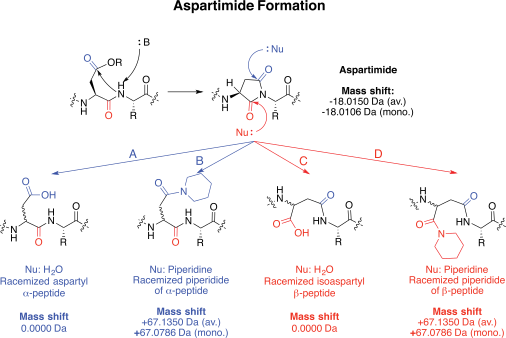
In Solid Phase Peptide Synthesis (SPPS), aspartic acid residues often have their side chains protected with ester groups to prevent undesired reactions. However, under basic conditions, such as during the Fmoc deprotection step, the following sequence can occur:
- Deprotonation: The backbone amide nitrogen adjacent to the aspartic acid residue is deprotonated, increasing its nucleophilicity.
- Nucleophilic Attack: The deprotonated amide nitrogen attacks the β-carboxyl carbon of the aspartic acid side chain, leading to the formation of a five-membered cyclic imide known as aspartimide.
- Ring Opening: The aspartimide intermediate can undergo ring-opening reactions via nucleophilic attack by various species, resulting in several possible side products:
- Hydrolysis at the α-Carbonyl: Restores the peptide with potential racemization at the aspartic acid residue, yielding L- or D-α-peptides. This modification does not result in a mass shift, making it challenging to detect by mass spectrometry and to separate by High-Performance Liquid Chromatography (HPLC).
- Hydrolysis at the β-Carbonyl: Produces isoaspartyl-β-peptides with possible racemization. Similar to the α-hydrolysis product, this modification lacks a mass shift, complicating its detection and purification.
- Aminolysis by Piperidine: Reaction with piperidine can lead to the formation of piperidide adducts at either the α- or β-carbonyl positions, resulting in side products with a nominal mass increase of +67 Da.
Notably, the aspartimide intermediate is prone to racemization due to the acidity of the α-hydrogen, leading to the formation of both L- and D-enantiomers of the aspartic acid residue.
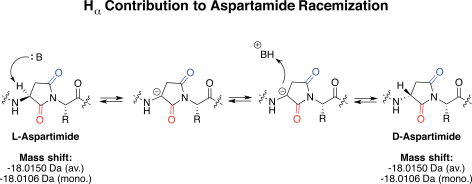
Note that a nearly identical mechanism of racemization occurs during glutarimide formation from Glu or Gln residues. Just like the 5-membered aspartimide ring, the 6-membered glutarimide intermediate features a highly acidic α-proton that promotes rapid enolization and subsequent D/L epimerization.
The “Invisible” Impurities: Mass Shift Analysis of Aspartimide Derivatives
When analyzing a synthetic peptide via LC-MS, it is a common “Chemist’s Trap” to assume a single peak at the expected mass indicates a pure product. In the context of aspartimide formation, relying solely on mass spectrometry can be misleading due to the nature of the resulting isomers.
The Zero-Mass Shift Problem: Racemized and Isoaspartyl Peptides
The ring-opening of the aspartimide intermediate by water (H2O) results in two primary products that are isobaric to the target sequence:
- Racemized α-aspartyl peptide: Formed by hydrolysis at the α-carbonyl.
- β-isoaspartyl peptide: Formed by hydrolysis at the β-carbonyl.
Both modifications result in a 0.0000 Da mass shift. Because they share the exact molecular formula and mass as the desired peptide, they cannot be detected by mass spectrometry alone. These impurities often require high-resolution HPLC or specialized enzymatic assays to identify, as they can significantly alter the peptide’s biological activity and stability.
The Asparagine Variation (+1 Da Trap): It is critical to note that Asparagine (Asn) residues—especially in Asn-Gly sequences—undergo a nearly identical cyclization path via a succinimide intermediate (deamidation). Unlike Aspartimide (0 Da shift), Asn deamidation results in a +1 Da mass shift (Asn → Asp/isoAsp). While you can see the +1 Da shift on MS, the resulting product is a mixture of α-Aspartyl and β-Isoaspartylpeptides. Just like with Aspartimide, these two isomers are isobaric to each other. Finding a +1 Da peak means you likely have a hidden mixture of active and inactive isomers that MS alone cannot resolve.
The Piperidide “Fingerprint”: +67 Da Shift
In contrast, if the aspartimide intermediate undergoes aminolysis—typically during Fmoc deprotection with piperidine—it forms stable piperidide adducts.
- Piperidide of α-peptide and β-peptide: These side products occur when piperidine acts as the nucleophile during the ring-opening of the imide.
- Mass Shift: These adducts result in a distinct nominal mass increase of +67 Da.
Sequences Prone to Aspartimide Formation
Certain dipeptide sequences are more susceptible to aspartimide formation:
- Asp-Gly (DG) & Asp-Asn (DN): The lack of steric hindrance in Glycine—and the hydrogen-bonding capability of Asparagine—facilitates the conformational flexibility required for rapid cyclization.
- Asp-Ser (DS) & Asp-Thr (DT): The hydroxyl groups in the side chains of Serine and Threonine can act as internal catalysts, promoting aspartimide formation (though Asp-Thr typically cyclizes slower than Asp-Ser due to steric hindrance).
- Asn-Gly (NG) & Asn-Ser (NS): Asparagine residues in these motifs undergo a nearly identical cyclization (deamidation), forming succinimide intermediates that hydrolyze to a mixture of aspartate and isoaspartate (+1 Da mass shift).
Factors Influencing Aspartimide Formation
The extent of aspartimide formation is influenced by several factors:
- Peptide Sequence: Sequences with nucleophilic residues adjacent to aspartic acid are more susceptible.
- Protecting Group Nature: The choice of β-carboxyl protecting group on aspartic acid affects the propensity for cyclization.
- Base Selection: The type of base used for Fmoc deprotection can influence the rate of aspartimide formation.
- Reaction Conditions: Factors such as solvent choice, temperature, and duration of exposure to basic conditions play significant roles.
By carefully considering these factors and implementing appropriate prevention strategies, the occurrence of aspartimide formation can be minimized, leading to higher fidelity and yield in peptide synthesis.
Peptalyzer™ automatically scans for these motifs, distinguishing between Aspartimide (-18 Da) and Succinimide/Deamidation (+1 Da) risks so you can anticipate the correct mass shift in your crude LC-MS before you even run the synthesis.
Aspartimide Formation Prevention Strategies
To mitigate aspartimide formation during SPPS, several strategies have been developed. The comparative analysis (i.e., advantages and limitation) is presented in further text.
Sterically Hindered Bases
Using sterically hindered bases (e.g., DBU, 2,6-lutidine, N-methylpyrrolidine) instead of piperidine reduces backbone amide deprotonation, minimizing nucleophilic attack on the aspartate side chain.
| Advantages | Limitations |
|---|---|
| Less aggressive deprotonation of the backbone amide reduces aspartimide formation. | May lead to incomplete Fmoc removal, requiring longer reaction times. |
| Milder conditions prevent side reactions that degrade peptide purity. | Not universally effective across all peptide sequences, particularly Asp-Gly. |
| Works well in sequences prone to aspartimide formation. | Some hindered bases may be less soluble in standard solvents (NMP, DMF). |
Alternative Protecting Groups
Employing side-chain protecting groups that are less prone to nucleophilic attack can prevent the initial cyclization step. For example, using bulkier side-chain protecting groups (e.g., Hmb, Dmb, tBu, and O-2,6-Cl₂Bzl) reduces nucleophilic attack by the backbone amide.
| Advantages | Limitations |
|---|---|
| Effectively blocks nucleophilic attack, reducing aspartimide formation. | Some protecting groups require harsher cleavage conditions, which can lead to side reactions. |
| Improves peptide purity and yield, particularly for Fmoc-Asp(X)-containing sequences. | May not be compatible with all peptide synthesis protocols. |
| Certain groups (e.g., tBu) can enhance solubility and reduce aggregation. | Some bulky protecting groups can increase steric hindrance, reducing coupling efficiency. |
Incorporation of Dipeptides
Using Fmoc-Asp(OtBu)-X dipeptides instead of free Asp residues prevents Fmoc deprotection from occurring at the Asp residue, reducing cyclization risk.
| Advantages | Limitations |
|---|---|
| Eliminates direct Fmoc cleavage at Asp, avoiding amide deprotonation. | More expensive than standard Asp building blocks. |
| Prevents diketopiperazine (DKP) formation, a common issue with Asp-containing sequences. | Not effective for Asp at the C-terminal end of a peptide. |
| Proven success in suppressing aspartimide formation. | Availability of certain Asp-X dipeptides may be limited in commercial peptide synthesis. |
Acidic Additives
Adding small amounts of mild organic acids to the piperidine Fmoc cleavage solution can suppress aspartimide formation by maintaining a more acidic environment during deprotection.
| Advantages | Limitations |
|---|---|
| Maintains a lower pH, reducing deprotonation of the backbone amide. | Does not completely eliminate aspartimide formation, only reduces its extent. |
| Compatible with standard SPPS workflows. | Requires precise control over concentration and reaction time. |
| Less aggressive than sterically hindered bases, ensuring complete Fmoc removal. | Some acidic additives may affect resin swelling and coupling efficiency. |
Optimized Fmoc Deprotection Conditions
Using optimized Fmoc deprotection cocktails (e.g., hexamethyleneimine, N-methylpyrrolidine, or weak organic acids) in solvents like NMP/DMSO prevents aspartimide formation during repetitive Fmoc deprotection cycles.
| Advantages | Limitations |
|---|---|
| Minimizes pH fluctuations during reaction/deprotection, reducing base-catalyzed racemization and aspartimide formation. | Buffering agents can slow reaction kinetics, potentially requiring longer exposure to basic conditions. |
| Preserves peptide integrity by preventing localized “hotspots” of high alkalinity. | Not universally applicable; effectiveness varies significantly based on the specific Asp-X sequence (e.g., Asp-Gly vs. Asp-Pro). |
| Compatible with automated SPPS workflows and standard resin types. | Certain buffer components or co-solvents (e.g., DMSO) can alter resin swelling or peptide solubility profiles. |
Using Cyanosulfurylides as Alternative Protecting Groups
Cyanosulfurylides (CSYs) are emerging carboxylic acid-protecting groups that prevent aspartimide formation without affecting coupling efficiency.
| Advantages | Limitations |
|---|---|
| Prevents aspartimide formation while preserving reaction efficiency. | Still under research; not widely available for commercial peptide synthesis. |
| Compatible with existing SPPS workflows. | May have solubility issues in certain solvent systems. |
| Does not interfere with Fmoc deprotection or resin attachment. | More expensive than traditional tBu or O-2,6-Cl₂Bzl protecting groups. |
Comparative Summary
Each prevention strategy offers a unique balance of effectiveness, cost, and applicability. The best approach depends on peptide sequence, synthesis conditions, and purity requirements.
- For routine SPPS, sterically hindered bases and acidic additives offer the most practical solutions.
- For high-risk sequences, preloaded Asp-X dipeptides and alternative protecting groups are more reliable.
- For advanced applications, cyanosulfurylides provide cutting-edge protection against aspartimide.
By combining strategies, peptide chemists can optimize their workflow while minimizing aspartimide-related side reactions.
| Prevention Strategy | Effectiveness | Standard Compatibility | Cost Consideration | Best Use Case |
|---|---|---|---|---|
| Sterically Hindered Bases | Moderate-High | High | Low-Moderate | Asp-Gly sequences; minimizing backbone deprotonation. |
| Alternative Side-Chain Protection | High | Moderate | Moderate-High | Peptides prone to both aspartimide and aggregation. |
| Pseudoproline/Hmb Dipeptides | High | Low-Moderate | High | High-risk sequences (Asp-Gly, Asp-Ser, Asp-Asn). |
| Acidic Additives (e.g., 0.1 M HOBt) | Moderate | High | Low | Standard Fmoc-SPPS deprotection cycles. |
| Optimized Reaction Conditions | Moderate | Moderate | Low-Moderate | Peptides sensitive to base-catalyzed racemization. |
| Cyanosulfurylides (CSYs) | High | Moderate | High | Research workflows requiring ultra-high purity. |
Aspartimide Formation — FAQ
It is a serious side reaction where the aspartic acid side chain attacks the backbone nitrogen, forming a five-membered cyclic imide. This typically occurs during repetitive Fmoc deprotection cycles under basic conditions.
The most dangerous motifs are Asp-Gly (DG), Asp-Ser (DS), and Asp-Asn (DN) . Glycine lacks steric hindrance, while Serine and Asparagine side chains can catalyze the ring closure. Asn-Gly (NG) is also high-risk, forming succinimide intermediates that lead to similar impurities.
+67 Da: Indicates a piperidide adduct formed by the reaction of aspartimide with piperidine.
-18 Da: Represents the intact cyclic aspartimide intermediate.
0 Da: The “invisible” trap. Hydrolysis converts aspartimide into β-isoaspartyl or racemized peptides with no mass change.
+1 Da: Indicates deamidation of Asparagine (Asn → Asp/IsoAsp) via a succinimide intermediate.
Common strategies include adding 0.1 M HOBt to the piperidine deprotection solution to lower the pH. Alternatively, you can use sterically hindered bases (like DBU) or bulky side-chain protecting groups (e.g., Hmb, Dmb).
Peptalyzer™ proactively scans your sequence for these specific hotspots (DG, DS, NG). It predicts whether you will face aspartimide issues allowing you to choose the right prevention strategy before synthesis begins.
Yes, heat significantly accelerates aspartimide formation. For high-risk motifs like Asp-Gly, strictly avoid heating during Fmoc deprotection and maintain room temperature.
Yes. Switching to DBU or piperazine reduces aspartimide risk by minimizing backbone deprotonation. However, verify that Fmoc removal remains complete, as these bases are less aggressive and may require longer reaction times.
References
Mechanism of Aspartimide Formation
Yang, Y. (2016). Intramolecular Cyclization Side Reactions. In Side Reactions in Peptide Synthesis, 119–161.
- Explores various intramolecular cyclization side reactions in peptide synthesis, including aspartimide formation.
- DOI: 10.1016/B978-0-12-801009-9.00006-9
Tam, J. P., Riemen, M. W., & Merrifield, R. B. (1988). Mechanisms of Aspartimide Formation: The Effects of Protecting Groups, Acid, Base, Temperature, and Time. Pept. Res., 1(1), 6–18.
- Investigates the mechanisms of aspartimide formation and the influence of various factors such as protecting groups, pH, and temperature.
Yang, Y., Sweeney, W. V., Schneider, K., Thörnqvist, S., Chait, B. T., & Tam, J. P. (1994). Aspartimide Formation in Base-Driven 9-Fluorenylmethoxycarbonyl Chemistry. Tetrahedron Letters, 35(52), 9689–9692.
- Examines aspartimide formation in base-driven Fmoc chemistry, demonstrating how reaction conditions influence its formation.
- DOI: 10.1016/0040-4039(94)88360-2
Neumann, K., & Bode, J. W. (2022). Cyanopyridiniumylides for the synthesis of monomeric and dimeric low-density lipoprotein receptor class A modules. Chemical Communications, 58, 1234-1237.
- This study demonstrates the application of cyanopyridiniumylides in synthesizing low-density lipoprotein receptor modules, highlighting their role in preventing aspartimide formation.
DOI: 10.1039/d2cb00234e
Racemization in Aspartimide Formation
Sandmeier, E., Hunziker, P., Kunz, B., Sack, R., & Christen, P. (1999). Spontaneous Deamidation and Isomerization of Asn108 in Prion Peptide 106-126 and in Full-Length Prion Protein. Biochem. Biophys. Res. Commun., 261(3), 578–583.
- Examines spontaneous deamidation and isomerization of asparagine residues in prion peptides and proteins, contributing to aspartimide-related racemization.
- DOI: 10.1006/bbrc.1999.1056
Radkiewicz, J. L., Zipse, H., Clarke, S., & Houk, K. N. (1996). Accelerated Racemization of Aspartic Acid and Asparagine Residues via Succinimide Intermediates: An Ab Initio Theoretical Exploration of Mechanism. J. Am. Chem. Soc., 118(38), 9148–9155.
- Theoretical study on the racemization of aspartic acid and asparagine through succinimide intermediates.
- DOI: 10.1021/ja953505b
Susceptible Sequences and Side-Reaction Occurrence
Bodanszky, M., Tolle, J. C., Deshmane, S. S., & Bodanszky, A. (1978). Side Reactions in Peptide Synthesis. VI. A Reexamination of the Benzyl Group in the Protection of the Side Chains of Tyrosine and Aspartic Acid. Int. J. Pept. Protein Res., 12, 57–68.
- Investigates the effectiveness of benzyl groups in protecting tyrosine and aspartic acid side chains during peptide synthesis.
- DOI: 10.1111/j.1399-3011.1978.tb02868.x
Bodanszky, M., & Kwei, J. Z. (1978). Side Reactions in Peptide Synthesis. VII. Sequence Dependence in the Formation of Aminosuccinyl Derivatives from β-Benzyl-Aspartyl Peptides. Int. J. Pept. Protein Res., 12, 69–74.
- Investigates how sequence context influences the formation of aminosuccinyl derivatives from β-benzyl-aspartyl peptides, highlighting the importance of sequence-dependent aspartimide formation.
- DOI: 10.1111/j.1399-3011.1978.tb02869.x
Subirós-Funosas, R., El-Faham, A., & Albericio, F. (2011). Aspartimide Formation in Peptide Chemistry: Occurrence, Prevention Strategies, and the Role of N-Hydroxylamines. Tetrahedron, 67(45), 8595–8606.
- Reviews the occurrence of aspartimide formation in peptide chemistry, including its causes and prevention strategies.
- DOI: 10.1016/j.tet.2011.08.046
Prevention Strategies for Aspartimide Formation
Michels, T., Dölling, R., Haberkorn, U., & Mier, W. (2012). Acid-Mediated Prevention of Aspartimide Formation in Solid-Phase Peptide Synthesis. Organic Letters, 14(20), 5218–5221.
- Demonstrates that adding small amounts of organic acids to the Fmoc cleavage agent (piperidine) efficiently prevents aspartimide formation.
- DOI: 10.1021/ol3007925
Behrendt, R., Huber, S., & White, P. (2016). Preventing Aspartimide Formation in Fmoc SPPS of Asp-Gly Containing Peptides—Practical Aspects of New Trialkylcarbinol-Based Protecting Groups. Journal of Peptide Science, 22(2), 92–97.
- Introduces new trialkylcarbinol-based protecting groups to prevent aspartimide formation in Fmoc-based SPPS.
- DOI: 10.1002/psc.2844
Karlström, A., & Undén, A. (1996). A New Protecting Group for Aspartic Acid That Minimizes Piperidine-Catalyzed Aspartimide Formation in Fmoc Solid-Phase Peptide Synthesis. Tetrahedron Letters, 37(24), 4243–4246.
- Introduces a novel protecting group for aspartic acid that reduces piperidine-catalyzed aspartimide formation.
- DOI: 10.1016/0040-4039(96)00807-6
Mergler, M., & Dick, F. (2005). The Aspartimide Problem in Fmoc-Based SPPS. Part III. J. Pept. Sci., 11(10), 650–657.
- Examines the aspartimide problem in Fmoc-based solid-phase peptide synthesis and evaluates various strategies to mitigate this side reaction.
- DOI: 10.1002/psc.668
Neumann, K., Farnung, J., Baldauf, S., & Bode, J. W. (2020). Prevention of aspartimide formation during peptide synthesis using cyanosulfurylides as carboxylic acid-protecting groups. Nature Communications, 11, 982.
- This study introduces cyanosulfurylides as novel protecting groups that effectively suppress aspartimide formation during peptide synthesis.
- DOI: 10.1038/s41467-020-14755-6
Cisse, E. H., & Aucagne, V. (2022). A straightforward method to prevent the under-estimated problem of aspartimide formation during chemical ligation-mediated protein synthesis. ChemRxiv.
This preprint proposes a method to address aspartimide formation during chemical ligation-mediated protein synthesis.