It is common to design a peptide that appears perfectly balanced on a standard Kyte-Doolittle plot, with an overall hydropathy score near zero. On paper, the sequence looks highly water-soluble. However, at the bench, it might still tightly bind to lipid vesicles, lyse bacterial cells, or form unmanageable gels in an aqueous formulation buffer.
Why do standard linear hydropathy plots fail to predict this behavior? The answer is that they are completely blind to 3D geometry.
Scales like Kyte-Doolittle calculate the average hydrophobicity across a linear chain, ignoring spatial orientation. If a peptide folds into an α-helix where all the non-polar amino acids segregate to one face and the polar amino acids align on the opposite side, the overall mathematical average of the sequence may cancel out to zero. Yet, the resulting 3D structure is a highly active, membrane-seeking amphipathic molecule.
To capture this phenomenon, peptide design requires stepping beyond 1D sequence averaging and moving into 3D vector mathematics. The Eisenberg Hydrophobic Moment (μH) bridges this gap. Instead of simply asking how much hydrophobicity is present in a sequence, the Eisenberg scale calculates what direction that hydrophobicity is pointing once the peptide folds.
Predict Bench Behavior with Peptalyzer™
Use Peptalyzer™ to map 3D amphipathic hotspots and identify severe formulation risks before starting your synthesis.
📘 What will you learn here?
What is the Hydrophobic Moment (μH)?
At its core, the hydrophobic moment is a mathematical measure of a peptide’s amphipathicity—its ability to separate hydrophobic and hydrophilic regions in 3D space. If Kyte-Doolittle measures the overall “greasiness” of a sequence, the Eisenberg Hydrophobic Moment (μH) measures whether that grease is concentrated on one specific side of the folded molecule.
The Vector Math (Simplified)
To understand the math without getting lost in the calculus, imagine each amino acid in your peptide as an arrow (a vector).
- The length of the arrow represents the amino acid’s intrinsic hydrophobicity using the Eisenberg normalized consensus scale.
- The direction of the arrow represents the angle at which that amino acid points outwards from the center of the helix axis.
The hydrophobicity values used in this vector model are defined by the Eisenberg normalized consensus scale and exist only for the 20 canonical amino acids. In Peptalyzer™, noncanonical residues are incorporated through curated residue-library mapping when a chemically defensible canonical analog is available. Because the hydrophobic moment depends directly on these residue-specific constants, residues without valid mapping block the calculation, while partial-support residues are included only in exploratory mode. As a result, hydrophobic moment analysis with noncanonical sequences is conditional and depends on residue compatibility with the Eisenberg scale. Full details of mapping rules, support levels, and strict versus exploratory behavior are provided in the noncanonical amino acids guide.
In a standard α-helix, each amino acid rotates approximately 100° from the previous one. The Eisenberg algorithm digitally “folds” your linear sequence into this helix and adds all these vector arrows together.
If a peptide has randomly distributed hydrophobic residues, the arrows point in all different directions and cancel each other out, resulting in a low μH. However, if all the hydrophobic arrows point in the exact same direction (and all the hydrophilic arrows point the opposite way), the vectors stack together to create a massive resultant arrow. That massive arrow is a high hydrophobic moment.
The Helical Wheel Connection
If you are a peptide chemist, you are likely already familiar with this concept visually. The hydrophobic moment is simply the strict mathematical quantification of the classic helical wheel diagram.
When you look at a helical wheel, your eyes naturally try to group the non-polar residues to see if they form a contiguous hydrophobic “face.” The Eisenberg μH does this for you mathematically, providing a concrete number to validate what your eyes are seeing on the wheel. This is why in Peptalyzer™, the Eisenberg metric pairs perfectly with the Helical Wheel visualization.
The Chou-Fasman Prerequisite The standard Eisenberg implementation assumes α-helical geometry (100° rotation per residue). If the peptide adopts a different secondary structure, the calculated moment may not reflect the true spatial distribution of hydrophobicity.
Workflow best practice: Verify α-helical propensity using modern secondary structure predictors (e.g., Chou-Fasman secondary structure predictor, PSIPRED, AlphaFold-derived models) or experimental CD data before interpreting the Eisenberg plot.
How Peptalyzer™ Calculates the Eisenberg Profile
To generate a sliding-window plot of the hydrophobic moment, Peptalyzer™ evaluates the sequence residue by residue using canonical Eisenberg constants and analog mapping where applicable. However, the parameters used for the Eisenberg calculation are highly specific to 3D helical geometry and differ significantly from standard 1D hydropathy plots like Kyte-Doolittle or Wimley-White. Here is exactly what is happening under the hood when Peptalyzer™ calculates the Eisenberg profile of your peptide:
The Mathematical Equation
The hydrophobic moment (μH) is calculated using the following vector sum equation:
\[\mu_H = \frac{1}{N}\left[\left(\sum_{i=1}^{N} H_i \sin(i\delta)\right)^2 + \left(\sum_{i=1}^{N} H_i \cos(i\delta)\right)^2\right]^{1/2}
\]
Where:
- μH: The mean (normalized) hydrophobic moment (the resultant vector magnitude divided by the window size).
- N: The window size (the number of residues being evaluated and the normalization divisor).
- Hi: The normalized hydrophobicity value of the specific amino acid at position i.
- δ: The angular rotation between consecutive amino acids (in degrees or radians).
- i: The index position of the amino acid within the sliding window.
Decoding the Vectors: The Eisenberg Consensus Scale
When evaluating the Eisenberg values, keep these mathematical particularities in mind:
- The Cationic Asymmetry: The basic residues Arginine (-2.53) and Lysine (-1.50) carry disproportionately massive negative weights compared to their acidic counterparts, Aspartic Acid (-0.90) and Glutamic Acid (-0.74). This mathematical imbalance explains why cationic (positively charged) AMPs naturally generate much higher and sharper peaks on an Eisenberg plot than anionic peptides. The basic residues simply provide mathematically greater spatial contrast.
- The Tryptophan Shift: While Tryptophan is famous for anchoring at the lipid interface, its Eisenberg consensus value (0.81) is significantly lower than pure aliphatics like Isoleucine (1.38). Swapping an Ile for a Trp will actually lower your calculated moment.
- The Polar “Dead Zone”: Mildly polar residues like Serine (-0.18) and Threonine (-0.05) are mathematically close to zero. They do not provide enough negative vector weight to pull against a strong hydrophobic face, often resulting in broad amphipathic plateaus rather than sharp lytic spikes.
This table provides the exact vector weights (Hi) used by the algorithm to calculate the hydrophobic moment. High positive values represent a strong hydrophobic pull into the membrane, while deep negative values represent a powerful hydrophilic pull toward the aqueous solvent, creating the spatial contrast necessary to generate a high amphipathic peak.
| Amino Acid | Value (Hi) | Physicochemical Property |
|---|---|---|
| Isoleucine (I) | 1.38 | Highly Hydrophobic |
| Phenylalanine (F) | 1.19 | Highly Hydrophobic |
| Valine (V) | 1.08 | Highly Hydrophobic |
| Leucine (L) | 1.06 | Highly Hydrophobic |
| Tryptophan (W) | 0.81 | Hydrophobic |
| Methionine (M) | 0.64 | Hydrophobic |
| Alanine (A) | 0.62 | Hydrophobic |
| Glycine (G) | 0.48 | Mildly Hydrophobic |
| Cysteine (C) | 0.29 | Mildly Hydrophobic |
| Tyrosine (Y) | 0.26 | Mildly Hydrophobic |
| Proline (P) | 0.12 | Neutral (Helix Breaker) |
| Threonine (T) | -0.05 | Mildly Hydrophilic |
| Serine (S) | -0.18 | Mildly Hydrophilic |
| Histidine (H) | -0.40 | Hydrophilic |
| Glutamic acid (E) | -0.74 | Hydrophilic (Acidic) |
| Asparagine (N) | -0.78 | Hydrophilic (Polar) |
| Glutamine (Q) | -0.85 | Hydrophilic (Polar) |
| Aspartic acid (D) | -0.90 | Highly Hydrophilic (Acidic) |
| Lysine (K) | -1.50 | Highly Hydrophilic (Basic) |
| Arginine (R) | -2.53 | Highly Hydrophilic (Basic) |
The 11-Residue Window (N=11)
If you are used to the 9-residue or 19-residue windows of the Wimley-White scale, you will notice that the standard Eisenberg calculation utilizes an 11-residue window. This is not a random number; it is dictated by physical chemistry. An ideal α-helix contains exactly 3.6 amino acids per complete structural turn. Therefore, a window of 11 residues captures exactly three full helical turns (3.6×3=10.8). A window smaller than 11 residues does not provide enough 3D structural context to confidently establish a continuous hydrophobic face, while a window much larger begins to mathematically “wash out” localized spikes in amphipathicity.
The 100° Angle Assumption (δ=100°)
Because a standard α-helix completes a full 360° turn every 3.6 residues, each sequential amino acid is rotated by roughly 100° relative to the one before it (360/3.6=100). When Peptalyzer™ calculates the sine and cosine vector sums for the Eisenberg moment, it strictly hardcodes this 100° rotation (δ) into the algorithm. The tool digitally projects the 11-residue window onto a cylinder, assigns the normalized consensus hydrophobicity value (Hi) to each residue, and calculates the resultant vector magnitude.
Handling the Termini (Edge-Clipped Averaging)
How does Peptalyzer™ plot the hydrophobic moment for the very first or very last amino acid in your sequence if an 11-residue window requires residues on both sides?
Just like the Kyte-Doolittle calculation, the Eisenberg tool in Peptalyzer™ uses edge-clipped averaging.
- For the middle of the peptide, the tool anchors to a center residue and calculates the vectors for the 5 residues to the left and 5 residues to the right.
- At the extreme N-terminus and C-terminus, the mathematical window “clips” to only include the residues that actually exist, so the normalization uses an effective window size for those edge positions.
This ensures you get a continuous, readable data point for every single amino acid in your sequence without the graph awkwardly cutting off at the edges, while still maintaining strict mathematical accuracy.
The Chemist’s Perspective: AMPs and Formulation Traps
Understanding the vector math is great for a computational biologist, but for a bench chemist, the Eisenberg moment is a predictive lifesaver. Knowing the amphipathicity of your sequence dictates exactly how your peptide will behave in biological assays and formulation buffers. Here are the two most common scenarios where the Eisenberg plot is indispensable.
Spotting Antimicrobial Peptides (AMPs)
Nature has been using the hydrophobic moment to its advantage for millions of years. Antimicrobial peptides (AMPs)—like melittin from bee venom or magainin from frog skin—are the classic examples of highly amphipathic α-helices. These peptides often have a net positive charge to attract them to the negatively charged bacterial membrane. A high hydrophobic moment is a key structural determinant of membrane disruption, working in combination with net charge, peptide length, and membrane composition. Once they reach the bacterial surface, they fold into a helix. The highly hydrophobic face plunges into the lipid core, while the hydrophilic face remains exposed to the aqueous environment or lines the inside of a newly formed pore.
If you are trying to design a novel AMP, cell-penetrating peptide (CPP), or membrane-lytic agent, the Eisenberg plot is your primary compass. You are actively looking for sequence domains that generate a massive spike in the μH profile.
Beware the False Positive: Do not assume that a high Eisenberg peak automatically guarantees a “killer” AMP. Remember the two-step biological mechanism: Net Charge is the “attractant” and the Hydrophobic Moment is the “weapon.” If your peptide has a massive Eisenberg peak but an overall negative (anionic) charge, it will be electrostatically repelled by the negatively charged bacterial cell wall. It will never get close enough to use its weapon. Instead of an AMP, you have simply designed a peptide that will aggregate and ruin your formulation buffer!
From a design perspective, amphipathic peptide behavior is best understood by plotting net charge against hydrophobic moment. Highly cationic peptides with high μH values tend to behave as membrane-active AMPs, whereas peptides with high μH but neutral or negative charge are more prone to self-aggregation in aqueous solution.
The Formulation Trap: Micelles and Gels
While high amphipathicity is great for killing bacteria, it can be an absolute nightmare for formulation and storage. This is a trap that catches many synthetic chemists off guard. Imagine you synthesize a peptide with a high net positive charge (+4). According to basic pI calculations, it should be wildly soluble in standard PBS buffer. Yet, when you try to dissolve your lyophilized powder, the solution instantly turns cloudy, froths like soap, or sets into a rigid gel.
What went wrong? Your peptide acted like a detergent.
Because the sequence had a very high hydrophobic moment, it behaved exactly like a surfactant molecule. In an aqueous buffer, the highly hydrophobic faces of the helices were thermodynamically disfavored in aqueous solution, seeking each other out and burying themselves together to form micelles, liposome-like structures, or extended polymeric gels.
The takeaway: If your peptide has a high Eisenberg moment but is not intended to interact with membranes (e.g., it is a simple receptor agonist or an ELISA antigen), you have a severe formulation risk. You may need to introduce a helix-breaking amino acid (like Proline) into the sequence to disrupt the hydrophobic face and restore true monomeric solubility.
Interpreting the Melittin Profile: Eisenberg Hydrophobic Moment Case Study
When evaluating standard hydropathy plots like Kyte-Doolittle, chemists look for broad, sweeping hills that indicate general hydrophobic mass. The Eisenberg plot requires a completely different perspective. You are not looking for overall mass; you are looking for sharp, distinct spikes that reveal 3D spatial contrast.
To understand how to read a Peptalyzer™ plot, let’s look at Melittin (GIGAVLKVLTTGLPALISWIKRKRQQ), the primary membrane-lytic toxin in bee venom. Melittin is not a perfect, uniform cylinder; it is a dynamic peptide with distinct functional domains, making it the perfect textbook example.
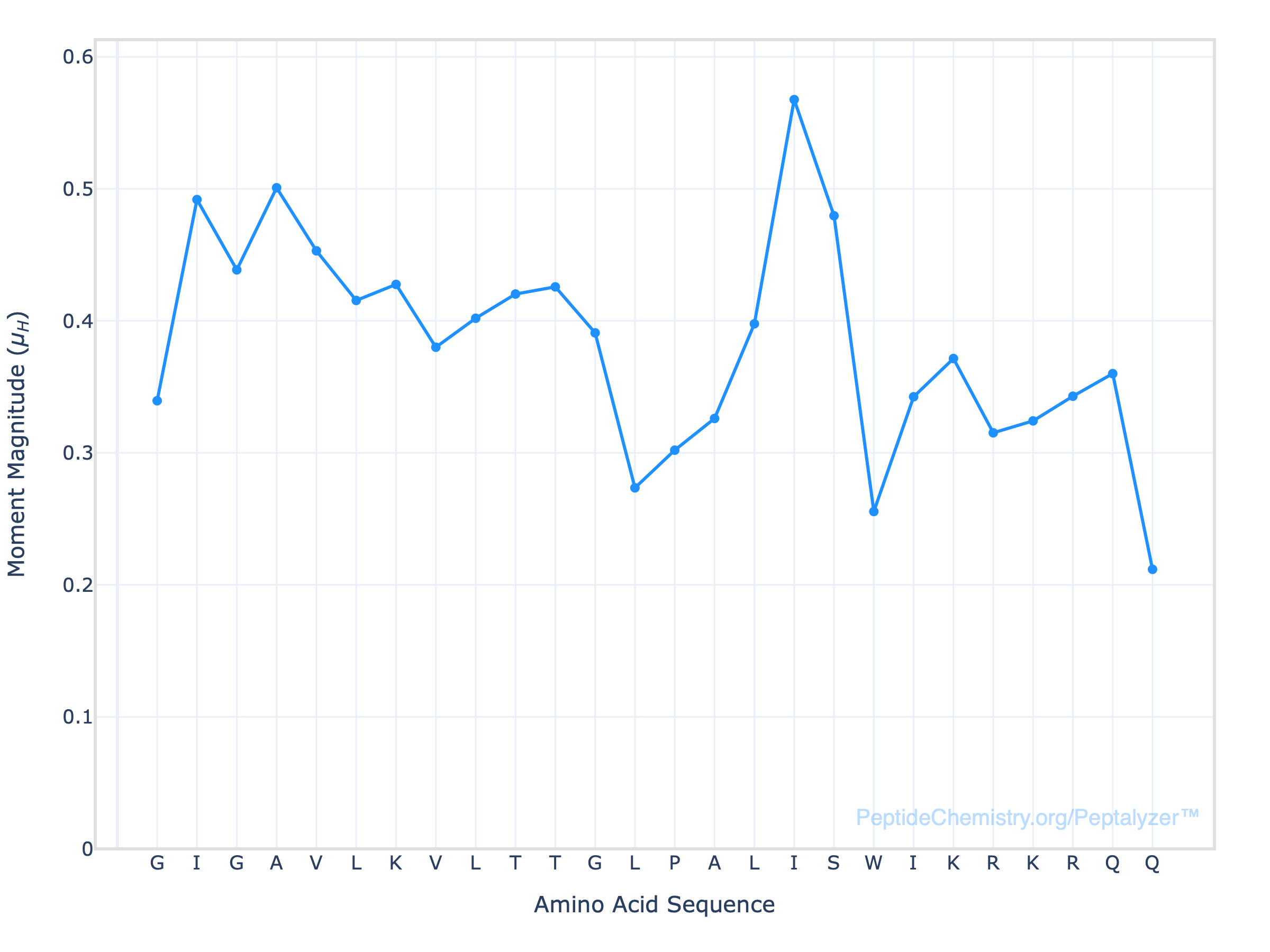
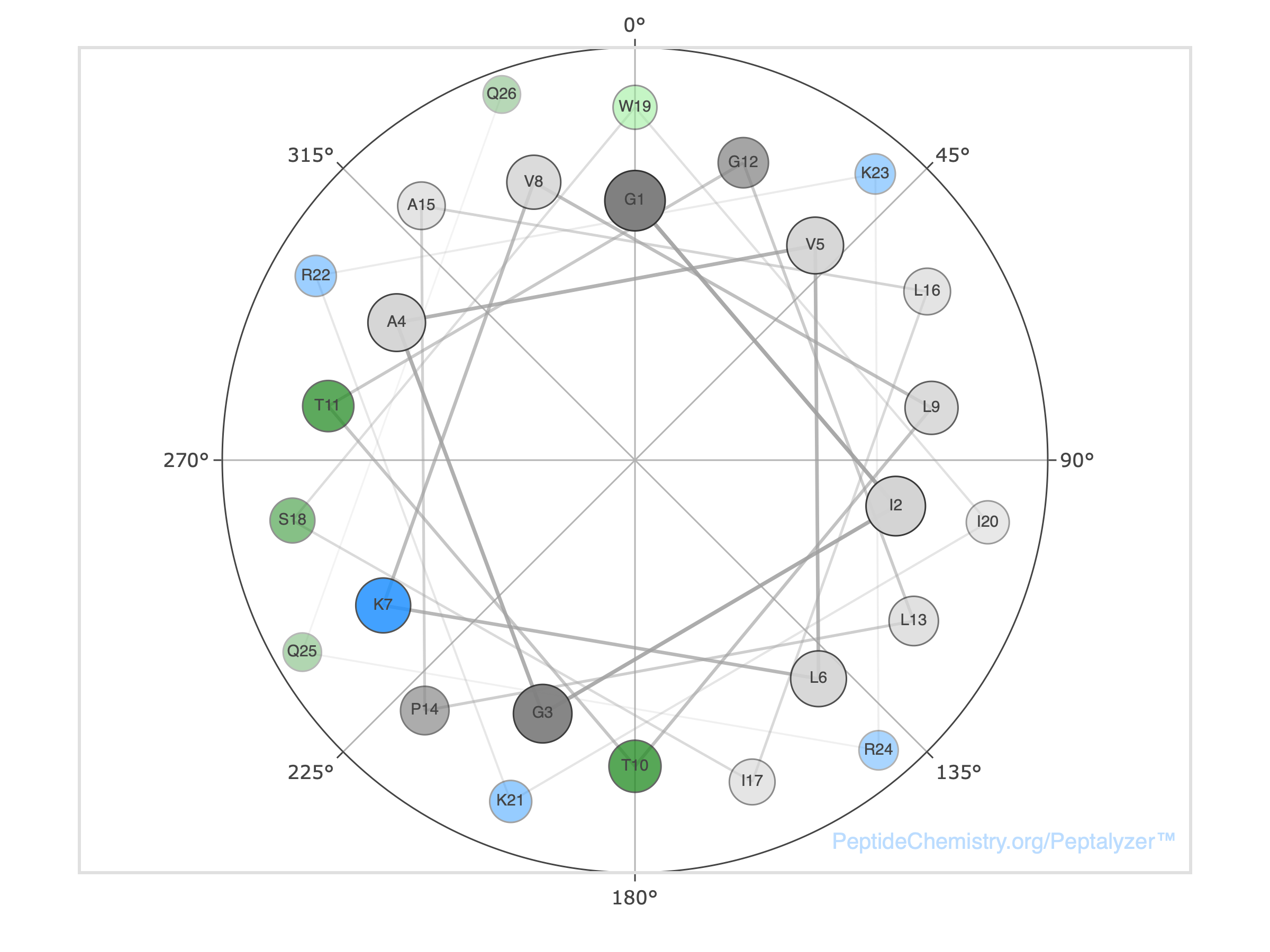
If you run Melittin through the tool, place the Eisenberg profile next to its Helical Wheel. The Wheel shows you the global amphipathicity—you can clearly see the non-polar residues segregating to one side and the polar/charged residues grouping on the opposite side.
Before looking at the individual dips and plateaus, check the tool’s calculated Peak Hydrophobic Moment (for Melittin, this is 0.568). This number represents the absolute maximum resultant vector calculated across any 11-residue window in the peptide. In practical terms, it quantifies the single most polarized, highly amphipathic hotspot in your sequence. The higher this peak number, the stronger the sequence’s thermodynamic drive to plunge into a lipid membrane.
For reference, random or weakly amphipathic helices typically produce peak values below ~0.3 (using the normalized consensus scale), whereas strongly membrane-active domains frequently exceed ~0.5. Absolute values depend on scale normalization and window size.
Deep Dive in Melittin Eisenberg Hydrophobic Moment
The Eisenberg plot maps exactly where in the sequence that perfect wheel geometry is actually happening:
- The Amphipathic Plateau (Residues 1–11): Notice the sustained high values at the N-terminus. This represents the stable, highly amphipathic helix that initially anchors the peptide to the membrane surface.
- The “Vector Washout” Dip (Residue 13): There is a violent crash right around Leucine 13 and Proline 14. Why does the math bottom out here? Remember that the plot uses an 11-residue sliding window. When the window centers on L13 (
VLTTGLPALIS), it hits a “dead zone” of nearly uniform, uncharged residues. Without highly polar or charged amino acids to pull against the hydrophobic mass, the 3D contrast vanishes. The vector arrows essentially cancel each other out, and the mathematical moment crashes. - The Lytic Spike (Residues 16–20): Immediately after the dip, the window slides forward and swallows the
WIKRKRdomain. The highly charged Arginines and Lysines violently contrast against the Tryptophan and Isoleucine. Look back at the Helical Wheel: this specific sequence of residues is exactly what drives that perfect visual segregation of charges to one side! The amphipathicity is restored, and the graph shoots up to its absolute maximum peak of 0.568. This hyper-amphipathic region is strongly associated with membrane insertion and pore-forming activity in bacterial membranes. - The Soluble Tail (Residues 21–26): The plot drops sharply at the very end. The C-terminal tail (
KRKRQQ) is almost entirely hydrophilic. Because it lacks a hydrophobic face to balance against, the moment drops, even though the sequence itself is highly water-soluble.
The Pro-Tip for Peptide Design: If you are designing an antimicrobial peptide (AMP), the highest peak on your Eisenberg plot is your primary membrane-active domain. Conversely, if you are trying to prevent a peptide from forming micelles in a formulation buffer, target that exact peak and introduce a helix-breaking amino acid (like Proline) to disrupt the amphipathic face and force the plot downward.
The Chou-Fasman Paradox: Resolving Conflicting Predictions
If you run a known amphipathic helix like Melittin through the Chou-Fasman secondary structure predictor, you might encounter a frustrating paradox. Instead of confirming a high α-helical propensity, the algorithm might predict a dominant β-sheet structure and even trigger a red “Aggregation Likely” warning.
Why does the algorithm predict a β-sheet for a famous α-helical pore-former?
The answer lies in the algorithm’s blindspot. Chou-Fasman is a statistical tool built primarily on a dataset of water-soluble, globular proteins. When it scans a sequence like Melittin and detects a massive, unbroken stretch of highly hydrophobic amino acids, it mathematically assumes the peptide will collapse into a β-sheet to bury that grease away from the surrounding water. The algorithm is completely blind to the existence of lipid membranes.
However, from a chemist’s perspective, this prediction is actually a highly accurate warning about the Formulation Trap. If you try to dissolve synthesized Melittin in plain water or PBS buffer, those exposed hydrophobic faces will violently stick together, aggregating exactly as Chou-Fasman predicted into β-sheet-rich fibrils, micelles, or a soapy gel.
How to Read Chou-Fasman + Eisenberg Hydrophobic Moment Together
When you get a conflicting result between these algorithms, you have to combine the two tools to get the full biological story:
- Chou-Fasman says: “In an aqueous buffer, this massive hydrophobic stretch has a severe β-sheet aggregation risk.”
- Eisenberg says: “But if you put this near a lipid membrane, it has a massive amphipathic moment and will fold into an active, membrane-seeking helix.”
The Conclusion: Amphipathic peptides like Melittin require solvent-induced folding. To work with this peptide at the bench and successfully run a CD spectrum, you will need to add a membrane mimic (like 50% TFE, SDS micelles, or liposomes) to your buffer. The moment you add those lipids, the peptide escapes the Chou-Fasman β-sheet aggregation trap and snaps perfectly into the α-helical profile predicted by the Eisenberg plot.
The Glucagon Aggregation Spike: Eisenberg Hydrophobic Moment Case Study
Consider Glucagon (HSQGTFTSDYSKYLDSRRAQDFVQWLMNT), a vital hormone notorious for its instability in solution. When you run Glucagon through the Peptalyzer™ Eisenberg Plot, you see a “quiet” N-terminus followed by a massive spike at the C-terminus, reaching a magnitude of 0.655. This places the C-terminal domain of glucagon in the upper range of amphipathic helices and explains its strong aggregation tendency under aqueous conditions.
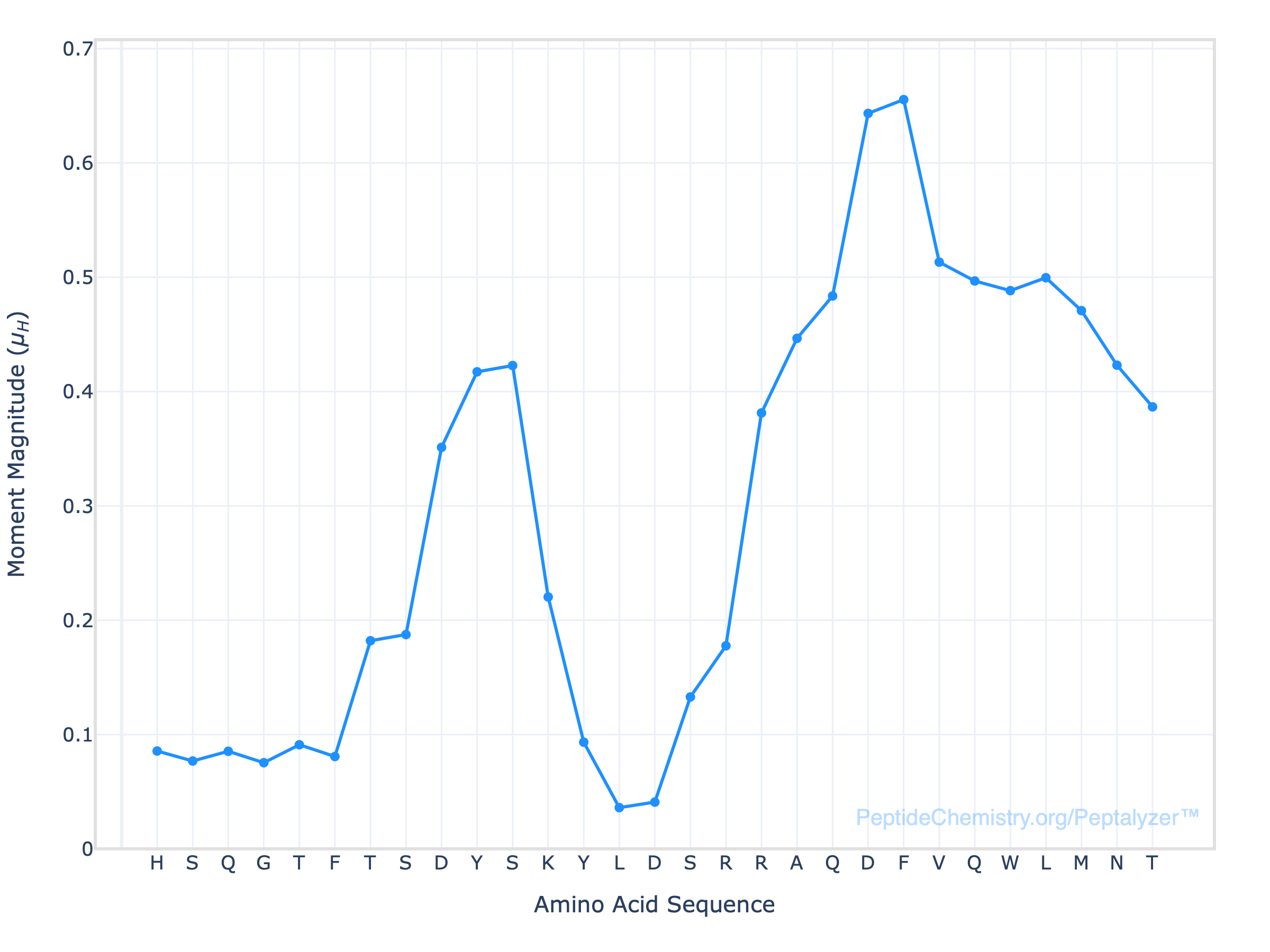
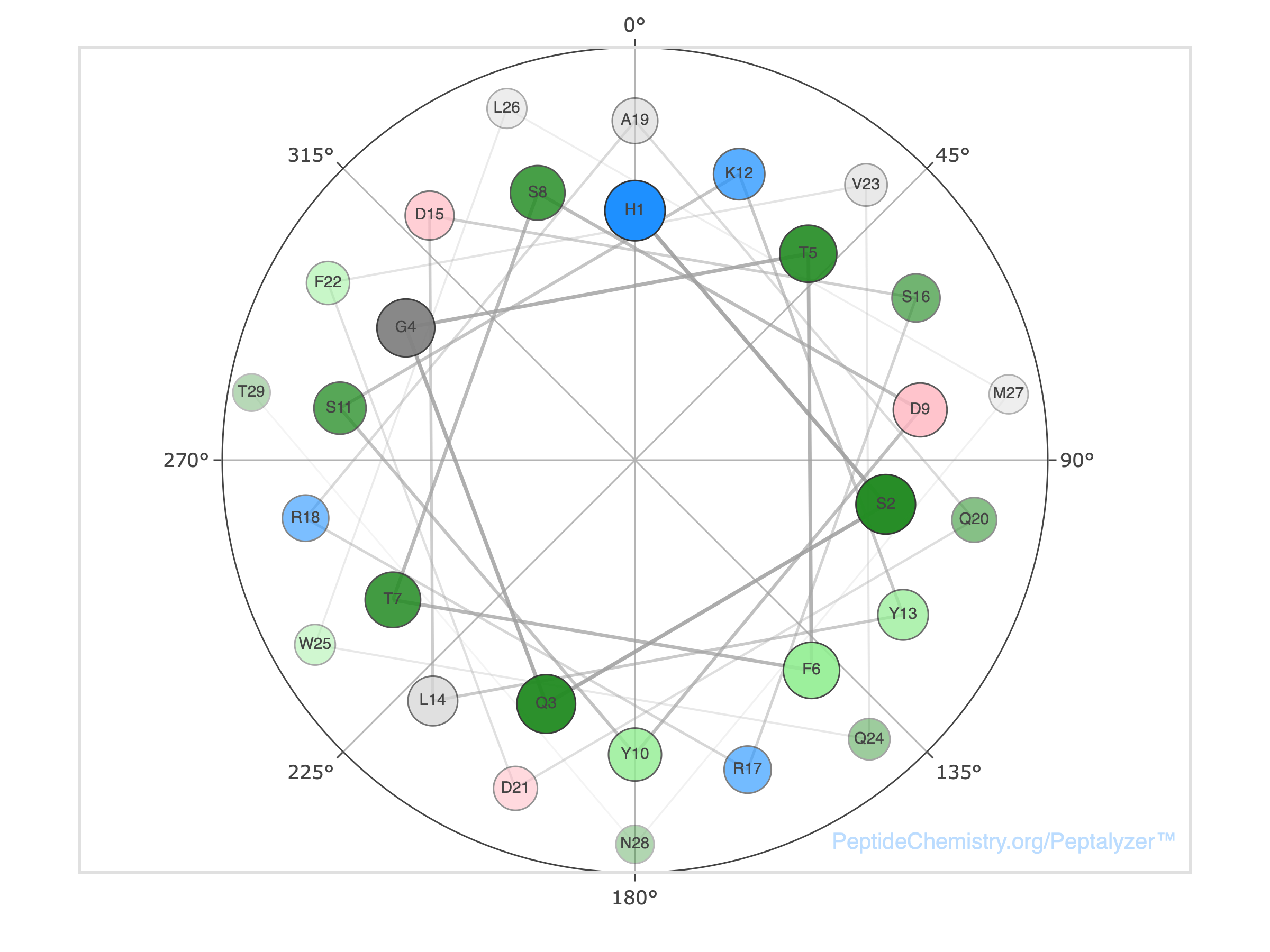
If you look at the Helical Wheel for this C-terminal domain, the reason for the “trap” becomes visible. The hydrophobic residues (F22, V23, W25, L26) align to form a contiguous non-polar face.
- The Mechanism: In an aqueous vial, these highly hydrophobic faces violently repel the water. Because there is no biological membrane to dive into, the hydrophobic clustering drives oligomerization in aqueous solution. Upon association, secondary structure may stabilize, leading to dimers, higher-order assemblies, and eventually insoluble amyloid-like fibrils.
- The Result: This molecular “clumping” is what leads to the frothing and gelation seen at the bench. The Eisenberg peak of 0.65 is a mathematical warning: this peptide has a strong thermodynamic tendency to aggregate.
The Takeaway: If your peptide has a high Eisenberg moment but is not intended to interact with membranes (e.g., it is a simple receptor agonist or an ELISA antigen), you have a severe formulation risk. To restore true monomeric solubility, you may need to introduce a “helix-breaking” amino acid, such as Proline, to disrupt that hydrophobic face and force the Eisenberg moment downward.
Analytical & Structural Chemistry: Troubleshooting at the Bench
Beyond predicting biological activity, the Eisenberg moment is a “secret weapon” for analytical chemists trying to explain bizarre behavior during purification and structural characterization. If your peptide is acting strangely on your instruments, its amphipathicity is likely the culprit.
The C18 HPLC Anomaly
In Reverse-Phase HPLC (RP-HPLC), retention time is generally dictated by the simple sum of a peptide’s hydrophobic amino acids. However, if you run a peptide and it elutes much later than its linear composition suggests, or if the peak is unusually broad and smeared, check its Eisenberg moment.
When a highly amphipathic peptide enters a C18 column, the non-polar environment of the stationary phase (coupled with organic solvents like acetonitrile) actively induces it to fold into an α-helix. Once folded, the entire hydrophobic face of the helix acts like a solid strip of Velcro, laying completely flat against the C18 chains. This multivalent hydrophobic interface can increase retention beyond what would be predicted from linear composition alone. Furthermore, because the peptide is constantly shifting between an unfolded state in the mobile phase and a folded state on the stationary phase, it causes severe peak broadening or split peaks. However, slow conformational exchange, partial aggregation, or ion-pairing effects may also contribute to anomalous retention behavior.
The Fix at the Bench: To break this secondary structure and overcome the “Velcro effect,” you must disrupt the peptide’s ability to fold into that amphipathic helix while on the column. The most effective strategies are increasing your column compartment temperature to 60°C or ensuring a strong ion-pairing agent like 0.1% TFA is present in your mobile phases. This forces the peptide to remain fully denatured, restoring sharp, predictable peaks based on pure sequence hydrophobicity rather than 3D folding.
Circular Dichroism (CD) & Solvent-Induced Folding
If you design an amphipathic peptide, you will likely need to prove its helical structure using Circular Dichroism (CD) Spectroscopy. A common mistake is dissolving the newly synthesized peptide in pure water, running a CD spectrum, and seeing the classic signature of unstructured “junk” (a random coil).
Why didn’t it fold? Because in a purely aqueous environment, exposing a massive, contiguous hydrophobic face to water is thermodynamically unfavorable. The peptide stays unfolded specifically to hide its greasy residues.
A high peak on the Eisenberg plot predicts solvent-induced folding. It tells you exactly how to set up your CD experiment: you must introduce a hydrophobic interface to “trigger” the folding. By adding membrane mimics to your CD buffer—such as 50% Trifluoroethanol (TFE), SDS micelles, or POPC liposomes—the peptide suddenly has a non-polar environment to bury its hydrophobic face into. The CD spectrum typically shifts toward the characteristic double-minima at 208 nm and 222 nm, consistent with α-helical formation under membrane-mimetic conditions.
Eisenberg vs. Kyte-Doolittle vs. Hopp-Woods vs. Wimley-White
Knowing which scale to use is just as important as the calculation itself, as each answers a fundamentally different biophysical question. While Kyte-Doolittle is the gold standard for identifying general buried hydrophobic cores and aggregation risks, and Hopp-Woods maps highly soluble, surface-exposed antigenic sites, both are limited to 1D linear sequence averaging. To understand 3D spatial geometry, you must step up to the Eisenberg Hydrophobic Moment to map the amphipathic faces of folded helices. Finally, if your goal is to calculate the strict thermodynamic free energy of lipid bilayer insertion, the Wimley-White scale is the required standard. Unlike the Eisenberg hydrophobic moment, which quantifies spatial amphipathicity, the Wimley–White scale provides experimentally derived free energy values (ΔG°) for membrane partitioning. The two metrics answer complementary but fundamentally different biophysical questions.
| Feature | Kyte-Doolittle Hydropathy | Hopp-Woods Hydrophilicity | Eisenberg Hydrophobic Moment | Wimley-White Partitioning |
|---|---|---|---|---|
| Primary Aim | Quantify amino acid hydrophobicity and predict hydrophobic regions | Quantify amino acid hydrophilicity and predict surface-exposed regions | Quantify 3D amphipathicity and predict spatial distribution of hydrophobicity | Calculate thermodynamic free energy (ΔG°) of membrane partitioning |
| Main Applications | Membrane-spanning helices, folding tendencies, aggregation risks | Epitope mapping, vaccine design, antibody-binding site prediction | Designing AMPs, CPPs; predicting micelle/gel formulation traps | Designing AMPs, CPPs, and liposomes; mapping surface anchors vs. full insertion |
| Experimental Correlates | Retention in RP-HPLC, CD spectra of folding | ELISA, antibody recognition assays | Anomalous RP-HPLC retention, solvent-induced folding in CD spectra | Liposome partitioning, vesicle leakage assays, bilayer energetics |
| Limitations | Over-predicts hydrophobic regions; depends heavily on window size | May overestimate antigenicity; ignores secondary/tertiary structure | Strictly assumes α-helical folding (100°); meaningless for unstructured coils | Does not predict RP-HPLC retention; in vivo activity requires biological context |
Eisenberg Scale — FAQ
No. The standard calculation assumes a 100° rotation between adjacent amino acids, which is the physical signature of an α-helix. A β-sheet has a completely different geometry (closer to 160°). Applying the standard 100° implementation to β-sheets is inappropriate. A different angular parameter (~160–180°) must be used for β-strand geometry.” Always verify your secondary structure first.
This is exactly why the tool exists! Kyte-Doolittle averages hydrophobicity linearly. If polar and non-polar residues alternate perfectly, their linear average cancels out to zero. The Eisenberg plot proves that in 3D space, those alternating residues actually segregate to opposite sides of a helix, creating a highly active amphipathic molecule.
Technically yes, but the biophysical relevance is poor. A standard α-helix requires 3.6 residues per turn. The default 11-residue window ensures you evaluate three full helical turns. Evaluating only 5 residues captures barely over one turn, making the vector sum structurally unreliable.
Absolute numerical values vary depending on the normalized consensus hydrophobicity scale your software uses under the hood. Different hydrophobicity scales or window sizes can shift absolute μH values. Therefore, comparisons should always be made using the same computational parameters. For a bench chemist, absolute numbers matter less than the shape of the plot. You are looking for sharp, distinct spikes that rise significantly above the sequence’s baseline. These localized peaks pinpoint your membrane-active or aggregating domains.
References
Eisenberg, D., Weiss, R. M., & Terwilliger, T. C. (1984). The hydrophobic moment detects periodicity in protein hydrophobicity. Proceedings of the National Academy of Sciences, 81(1), 140-144.
- Describes the Eisenberg scale and hydrophobic moment, an alternative scale.
- DOI: 10.1073/pnas.81.1.140
Kyte, J., & Doolittle, R. F. (1982). A simple method for displaying the hydropathic character of a protein. Journal of Molecular Biology, 157(1), 105-132.
- Foundational paper introducing the scale.
- DOI: 10.1016/0022-2836(82)90515-0
Schiffer, M., & Edmundson, A. B. (1967). Use of helical wheels to represent the structures of proteins and to identify segments with helical potential. Biophysical Journal, 7(2), 121-135.
- Introduced the concept of the helical wheel to visualize amphipathic alpha-helices, providing the visual foundation for the mathematical hydrophobic moment.
- DOI: 10.1016/s0006-3495(67)86579-2
Zhou, N. E., Mant, C. T., & Hodges, R. S. (1990). Effect of preferred binding domains on peptide retention behavior in reversed-phase chromatography: amphipathic alpha-helices. Peptide Research, 3(1), 8-20.
- Describes the anomalous retention behavior of amphipathic alpha-helices on reversed-phase HPLC columns compared to standard linear hydrophobic retention.
- PMID: 2134049
Hopp, T. P., & Woods, K. R. (1981). Prediction of protein antigenic determinants from amino acid sequences. Proceedings of the National Academy of Sciences, 78(6), 3824–3828.
- Introduced the Hopp–Woods hydrophilicity scale, often contrasted with Kyte–Doolittle.
- DOI: 10.1073/pnas.78.6.3824
Wimley, W. C., & White, S. H. (1996). Experimentally determined hydrophobicity scale for proteins at membrane interfaces. Nature Structural Biology, 3(10), 842-848.
- Defines the Wimley-White interfacial hydropathy scale, often used for membrane proteins.
- DOI: 10.1038/nsb1096-842